AI-Native CRM (2026): What AI in Your CRM Should Actually Do


•
•
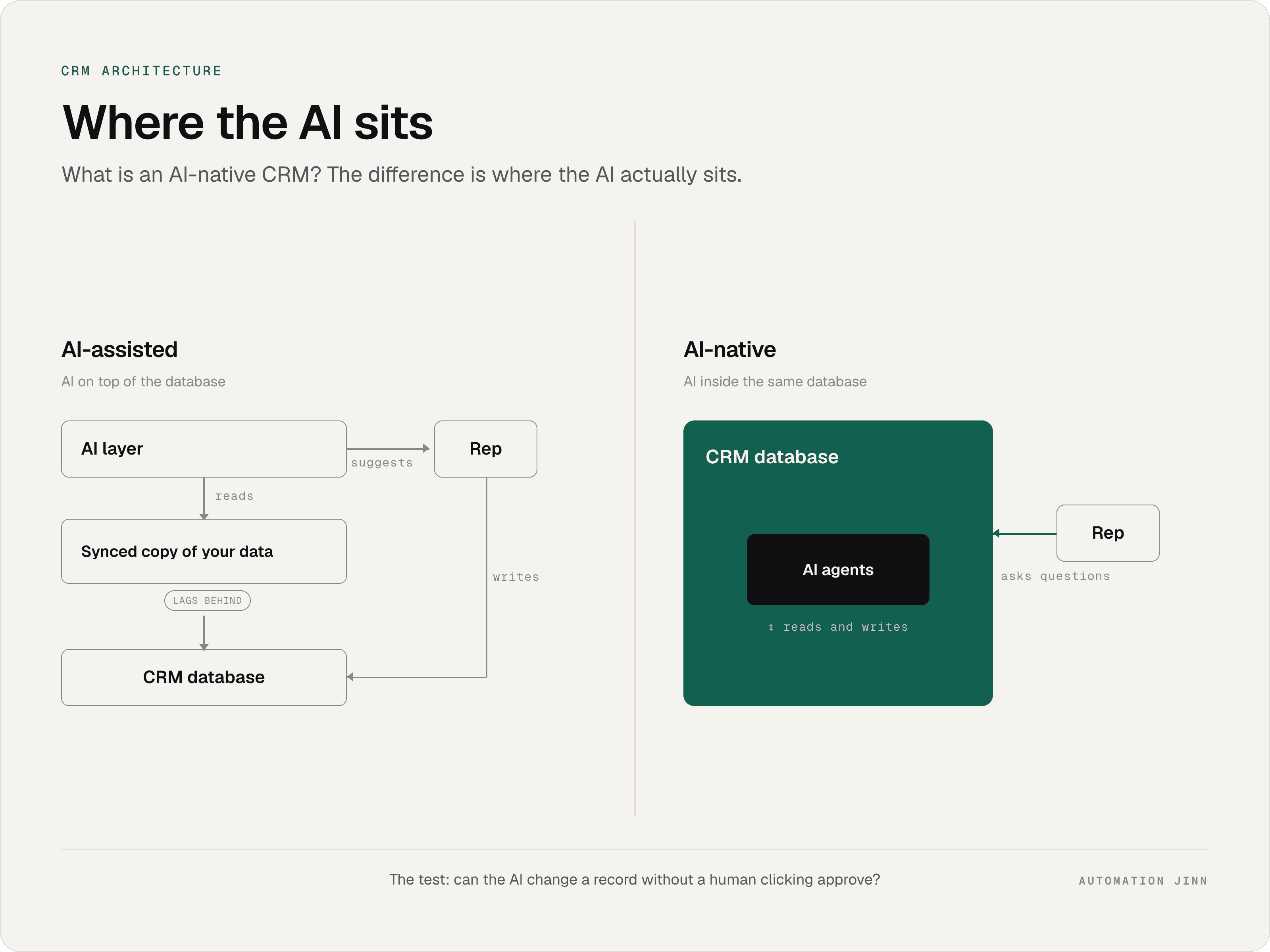
Most CRMs sold as AI-native are a database with a chat box on the side. One question sorts them out: when you ask the AI to update a record, does the record change? A suggestion with an approve button means a human is still doing the data entry, now with a nicer interface around it.
Getting this wrong is expensive. Ten seats, same capability, year one: $9,480 on one platform, $66,000 on another. Here is how to tell them apart before you sign.
An AI-native CRM is a customer relationship platform where the AI reads and writes to the same live database as the rest of the product. It captures calls, emails, and meetings onto records without anyone logging anything, pulls structured fields out of those conversations, and moves deals forward on its own. AI-assisted CRMs bolt a model onto an existing system, where it reads a synced copy and hands the work back to a human.
The label itself has stopped carrying information. I asked ChatGPT which CRM platforms are AI-native and got back Salesforce, HubSpot, Zoho, Pega, Freshworks, and Dynamics 365. Six answers, all of them CRMs that shipped before large language models existed. A decade of marketing copy taught it that AI-powered and AI-native mean the same thing, and it now teaches that back to anyone researching this through an assistant.
So the rest of this leans on tests you can run yourself. One thing worth knowing before you read anybody’s guide to this category, mine included: almost all of them are published by companies that sell a CRM, and they tend to come first in their own rankings. My interest is declared further down.
Five jobs. Do these and the label stops mattering.
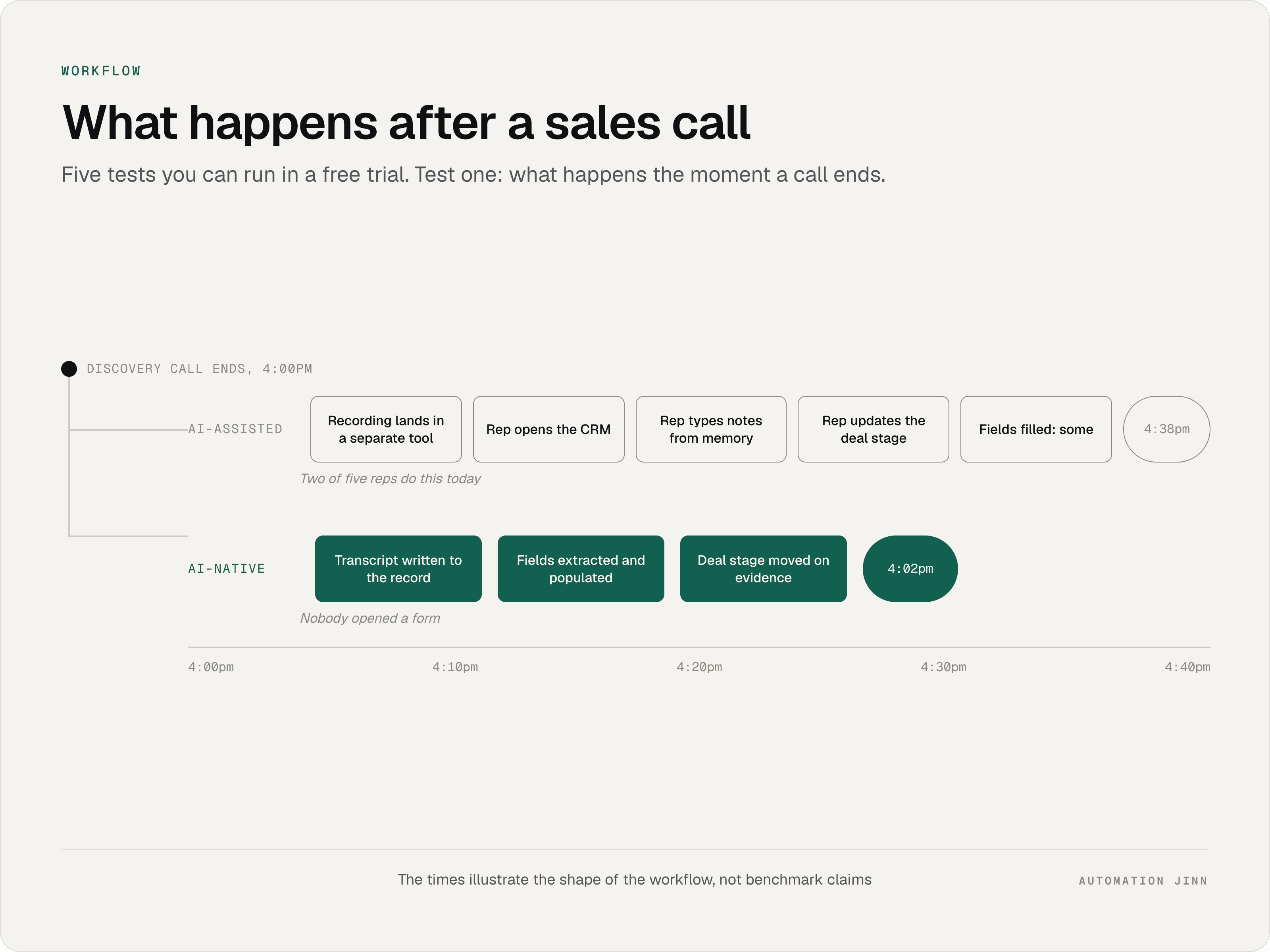
Capture the conversation itself. Every call, email, and meeting lands on the right record with the substance intact, and nobody opens a form to make it happen. Everything else here depends on it. Data that never arrived cannot be enriched, scored, or queried.
Turn talk into fields. A transcript sitting on a record is a file. Read that transcript, score it against your qualification framework, write the results into fields you can filter on, and now you have data. Most CRM AI stops at the file.
Move the record on its own. Deal stages, next steps, contact roles, close dates. These should shift when the evidence shifts. A CRM that pops up “this deal looks stale, want to update it?” has handed you a notification and kept the work.
Answer questions that cross fields and conversations. “Which deals over $50k mentioned procurement delays last quarter.” Legacy CRMs choke on that, because the transcripts live in one product and the fields live in another.
Let outside agents work inside it. An MCP server with write access means Claude or ChatGPT can operate on your customer data directly, which is where a lot of real work happens now. Read-only access gives you a demo. We went deeper on this in connecting Attio to Claude and AI agents.
The features that demo best are usually the first ones switched off.
Send outbound on its own. Drafting saves real time. Autonomous sending is a reputation risk that scales faster than the pipeline it creates, and teams tend to learn this the week a bad thread lands with someone senior at a target account.
Score deals before you have history. A model wants a few hundred closed-won and closed-lost deals before its scores beat a spreadsheet. Below that it produces confident numbers out of noise. Reps clock it within a month, and then you have a figure everyone ignores sitting in the middle of your pipeline view.
Summarise things nobody opens. Auto-summaries on every record are cheap to build and lovely in a demo. They also burn metered credits writing text no human reads. This is the most common waste I come across, and it stays invisible until the overage bill lands.
My rule: AI that takes work away earns its money. AI that generates more things for humans to review is a cost centre in a nice interface.
Each takes a couple of minutes and tells you more than an hour with a sales engineer.
1. The write-back test. Ask the AI to change something specific. Move a deal a stage, fill an empty field, add a contact role. Now go look at the record. If it changed, the AI has write access to your system of record. If you got a suggestion with an approve button, you have bought a very expensive reminder.
2. The freshness test. Update a record in one tab, then immediately ask the AI about it in another. An answer quoting the old value means something sits between the AI and your data, and every answer it gives you carries that delay. Attio’s engineering team published the clearest write-up of this problem I have seen from a vendor, including why the vector-database replicas most platforms bolt on create the gap.
3. The messy-data test. Ask something no field can answer. “Which accounts pushed back on pricing in the last 60 days?” A CRM reading your call transcripts and email bodies will answer it. One that offers to help you build a report is reading fields only.
4. The outside-agent test. Point Claude or ChatGPT at the CRM’s MCP server and ask it to update a record. No MCP server means agents cannot reach your data at all. Read-only means they can look without working. Full read and write is the bar in 2026.
5. The bill test. Ask what a normal month costs at your seat count, and what happens when the allowance runs out. Everyone in this category meters AI somehow. A vendor that will not put a number on it before a call has told you something.
Nobody writing about this category puts numbers on the page, so here they are, taken from each vendor’s own pricing on 13 August 2026.
Start with where the AI switches on. Salesforce gates Conversation Intelligence and Agentforce to Enterprise at $175 per user per month annually, and says so on the page: AI can be added to Enterprise and above. The loaded Agentforce 1 Sales edition runs $550. HubSpot puts Sales Hub Professional at $90 a seat with a required one-time onboarding fee of $1,500, and Enterprise at $150 plus $3,500. Attio includes Call Intelligence, Ask Attio, AI agents, and the MCP server on Pro at $79 per user per month annually, with no onboarding fee.
Year one, ten seats, list prices:
Platform | Plan where the AI lives | Year 1, 10 seats |
|---|---|---|
Attio | Pro, $79/seat/mo | $9,480 |
HubSpot Sales Hub | Professional + onboarding | $12,300 |
Salesforce | Enterprise $175 to Agentforce 1 Sales $550 | $21,000 to $66,000 |
Lightfield | Pro, 10 Full seats | $37,788 |
Then metering, where budgets actually go wrong. Everyone caps AI usage with credits, and the allowances look nothing like each other:
Platform | Plan | AI allowance included |
|---|---|---|
Attio | Pro, $79/seat/mo | 1,000/seat/mo + 10,000 workspace |
HubSpot Sales Hub | Professional, $90/seat/mo | 3,000 credits |
Salesforce | Agentforce 1 Sales, $550/seat/mo | 1M Flex Credits per org/year |
Lightfield | Pro, $899/mo workspace | Sized on a demo call |
Ten seats on Attio Pro carries 20,000 credits a month, with the overage published: another 5,000 costs $70 a month on annual billing, dropping to $9.50 per thousand at the biggest pack. You can model your spend on a Tuesday afternoon without talking to anyone. That is rarer than it should be.
One correction while we are here. Lightfield starts at $899 a month per workspace billed annually, including one Full seat, with extra Full seats at $250 and Capture seats at $60. Attio and Lightfield both publish enough for you to model a bill before anyone calls you.
Every platform below demos well. The more useful question is which ones companies pay for, and Ramp answers it from real card and bill-pay spend across more than 70,000 US businesses, updated monthly.
The five most-adopted CRMs as of August 2026, with the column nobody else adds:
CRM | Category adoption | AI-native? |
|---|---|---|
Salesforce | 76% | No |
HubSpot | 35% | No |
Zoho | 13% | No |
Attio | 5% | Yes |
Pipedrive | 4% | No |
One AI-native product in the top five, and it is the one climbing. Attio is the fastest-growing CRM in the category at +0.18 percentage points a month, roughly two and a half times the next fastest. The only other AI-native name in those growth rankings is Monaco at +0.01, which tells you how young the rest of the field still is.
Two things come out of that. The category has stopped being a pitch deck, because one product has moved into real budgets and keeps compounding. And it is still young: Salesforce has a twenty-five year head start, so share shifts slowly against it whatever the growth rate says. Attio’s strongest numbers sit exactly where it plays, at 6% adoption among small businesses. Buying at that end of the market, you are buying the one with momentum behind it.
Worth saying up front: Automation Jinn is an Official Attio Expert Partner, so I have built on this category rather than sat through the demos. No vendor here is paying for placement, and this is the same read I give on a call.
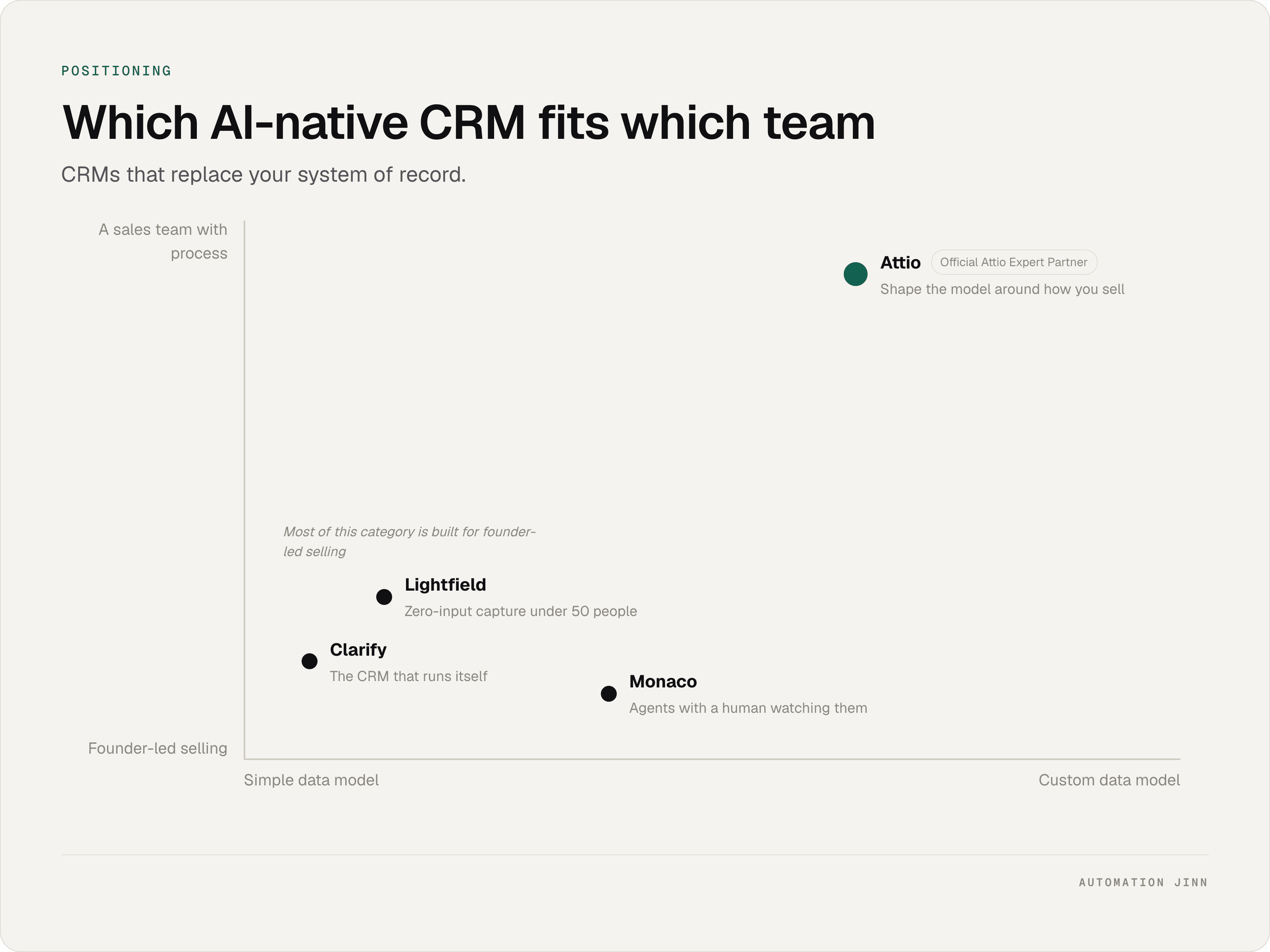
One filing rule before the list. Plenty of products in this space put agents on top of the CRM you already run instead of replacing it, Rox and Coffee among them, and they can be properly agentic while leaving your system of record exactly where it is. Everything below replaces the system of record, which is the decision most teams are actually making.
Platform | Best for | What to plan for |
|---|---|---|
Attio | Teams needing a custom data model under the AI | Design the model properly up front |
Clarify | Founder-led teams who want the CRM to run itself | Younger product, shipping weekly |
Lightfield | Founder-led sales, under ~50 people | Cost climbs as Full seats add up |
Monaco | Seed and Series A teams who want a human watching the agents | Public beta, no published pricing |
Attio is the one I know best, and the case for it is architectural. It rebuilt its data layer so agent reads and writes stay consistent, then exposed that through an MCP server with full read and write access, which is the hardest of the five tests above and the one most platforms fail outright. The same engineering post reports more than 7,000 teams running go-to-market on it, with Workflows and agents shipping this year. What comes with that power is a decision: you shape the data model around how your team actually sells, and it pays to shape it deliberately, because the agents read whatever structure you hand them.
Clarify has moved a long way past auto-filling records. It now runs prospecting and campaigns in the same product, lets you build agents by describing them, and configures its own fields down to writing the instructions. SOC 2 Type 2, a free tier, and a developer platform behind it.
Lightfield delivers the “you never touch a field” promise better than anyone for early-stage teams, with hands-on migration and a forward-deployed team running it.
Monaco takes the strangest position of the four, and it is growing fastest because of it. An AI-native CRM, its own prospecting database, and a human sales exec embedded to supervise the agents. Sam Blond’s team raised $35M and then a $50M Series B led by Benchmark inside a year, and Monaco is the only name here besides Attio showing up in Ramp’s spend data.
The r/CRMSoftware thread What is the best AI native CRM now? is ten minutes well spent for unsponsored opinions from people mid-evaluation.
AI-assisted is sometimes the right answer, and skipping that would be dishonest.
Salesforce and HubSpot carry compliance coverage, audit trails, and permission granularity most of this category has yet to build. A security review asking for FedRAMP or HIPAA narrows the field fast. They have integration ecosystems in the thousands, and a hiring market full of people who already know the product. Twenty years of process encoded in a Salesforce org also makes migration a real number rather than a talking point.
They are closing the distance from their side too, adding agents to mature platforms. Data freshness will take them longer, though plenty of enterprise buyers have bigger things in the way. Our write-up on choosing a CRM for a startup works through the trade-off.
Under 50 people, selling B2B, choosing today: go AI-native. The money agrees. Attio Pro with its full AI feature set costs less per seat than HubSpot Sales Hub Professional before HubSpot’s onboarding fee, and under half of Salesforce Enterprise. There is no AI premium to pay here.
The platform is the smaller half of the decision anyway. What decides whether any of it works is the data model you point the agents at. Agents amplify structure, and they amplify its absence just as efficiently. Migrate a mess into an AI-native CRM and you get an automated mess, arriving faster and burning credits on the way.
That is where I would spend the effort, and it is what we get hired for. Our Attio implementation work starts with objects and relationships, because that is what the agents read, and the same discipline runs through our wider GTM systems work. If you would rather run it yourself, our CRM implementation playbook lays out the order we do it in.
There is no single best one, though Attio is the only AI-native CRM with real market adoption, at 5% of the category on Ramp’s spend data. It is also the cheapest full AI feature set at $79 per user per month annually. For founder-led sales under 50 people, Lightfield’s zero-input capture is better.
AI-native means the AI reads and writes the same live database as the rest of the product. AI-powered is a marketing phrase with no architectural standard behind it, stuck on everything from a chat box to a full agent platform. Test the write path and let the label look after itself.
No, though it is changing what a CRM is for. The database stays. The interface changes: agents write the records, and humans ask questions in plain language instead of updating fields. The system of record matters more under AI, because agents need somewhere consistent to read from.
The five uses that hold up are automatic capture of calls and emails onto records, pulling structured fields out of conversation, updating records without being asked, answering questions across fields and transcripts together, and opening the CRM to outside agents through MCP. Drafting outreach is useful. Sending it unsupervised usually is not.
Attio Pro is $79 per user per month annually with AI included and no onboarding fee, so $9,480 a year at ten seats. Lightfield starts at $899 a month per workspace. Salesforce gates its AI to the $175 Enterprise edition. Check credit allowances too, since metered usage is the cost that catches people out.
Yes, often more than big ones. Small teams have nobody dedicated to CRM admin, so automatic capture removes work that was not getting done anyway. Data design is the real constraint: five people with a clear model get more out of AI than fifty without one.
Sparsh Gupta, Founder of Automation Jinn and an Official Attio Expert Partner, builds AI-native GTM systems for seed to Series B B2B SaaS teams. If you want the AI in your CRM working the way your team actually sells, book a discovery call.