Salesforce Alternatives (2026): The AI-Native Shortlist


•
•
The best Salesforce alternative for most startups is Attio at $79 per seat, and I’ll defend that below. But the tool matters less than the number, so here it is first: matched feature for feature, a ten-seat team switching saves about $44,000 in year one, and only a quarter of that is the licence.
The rest is the implementation project and the admin hours, which is the part no pricing table shows you. That is the whole argument of this post, and it is why the comparison you have been reading everywhere else is measuring the wrong thing.
In my experience, teams do not call me because Salesforce cannot do something. Salesforce can do almost anything. They call because somebody asked a simple question, how much pipeline came out of that campaign, and getting a trustworthy answer took four days and three people.
Then we open the org. There are forty-something custom fields on the Opportunity, a third of them some variant of Status, half of them empty since 2023. Two automations fire on the same trigger and quietly disagree. The person who built it left last year. Nobody wants to touch anything because nobody is sure what breaks.
That is not a software problem. It is what happens when a system needs a specialist and a startup does not have one. The bill for that shows up as your ops lead’s Thursday, every Thursday, forever.
So this list is deliberately short. Seven tools, not twenty, judged on three things that decide whether you are doing this again in eighteen months: the data model, the AI, and the fit for how a seed to Series B team actually sells.
Where most teams should start:
Top pick | Best for | Why it wins |
|---|---|---|
Attio | Escaping the admin tax | AI-native, custom objects at $79/seat, no onboarding fee |
HubSpot | Marketing-led growth | One system for campaigns and pipeline, real free tier |
Close | High-volume outbound | Dialer, sequences, and CRM in one place |
Data model is whether the CRM can describe your business or only a generic sales team. Can you build the objects you actually track and connect them properly? This is the thing you outgrow first. Salesforce’s answer to flexibility is configuration work, which you pay for once to build and again every time your motion changes.
AI is whether intelligence lives in the core or gets sold to you as an add-on. The sharper 2026 question is agent access: can your AI tools read and write live customer context without you building plumbing? That gap between generations is wider than any feature comparison suggests.
Fit is unglamorous and decides everything. It is team size, budget curve, and whether your reps will actually open the thing. A CRM nobody uses is the most expensive product on any list, and it is the real reason so many Salesforce orgs turn into shelfware nobody will admit to.
I scored each of these Salesforce alternatives out of five on the three axes above. The scores are my own judgment from setting these systems up as an Official Attio Expert Partner, not vendor marketing, and I verified every price on the vendor’s own pricing page the week this guide went live. Where a tool is strong on one axis and weak on another, the score shows it rather than rounding into a single vague verdict.
Prices are the entry paid tier through the top self-serve tier, per seat per month on annual billing. Salesforce is in the table as the baseline you are measuring against, scored on the same axes.
CRM | Best for | Data model · AI · Fit | Price from |
|---|---|---|---|
Attio | AI-native GTM, escaping admin cost | 5 · 5 · 5 | $0-$79 |
HubSpot | Marketing-led growth | 3 · 4 · 4 | $0-$150 |
Close | High-volume outbound teams | 2 · 4 · 4 | $9-$139 |
Pipedrive | Simple visual sales pipeline | 2 · 3 · 4 | $14-$79 |
Zoho CRM | Budget all-in-one breadth | 4 · 4 · 3 | $0-$52 |
folk | Agencies and solo founders | 3 · 3 · 4 | $24-$80 |
Dynamics 365 | Microsoft-shop enterprises | 4 · 4 · 2 | $65-$150 |
Salesforce (baseline) | Teams heading to enterprise | 5 · 4 · 2 | $25-$175+ |
That baseline row is the whole argument in one line. Salesforce wins the data model outright and loses fit badly, and fit is what you pay for every week.
Score: Data model 5/5 · AI 5/5 · Startup fit 5/5
Best for: Teams paying for Salesforce and an admin, and still fighting for a clean report.
Pricing: Free up to 3 seats, Plus $35 (up to 10 seats), Pro $79 per seat/mo (annual), Enterprise custom. No onboarding fee (Attio).
Data model: Fully flexible. Custom objects on Pro, two-way relationships, models workspaces and usage natively.
AI: Native. AI attributes, a research agent inside workflows, call intelligence, and an MCP server on every paid tier.
The catch: Not a marketing suite, and no published SOC 2 Type II report as of mid-2026.
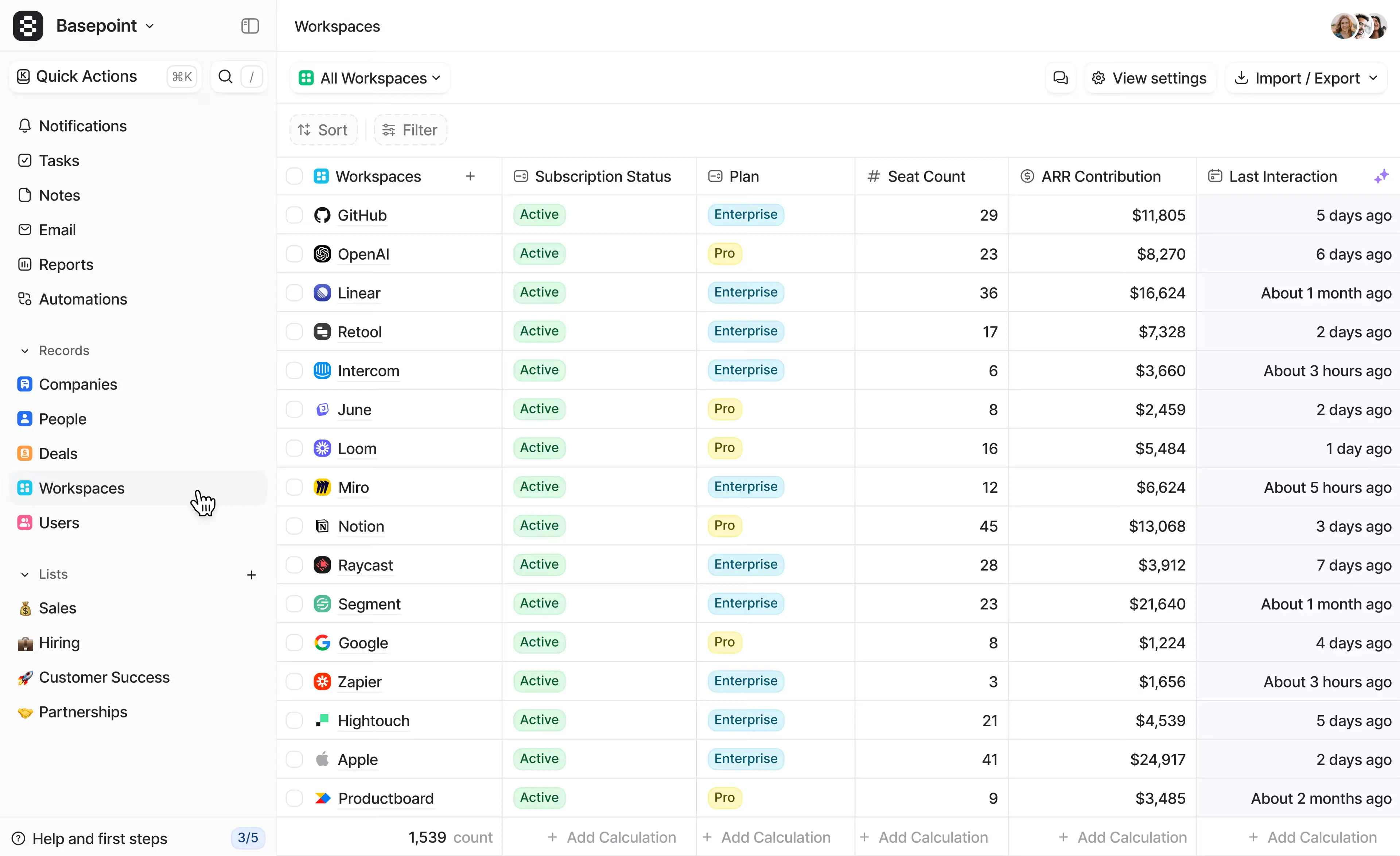
The difference that matters is that you define what a record is. A usage-based PLG motion or a fund’s deal flow gets modelled as itself, instead of being crammed into an Opportunity and explained in a text field. Snackpass moved here from Salesforce and describes the result as freeing up a full-time position that had been maintaining the CRM. They tried HubSpot and Pipedrive first.
It sits at 4.3 on G2 across 583 reviews and is the fastest-growing vendor in Ramp’s CRM category. On security, ISO 27001, GDPR, and CCPA are in place, and trust.attio.com is the page to send procurement to.
Bottom line: The marketing gap is real and I would still make the trade, because that work belongs in a dedicated tool anyway. The thing that decides whether Attio pays off is not the product, it is the model you build in week one. I have watched teams import their Salesforce schema wholesale and rebuild the exact same mess in a nicer interface, which is a fast way to spend a migration and change nothing. That first week is the Attio implementation work I do. The head-to-head is in Attio vs Salesforce.
Score: Data model 3/5 · AI 4/5 · Startup fit 4/5
Best for: Teams where marketing owns as much of the funnel as sales does.
Pricing: Free (2 users), Starter, Professional $90 per seat/mo plus a one-time $1,500 onboarding fee, Enterprise $150 plus $3,500 (HubSpot).
Data model: Contacts, companies, deals. Custom objects in Sales Hub are Enterprise-only.
AI: Breeze agents, metered through credits priced separately from the seat.
The catch: Marketing Hub is a different product with its own bill.
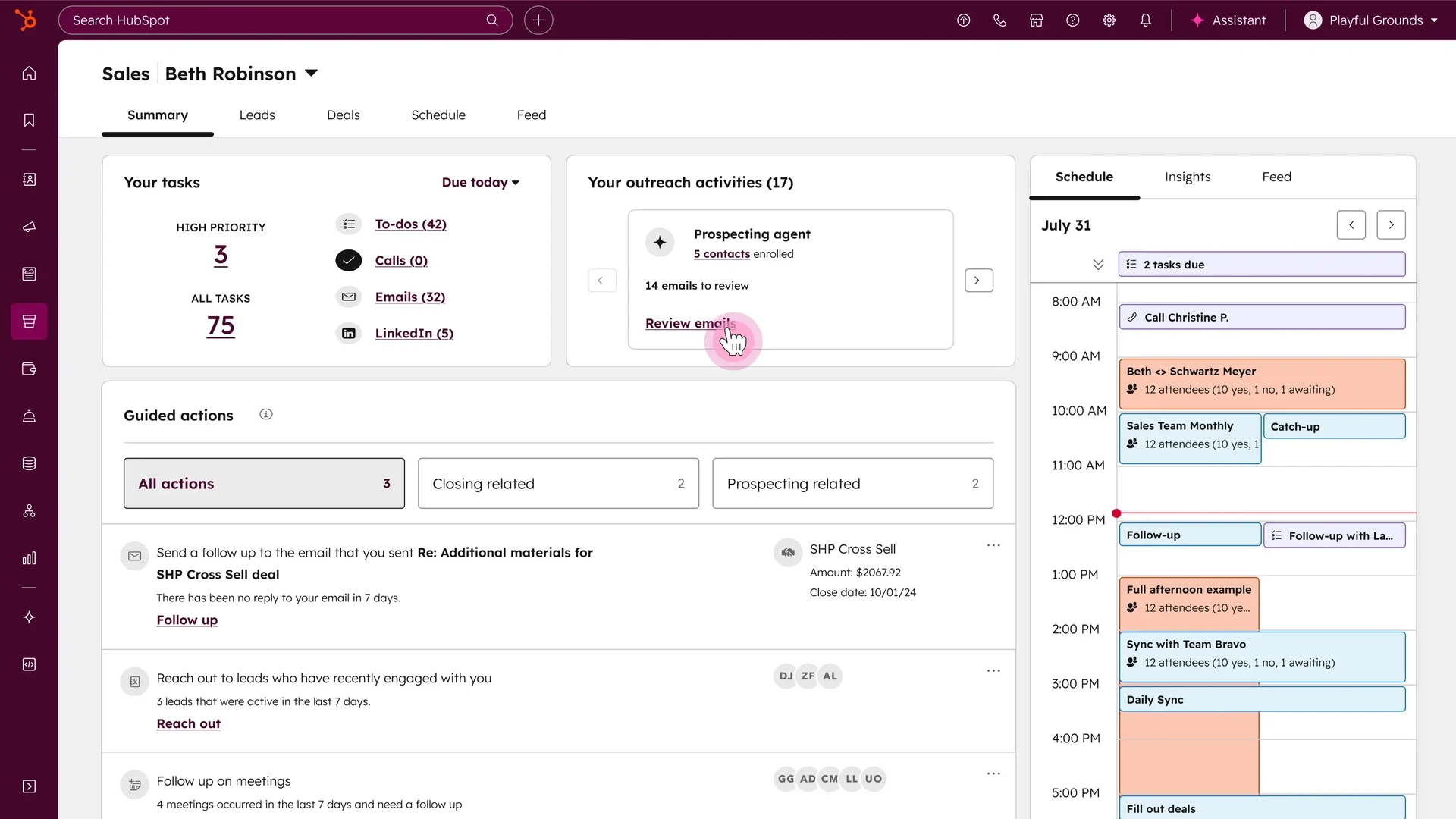
This is where most Salesforce leavers land, and for a marketing-led company it is the right call. Campaigns, forms, nurture, and pipeline in one place, and a free tier that is a real product rather than a trial in disguise.
Bottom line: Watch the shape of the trap. If you are leaving Salesforce because the data model would not bend, HubSpot’s custom objects sit behind the $150 Enterprise tier. That is the same wall, repainted. Take HubSpot when inbound is the engine and your business really is contacts, companies, and deals.
Score: Data model 2/5 · AI 4/5 · Startup fit 4/5
Best for: SDR-heavy teams where the number that matters is conversations per day.
Pricing: Solo $9, Essentials $35, Growth $99, Scale $139 per user/mo (annual) (Close).
Data model: Fixed and sales-shaped. A system of action, not a system of record.
AI: Chloe, an AI sales agent, with monthly credits on every plan.
The catch: Wrong shape for product-led or account-based motions.
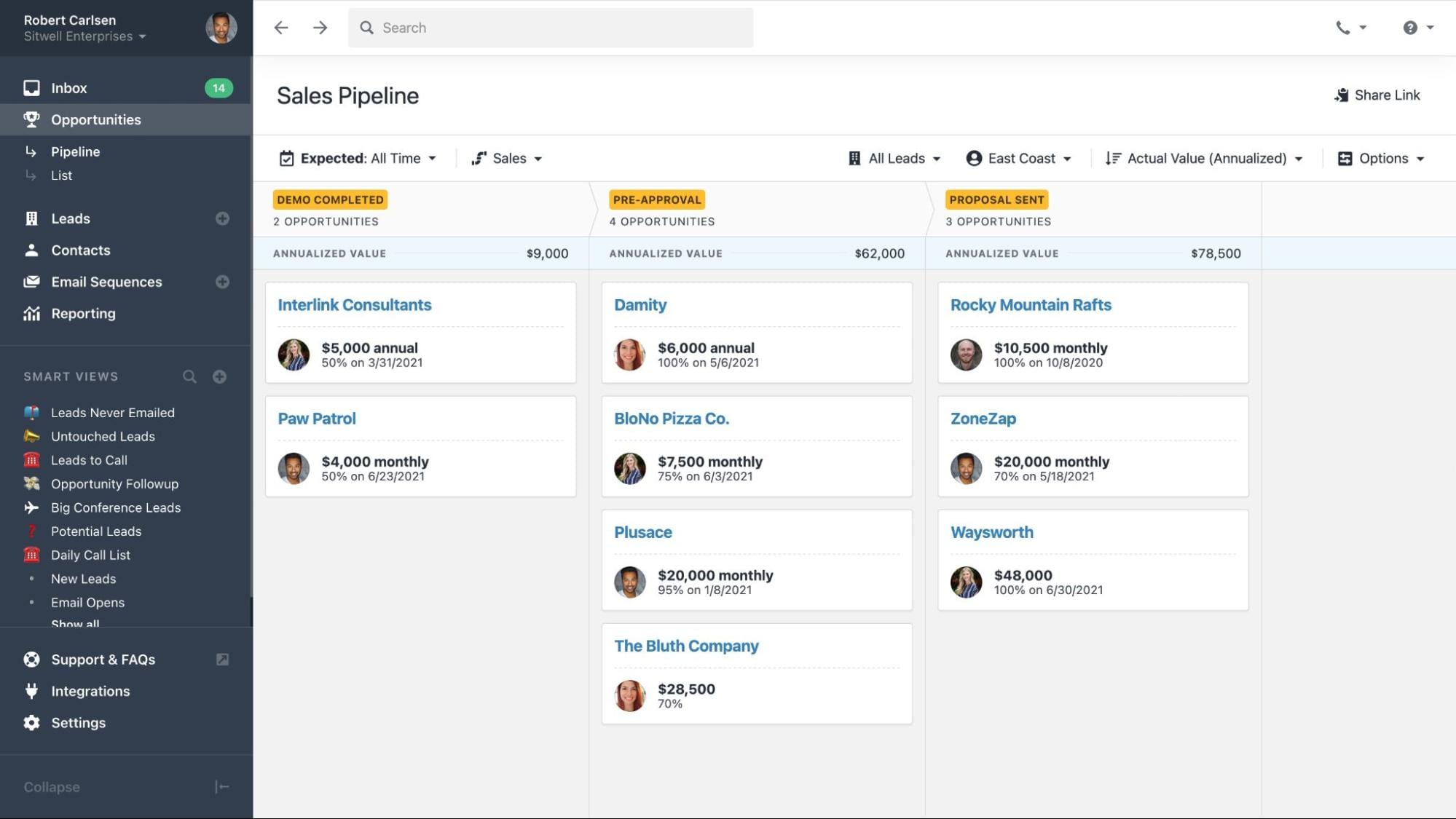
Calling, SMS, email, and sequences are native rather than stitched in, which is the entire point for a team living on the phone. Workflows and the power dialer start at Growth.
Bottom line: For five to twenty reps doing real call volume, Close beats a general CRM plus a dialer plus a sequencer on cost, and beats it by more on adoption, because reps stop tab-switching. It is a specialist and it does not pretend otherwise. If you need a system of record you will bend around a usage-based motion, this is not it.
Score: Data model 2/5 · AI 3/5 · Startup fit 4/5
Best for: Small sales teams that want dramatically less system than they have.
Pricing: Lite $14, Growth $39, Premium $59, Ultimate $79 per seat/mo (annual). No free plan, 14-day trial (Pipedrive).
Data model: Fixed. People, organizations, deals, activities. Custom fields, no custom objects.
AI: Improving, behind the AI-native tools.
The catch: LeadBooster, Campaigns, Web Visitors, and Smart Docs are all separate line items.
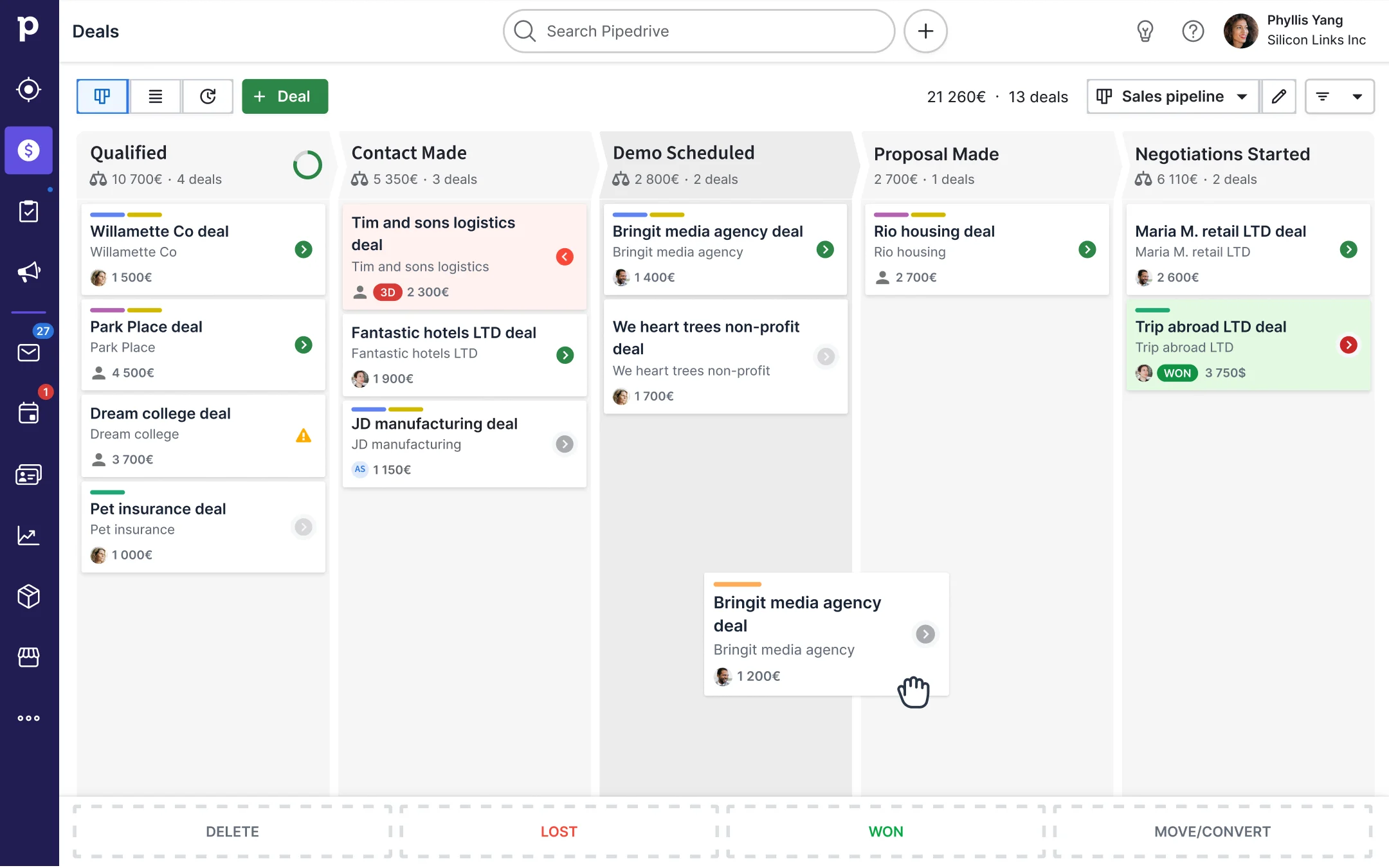
Let me be blunt about what this is. Moving from Salesforce to Pipedrive is a downgrade in capability, and sometimes that is exactly the right decision. A five-person team drowning in an org built for a company four times their size does not need a better CRM, they need less CRM. Pipedrive is the shortest distance between signing up and having a pipeline your reps will actually update.
Bottom line: Choose it when simplicity is the feature and your sales motion is textbook. The fixed data model is why it stays clean and why it will refuse anything unusual you ask of it. If you can already see accounts, workspaces, or usage-based billing in your future, you will be running this evaluation again next year. Note that Pipedrive repackaged its plans recently, so most pricing articles you find elsewhere are quoting a lineup that no longer exists.
Score: Data model 4/5 · AI 4/5 · Startup fit 3/5
Best for: Cost-led teams that want Salesforce-sized scope for Salesforce-tenth prices.
Pricing: Free up to 3 users, Standard $14, Professional $23, Enterprise $40, Ultimate $52 per user/mo (annual) (Zoho).
Data model: Flexible modules, more customizable than HubSpot.
AI: Zia for scoring and predictions, which starts at Enterprise.
The catch: A dense interface, and enough settings to configure that it will start to feel familiar in the worst way.
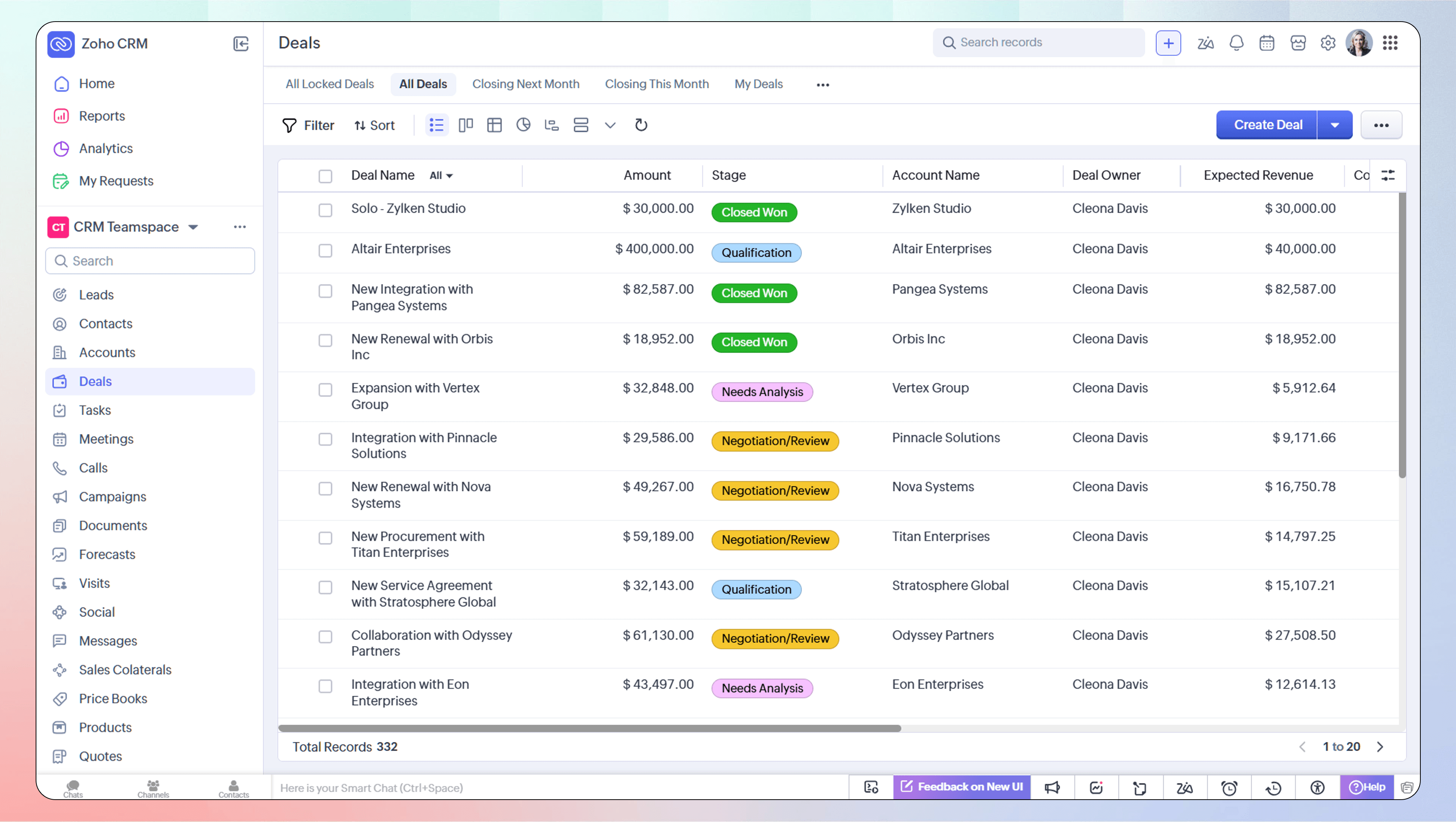
Pound for pound there is more software here than anywhere else on this page, and Zoho One is a serious argument if you want finance, support, and HR from one vendor. Its 4.1 on G2 across 2,900+ reviews is one of the lowest score here, and reading them the complaint is almost never a missing feature. It is how long everything takes.
Bottom line: I have included Zoho because leaving it off would be dishonest, not because I usually recommend it to this reader. Venture-backed software teams rarely pick it, and the ones who do are optimising for cost over speed, which is a legitimate choice if runway is the constraint. But if you are leaving Salesforce because setting it up was eating your week, think hard before buying a system with more knobs on it, not fewer.
Score: Data model 3/5 · AI 3/5 · Startup fit 4/5
Best for: Agencies, small funds, and founder-led motions that run on network rather than process.
Pricing: Standard $24, Premium $48, Enterprise from $80 per member/mo (annual) (folk).
Data model: Light. Custom objects and deals need the Premium plan.
AI: Magic fields and assistants, plus a LinkedIn extension people actually use.
The catch: No free tier, and it stays light by design as you grow.
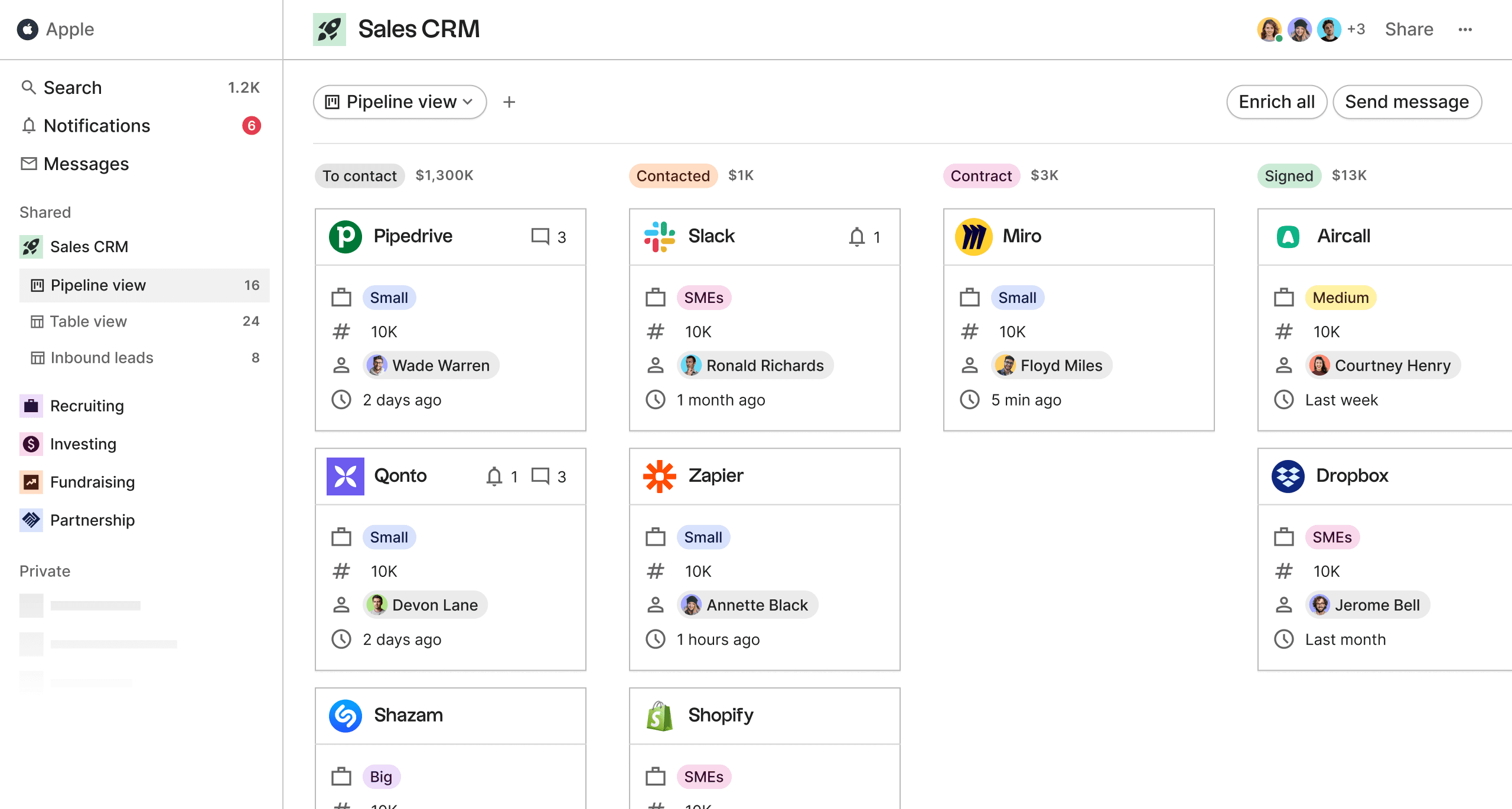
folk is quick and pleasant in a way most CRMs are not, and for a business that runs on warm introductions it is a pleasure.
Bottom line: The caveat you need, given where you are standing: if your company was big enough to buy Salesforce, folk is probably too light to catch you. It earns its place here for the deal-flow and agency readers, not for a scaling B2B sales team. Under about ten people with a relationship-driven motion, it is the fastest thing on this list to get live. For a metered product motion it runs out of room, which is the line we draw in Attio vs folk.
Score: Data model 4/5 · AI 4/5 · Startup fit 2/5
Best for: Companies already running on Microsoft, with the IT function to support it.
Pricing: Sales Professional $65, Sales Enterprise $105, Sales Premium $150 per user/mo, paid yearly (Microsoft).
Data model: Deeply customizable, and it expects you to customize it.
AI: Copilot and prebuilt sales agents, metered through Copilot Credits on top of the seat.
The catch: It is Salesforce’s weight class. Everything this post says about implementation and admin cost applies here too.
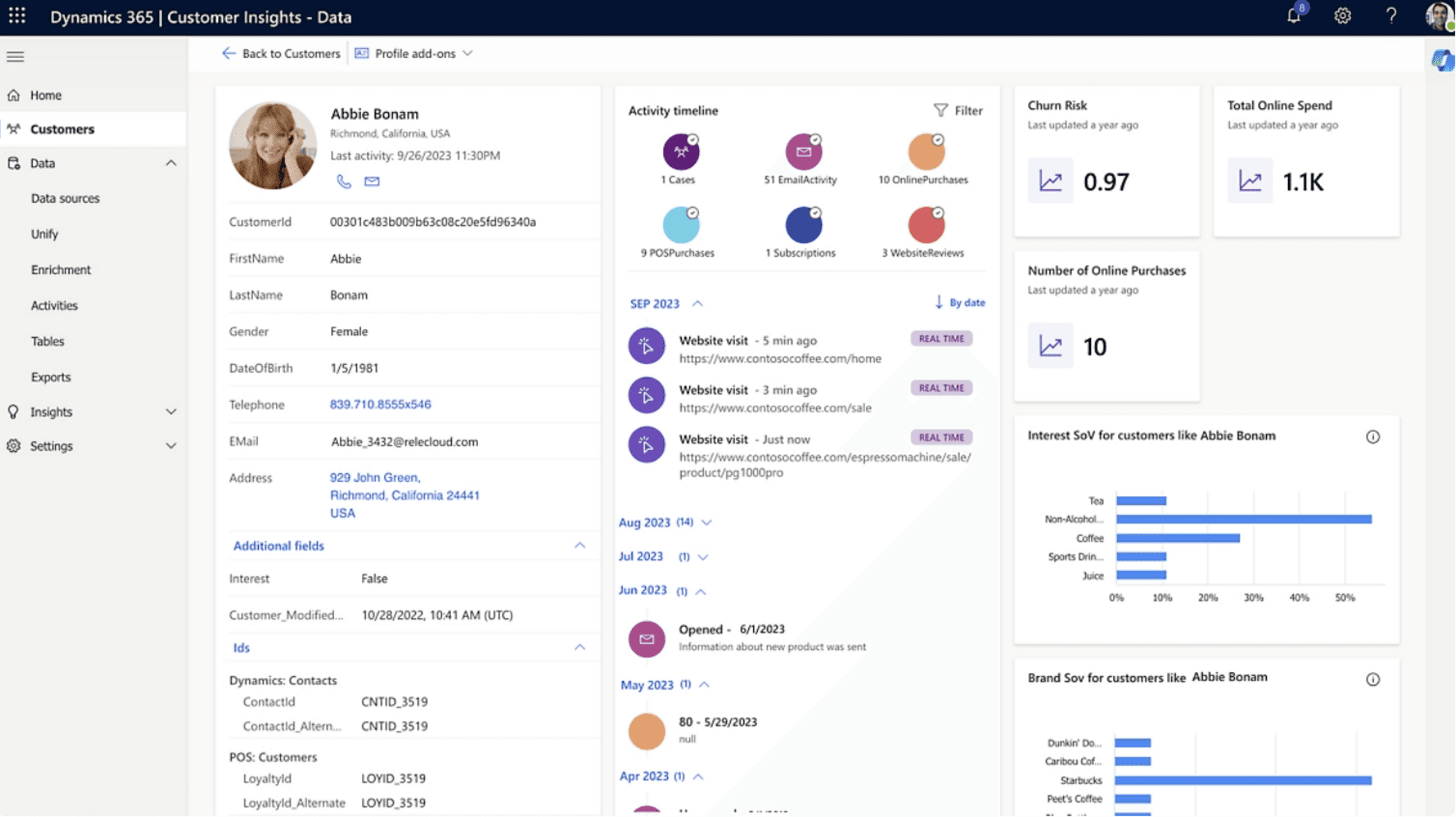
Dynamics is on this list because it belongs in any complete answer, and because leaving it out would tell you I was only counting tools that flatter my argument. If your company runs on Microsoft 365, Teams, and Power BI, the integration story is real and the shared identity layer saves genuine work.
Bottom line: For the team this post is written for, it is the wrong direction. You are leaving Salesforce because a heavy CRM needed a specialist you do not have, and Dynamics is a heavy CRM that needs a specialist you do not have. Sales Premium at $150 still meters its agents separately. Pick it when the Microsoft estate is the deciding fact about your company, and pick almost anything else above when it is not.
Before the numbers, the tier question, because getting this wrong is how most comparisons end up meaningless.
Attio Pro at $79 includes custom objects, call intelligence, sequences, workflows and AI agents, and full API access. On Salesforce, call intelligence and Agentforce arrive at Enterprise, $175, and Salesforce describes that same tier as the one with “web API.” So the honest like-for-like against Attio Pro is Enterprise at $175, not Pro Suite at $100. Comparing $79 to $100 flatters Salesforce by pricing a smaller product.
Here is year-one cost at feature parity, including implementation and the admin hours that never make it into a pricing table. The admin line uses Glassdoor’s median total pay for a US Salesforce Administrator, $116,476, which is $56 an hour loaded. Implementation uses $15,000, the low end of what partners quote for a small Sales Cloud rollout.
Cost line (10 seats, year 1) | Salesforce Enterprise | HubSpot Pro | Attio Pro |
|---|---|---|---|
Licences | $21,000 | $10,800 | $9,480 |
Onboarding / implementation | $15,000 | $1,500 | $0 |
Admin time | $23,300 (8 h/wk) | $14,560 (5 h/wk) | $5,820 (2 h/wk) |
Year-one total | $59,300 | $26,860 | $15,300 |
Change the seat count and the shape holds.
Seats | Salesforce Enterprise | Attio Pro | Year-one difference |
|---|---|---|---|
5 | $40,060 | $7,650 | $32,410 |
10 | $59,300 | $15,300 | $43,990 |
20 | $101,940 | $30,610 | $71,340 |
So $43,990 at ten seats, of which the licence explains $11,520. Twenty-six percent. Three quarters of what you save has nothing to do with the price per seat.
Now run it the other way, in Salesforce’s favour. Drop to Pro Suite at $100, accepting that you lose call intelligence, Agentforce, and the web API, and Salesforce’s year-one total falls to $50,300. The gap narrows to $34,990, and the licence now explains seven percent of it. Cheaper tier, and the seat price matters even less.
That is the point. Match the tiers properly, or hand Salesforce the cheaper one, and the licence still only explains between a quarter and a twentieth of the difference. Every other article on this search compares that line and stops.
Two caveats I would rather give you than have you find. HubSpot Sales Hub Pro is not a strict parity match either, because custom objects sit on its $150 Enterprise tier, so read that column as generous to HubSpot.
The second is the admin hours, and that is the number to argue with. Eight a week at ten seats is what I see on audits, and it stops sounding dramatic once you write it out: field requests, permission sets, a flow that broke, the report somebody needs by Friday, the duplicates. Attio’s two hours is mostly workflow tweaks. Halve my figures if yours are better. The ranking does not move. And check every price yourself before you buy, because these lineups get repackaged constantly.
Leaving a system that fits you is its own expensive mistake, so here are the four cases where I would tell you to stay.
Compliance. SOC 2 Type II, FedRAMP, and HIPAA together are not something most of this list can match. Sell to government, healthcare, or financial services and the procurement questionnaire has already decided this for you.
Complexity that is real. Multi-entity revenue, CPQ, partner channels, territory hierarchies, quota planning across regions. Salesforce costs what it costs because it does all of that. If you need it, everything above this line is a downgrade.
It already works. A well-configured org with an admin who understands the business is an asset. Tearing it out to save $44,000 while burning a quarter of GTM attention is a bad trade. The teams who should move are the ones paying for the licence and the admin and still not getting the report.
The data transfer is the easy part, and it is the only part anyone worries about. Attio’s Import2 migration is free on paid plans and pulls contacts, companies, deals, and history straight across. Most others have something similar. That is a weekend.
Here is what actually goes wrong.
You copy the model. Export Salesforce, import Salesforce. Now you own the same forty custom fields, in a product with better typography. Decide what your objects should be before anything moves.
Reporting history evaporates. Your records will come across. Five years of report snapshots will not. Export the three dashboards you actually look at, and stop pretending you will miss the rest.
Integrations take longer than everything else. Swapping the CRM takes days. Rewiring billing, product analytics, support, and every automation quietly pointed at Salesforce takes weeks. Write that list out before you promise anyone a date.
A clean import of a messy org just gives you a tidy-looking mess. Doing it as a redesign is what makes the switch worth the disruption, and it is the GTM systems work I do with teams making this move.
Attio is my pick for a startup leaving Salesforce because the operating cost stopped making sense, which is most of the reason anyone leaves. Everything else here wins a narrower lane, and winning a narrow lane properly is worth more than being adequate at everything.
Your situation | Best pick |
|---|---|
Paying for Salesforce and an admin, still fighting reports | Attio |
Marketing owns half the funnel | HubSpot |
High-volume outbound with calls and SMS | Close |
Want dramatically less system, on purpose | Pipedrive |
Cost is the deciding constraint | Zoho |
Agency, small fund, or relationship-led | folk |
The whole company runs on Microsoft | Dynamics 365 |
Regulated, or big enough to need it | Stay on Salesforce |
Whichever way you go, price the admin hours before you price the seats. That is the line that decides what this costs, and it is the one nobody puts in the table. If you are weighing the wider category rather than just the exit, start with our best CRM for startups breakdown.
No single product replaces Salesforce, but AI-native CRMs like Attio are taking the startup and mid-market segment fastest. Ramp’s July 2026 data shows Attio as the fastest-growing CRM vendor while Salesforce adoption slipped a point. Enterprise and regulated buyers are not moving, and probably will not.
HubSpot is Salesforce’s biggest competitor by adoption and market overlap, particularly among small and mid-sized businesses where its free tier and unified marketing tools win deals. Microsoft Dynamics 365 competes hardest at enterprise level, from $65 per user monthly for Sales Professional.
Attio’s free plan is the strongest for startups, covering up to 3 seats with contact syncing, enrichment, and pipeline management. HubSpot’s free CRM supports 2 users with more marketing tools attached. Zoho CRM is free for 3 users. All three are real products rather than time-limited trials.
Yes. Twenty is the most modern, self-hostable free with unlimited custom objects and an MCP server, or $9 per user monthly hosted. Odoo is the established option if you want CRM attached to ERP. Both mean you own the hosting, which trades admin cost for engineering cost.
For a small B2B sales team, Attio Pro at $79 per user monthly gives you the most capability without needing an administrator. On a tighter budget, Pipedrive Lite at $14 covers a simple pipeline. Zoho CRM at $14 offers the most features per dollar if you will invest the configuration time.
Record migration is usually free. Attio includes Import2 on paid plans, and most vendors offer CSV import. The real cost is redesigning your data model and rewiring integrations, typically two to six weeks. Weigh that against the roughly $44,000 a ten-seat team saves in year one at matched feature tiers.
Sparsh Gupta, Founder of Automation Jinn and an Official Attio Expert Partner, helps seed to Series B startups leave Salesforce without losing a quarter to the migration, rebuilding the data model and workflows so the new CRM earns its place. If you want your real year-one number before you commit to anything, book a discovery call.