Best CRM for Startups (2026): An Implementer's Shortlist


•
•
The best CRM for most startups in 2026 is Attio: an AI-native system of record you shape to your own sales motion and set up in days, not a quarter. If marketing is your growth engine, HubSpot fits better. For dead-simple outbound, Pipedrive. For relationship-led founders and VCs, Folk. For a solo founder living in Gmail, Streak.
That is the short version, and it is the honest one. “Best” depends entirely on how you sell, and the wrong pick does not announce itself on day one. It shows up six months later as a CRM nobody opens, with a pipeline that is fiction. I design and build these systems for startup teams as an Official Attio Expert Partner, so this ranking is written from what survives contact with a growing team, not from a feature grid.
If you want the answer without the reading:
Attio, best overall. The modern default for AI-native and B2B SaaS startups that intend to scale. Flexible data model, native AI, fast adoption. Free to start, $35 to $79 per user after.
HubSpot, best for marketing-led teams. Free CRM core and one suite for marketing, sales, and service. Great on-ramp, steep price step-ups later.
Pipedrive, best for simple outbound. The visual pipeline reps actually update, cheap and quick to launch, limited once your data model gets interesting.
The other four picks below cover relationship-led, enterprise-bound, Gmail-native, and pre-revenue teams. Match the tool to your motion, not to a logo.
CRM | Best for | Price (annual) | My rating |
|---|---|---|---|
Attio | AI-native and B2B SaaS, sales-led or PLG | Free, then $35–$79/user | 4.5/5 |
HubSpot | Marketing-led inbound teams | Free, then ~$90/user (Pro) | 4/5 |
Pipedrive | Simple outbound pipelines | $14–$79/user | 3.5/5 |
Folk | Relationship-led founders, agencies, VCs | $24–$48/user | 4/5 |
Salesforce | Teams heading to enterprise fast | $25–$175/user | 3.5/5 |
Streak | Solo founders inside Gmail | Free, then $49/user | 3.5/5 |
Notion / Airtable | Pre-revenue, spreadsheet refugees | Free, then ~$10–$20/user | 3/5 |
Prices are per user, per month, billed annually. Ratings are my own, based on building and running these tools for startup teams. The sections below explain the scores.
I set up CRMs for seed-to-Series-B startups for a living, so this list is graded on what actually matters once real leads hit the system, not on demo-day polish. Five criteria carried the most weight: whether the data model fits how you truly sell, whether reps adopt it without nagging, how honest and predictable the pricing is, how useful the built-in AI is in daily work, and how fast you get to value. Where I lean on outside numbers, ratings, prices, adoption data, I cite the source. Where I give a verdict, it is mine. For the deepest version of my Attio take, see the complete Attio guide for startups.
Maybe not this week. If you are pre-revenue with under a dozen leads you can hold in your head, a well-structured spreadsheet or a Notion table is a reasonable start. The trigger to graduate is simple: the moment follow-ups start slipping, two people touch the same lead, or you cannot answer “what is the state of that deal” in five seconds, the spreadsheet is now costing you money. Most startups hit that wall between 30 and 60 active leads. Past it, a real CRM stops being overhead and starts being the thing that keeps deals from quietly dying.
My rating: 4.5/5
Attio is the CRM I recommend to most seed-to-Series-B teams, and the one I build on. It is an AI-native system of record with a flexible data model: instead of forcing your business into pre-set Contacts and Deals, you model what you actually sell, whether that is workspaces, accounts, communities, or usage-based signups. Email and calendar sync populate and categorize records automatically, which is the feature founders keep naming as the reason they stopped fighting their CRM.
Where it wins. The data model is the category benchmark, and native AI (Call Intelligence, sequences, an AI research agent, and natural-language “Ask Attio”) is built into records rather than bolted on. That is exactly why AI-native startups keep choosing it: Attio’s own customer base skews toward the teams shipping AI products, names like Granola, Modal, and Replicate, who want a CRM as modern as what they are building. The broader momentum backs it up: Attio is the fastest-growing vendor in the entire CRM category per Ramp’s spending data, it raised a $52M Series B led by GV in 2025, and it serves roughly 5,000 companies, holding a 4.3/5 rating on G2 across 500-plus reviews. It fits both sales-led and product-led motions, which is rare.
Pricing. The Free plan covers up to three seats with 50,000 records and full API plus MCP access. Plus is $35 per user per month annually ($44 monthly), and Pro is $79 ($99 monthly) with Call Intelligence, sequences, and AI agents. Enterprise is custom; Attio does not publish a fixed Enterprise price, and there is no onboarding fee on any tier. Two details matter for planning: custom objects start on Pro rather than Plus, and Plus now tops out at 10 seats, so your eleventh hire is the moment you move up to Pro. For the full breakdown including the credit system, see Attio pricing explained.
Watch-outs. Reporting is good on Pro but not a full BI replacement, the integration catalog is smaller than HubSpot’s, and the blank canvas that makes Attio powerful will punish a team that rushes setup. That last point is the whole game. A well-designed Attio instance drives adoption; a rushed one becomes the graveyard everyone was trying to escape.
Bottom line. For a technical, fast-moving B2B startup, Attio is the strongest foundation on this list. My full Attio review scores it dimension by dimension.
My rating: 4/5
If inbound content and marketing are your primary growth engine, HubSpot earns its place. The free CRM is legitimately useful, and the all-in-one suite means marketing, sales, and service share one contact record. For a team whose first hire is a content marketer, that gravity is real.
Where it wins. Breadth. One vendor for marketing automation, sales sequences, service, and reporting, plus a huge integration ecosystem and free onboarding academy. Nothing else here matches the all-in-one story.
Pricing. The free tier covers two seats. Sales Hub Professional runs about $90 per user per month annually plus a one-time onboarding fee of roughly $1,500, and Enterprise steps up again. Custom objects are gated to Enterprise, and marketing automation is a separate product. The HubSpot for Startups program can knock up to 90% off year one for eligible venture-backed startups that have raised under $20M, with the discount tapering after. Plan for the list price, not the promo, because the step-up lands right as your seat count grows.
Watch-outs. Cost compounds fast past the free tier, and the AI still depends on your team keeping records current. If you are weighing the two directly, I go deep in Attio vs HubSpot for startups, and if you are leaving it, how to migrate from HubSpot to Attio walks the whole path.
Bottom line. The most complete platform here, and the right call when marketing is your engine. Overkill and overpriced before you need the full suite.
My rating: 3.5/5
Pipedrive is the sane, visual pipeline that reps actually update, and it shows up again and again when founders want something lighter than the incumbents. It was built by salespeople for a Kanban-style deal flow, and for a small outbound team that just needs stages, activities, and reminders, it is hard to over-complicate.
Where it wins. Speed to value and low admin. You are running in an afternoon, and reps get it without training.
Pricing. Pipedrive repackaged its plans in 2026: Lite at $14, Growth at $39, Premium at $59, and Ultimate at $79 per user per month billed annually, with automations from Growth up. There is no free plan, only a trial, and useful extras (LeadBooster, Campaigns, Web Visitors) are paid add-ons that stack.
Watch-outs. Pipedrive uses fixed objects (People, Organizations, Deals, Activities) with custom fields but no custom objects, so a usage-based or multi-sided model does not fit cleanly. Founders also flag inconsistent support as a risk when scaling fast. It rates 4.2 on G2. See the full Attio vs Pipedrive breakdown if you expect your data model to grow.
Bottom line. Great for a no-frills sales motion, limiting the moment your model gets interesting.
My rating: 4/5
Folk is the pick when your product is the relationship. Agencies, consultants, solo founders, and VCs who run their business out of an inbox get a lightweight, contact-first CRM with enrichment, LinkedIn sourcing, and AI-drafted follow-ups, without the weight of a sales-ops platform.
Where it wins. Fast setup, strong relationship tracking, and a clean Chrome extension for sourcing from LinkedIn and social. It is the friendliest tool here for a networker.
Pricing. Folk is $24 per user per month for Standard and $48 for Premium, billed annually, with a two-week trial and no permanent free tier. Custom objects and deals live on Premium.
Watch-outs. It is light on heavy sales ops. If you have SDRs, quotas, and a forecast to run, Folk will feel thin. For funds specifically, the deal-flow motion is better served by a purpose-built setup, which I cover in Attio for VC and deal flow.
Bottom line. If your edge is partnerships and warm intros, Folk is exactly enough. If it is a repeatable sales pipeline, look higher on this list.
My rating: 3.5/5
Salesforce belongs on this list for one specific startup: the one that already knows it is going enterprise, fast, with a complex motion and the budget to run it. The customization ceiling is effectively unlimited, and the governance and reporting are built for scale.
Where it wins. Depth and extensibility no one else matches, plus the largest app ecosystem in software.
Pricing. Salesforce plans run from Starter Suite around $25 to Pro Suite around $100 to Enterprise at $175 per user per month, and the sticker is the smallest part of the cost. Real total cost of ownership includes implementation and, before long, a dedicated admin.
Watch-outs. For a seed or Series A team, it is enterprise overhead for a motion you have not validated yet, and the better AI is gated to the higher tiers. The full case is in Attio vs Salesforce for startups.
Bottom line. Powerful, and premature for most startups until you are truly enterprise-bound.
My rating: 3.5/5
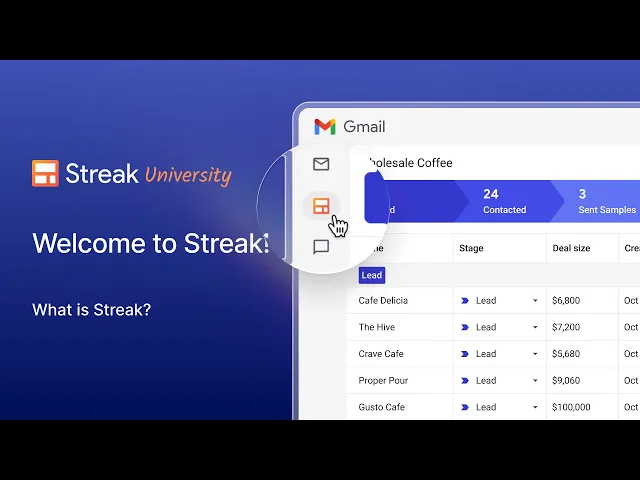
Streak lives entirely inside Gmail, which for a solo founder or a two-person team already glued to Google Workspace is a real advantage. Pipelines, email tracking, and mail merge sit right in the inbox with almost no context-switching.
Where it wins. Zero context-switching and a gentle learning curve. If your whole day is already in Gmail, Streak meets you there.
Pricing. There is a free personal plan, and paid plans start at $49 per user per month annually ($59 monthly).
Watch-outs. The ceiling arrives with your second and third rep. Streak is superb as a personal deal tracker and strains as a shared system of record with real reporting and automation needs.
Bottom line. Use it to escape a spreadsheet fast, and plan to reassess once you are hiring salespeople.
My rating: 3/5
Plenty of pre-revenue teams do not need a CRM yet; they need to escape a spreadsheet. Notion and Airtable, with a bit of structure and automation, carry an early team surprisingly far, and Notion even ships a startup-in-a-box template.
Where it wins. Flexibility and price. You already know how to use them, and they bend to any shape.
Pricing. Both have free tiers; paid plans land around $10 to $20 per user per month.
Watch-outs. These are databases you are hand-shaping into a CRM, with no native email sync, no enrichment, and no sales logic unless you build it. That is fine at ten leads a month. At sixty, the cracks that pushed you off Sheets reappear, just with more setup sunk into them.
Bottom line. A deliberate stopgap, not a destination. Treat it as the thing you will replace, on purpose, within a year.
Once you are past the shortlist, five things separate a CRM you will still love in a year from one you will rip out. Weigh them in this order.
First, data-model fit. Can it represent how you actually sell? A pure pipeline tool cannot model usage-based or multi-sided motions, and forcing it creates the mess you were escaping. Second, adoption, the only metric that matters, because a CRM nobody updates is negative value. Favor tools that capture context automatically over ones that depend on discipline. Third, honest pricing: watch for onboarding fees, per-seat step-ups, and usage-based AI credits that turn a $29 plan into a $290 bill. Fourth, native AI that does real work, enrichment, call notes, drafting, not a chatbot bolted to the corner. Fifth, time to value: you should be running in days, and if a tool needs a quarter and a consultant just to start, that cost is part of the price. For most B2B startups, the tool that scores well across all five is the one you build your sales-led or product-led motion on and do not outgrow.
Search sentiment matters here, so I read the room. In the most-read r/CRM thread on this exact question, a bootstrapped founder growing fast asks for a lightweight CRM that is not Salesforce or HubSpot. The most-upvoted answers converge on Attio, praised by one founder who had tried Pipedrive and Monday for the way it “just works,” specifically its automatic contact sync and categorization. Pipedrive and OnePageCRM come up as simple pipelines, and Notion or Airtable as the spreadsheet upgrade. The single best piece of advice in the thread is process, not product: shortlist two, load a week of real leads into each, and keep whichever one you reach for without being reminded. A CRM you avoid updating is worse than the spreadsheet you left, because now the gaps are hidden.
List price per seat hides the real number. Here is year-one cost at 5, 10, and 20 seats, comparing each tool at the tier a scaling startup would actually run, with full automation and AI, so Attio Pro sits against Pipedrive’s top Ultimate tier and Salesforce Enterprise, not their entry plans. This is the math I run for clients before anyone signs anything.
CRM (tier matched to Attio Pro) | 5 seats | 10 seats | 20 seats |
|---|---|---|---|
Attio Pro | $4,740 | $9,480 | $18,960 |
Folk Premium | $2,880 | $5,760 | $11,520 |
Pipedrive Ultimate | $4,740 | $9,480 | $18,960 |
HubSpot Sales Hub Pro | $6,900 | $12,300 | $23,100 |
Salesforce Enterprise | $10,500 | $21,000 | $42,000 |
Year-one totals, billed annually, each competitor shown at the tier that matches Attio Pro’s feature depth: Pipedrive at Ultimate, HubSpot at Professional, Salesforce at Enterprise where its automation and API actually live. HubSpot adds a roughly $1,500 onboarding fee, and its startup discount can cut year one sharply but expires; Salesforce Enterprise adds implementation and an admin on top of the seat cost. Attio Pro undercuts Pipedrive’s top tier and HubSpot Pro, and runs a fraction of Salesforce Enterprise. Folk Premium comes in lower because it is a lighter, relationship-first tool, not a full sales-ops platform. Verify current pricing on each vendor’s site before buying; these lineups get repackaged often.
Picking the tool is the easy half. The half that decides whether a CRM compounds or rots is the setup: the objects, the pipeline stages, the automations, the data hygiene that makes reports trustworthy. You can absolutely do this yourself, and for a simple pipeline in Pipedrive or Streak, you should. The stakes rise with the tool’s power. Attio’s flexibility is exactly why a rushed build turns into the graveyard, and exactly why a deliberate one drives adoption from week one.
That build is what I do. As an Official Attio Expert Partner, I design the data model and workflows around how your team actually sells, so pipeline is clean, adoption is real, and you are selling from the CRM instead of maintaining it.
For most early-stage B2B startups in 2026, Attio is the best fit: it is AI-native, flexible enough to model your actual motion, and free for up to three seats to start. If your growth is marketing-led, HubSpot is the stronger choice, and for a pure two-person outbound team, Pipedrive is simpler.
Attio’s free plan is the most capable for B2B teams, covering three seats, 50,000 records, and full API access. HubSpot’s free CRM is better if you want marketing tools in the same place, and Streak’s free plan wins for a solo founder who lives inside Gmail. Match the free tier to your motion.
Attio is better for sales-led and product-led startups that want a focused, adaptable system of record set up in days. HubSpot is better when inbound marketing is your main growth engine and you want one suite for marketing, sales, and service. The trade is focus and price against breadth.
Most seed-to-Series-A startups land between $0 and $70 per user per month. Expect to start free or near it, then pay $35 to $79 per seat once you need automation and custom objects. Budget for total cost, including onboarding fees and the price step-ups that hit as you add seats.
A growing share of AI-native and venture-backed startups run on Attio, including Granola, Modal, Railway, and Replicate. HubSpot remains common for marketing-led teams, and Salesforce shows up once companies scale toward enterprise. The modern default for a technical, fast-moving startup has shifted toward Attio.
In the most-read r/CRM thread on this question, bootstrapped founders most often recommend Attio for a modern, low-admin system, with Pipedrive for a simple pipeline and Notion or Airtable as a spreadsheet upgrade. The recurring advice: trial two with real data before committing.
Sparsh Gupta, Founder of Automation Jinn and an Official Attio Expert Partner, helps seed to Series B startups choose and build CRM and GTM systems that their teams actually adopt. If you have picked your CRM and want it set up right the first time, book a discovery call.