CRM Implementation for Startups: A Playbook (2026)


•
•
A CRM implementation for a seed to Series B startup should take about 30 days, and on a modern platform it should cost you nothing in onboarding fees. What decides whether it works is not the platform you choose or how many steps you follow. It is whether you settle the data model in week one, before anyone configures a single field.
Almost every guide ranking for this topic was written for a different company than yours. They assume an IT department, a steering committee, and a six-month runway. That advice is not wrong for a 2,000-person insurer. Applied to a 12-person startup, it produces a system so heavy that the sales team quietly goes back to a spreadsheet by month two. This playbook is the version I actually run with clients.
CRM implementation is the process of designing your customer data model, configuring the platform around your real sales process, migrating existing data, connecting the rest of your stack, and getting the team to work inside it every day.
Notice what is first on that list. Most step-by-step guides open with “define your goals” and then jump to “choose a CRM,” treating configuration as a downstream chore. The configuration is the project. Goals are an afternoon. The data model is the thing you will still be living with in three years.
You will read that 70% of CRM implementations fail. It appears on vendor pages, agency blogs, and in the AI Overview for half the queries in this space. One page-one result currently states that three out of four flop.
The number traces back to Gartner commentary from around 2001. In a 2004 interview with Gartner’s Ed Thompson, he explained what happened to it: the firm had said projects “failed to meet expectations,” and the industry dropped the qualifier, leaving a much scarier claim than the research supported. Twenty-five years later it is still being recycled, with no primary source attached.
The better data is more useful anyway. Validity’s 2025 State of CRM Data Management report, based on 602 CRM users, found that 76% say less than half of their organization’s CRM data is accurate and complete, and 37% have lost revenue as a direct result of poor data quality.
Read those together and the picture changes. The common outcome is not a project that collapses. It is a project that ships, quietly under-delivers, and leaves you with a database nobody trusts.
Enterprise failure modes are about governance and politics. Startup failure modes are different, and they are more fixable.
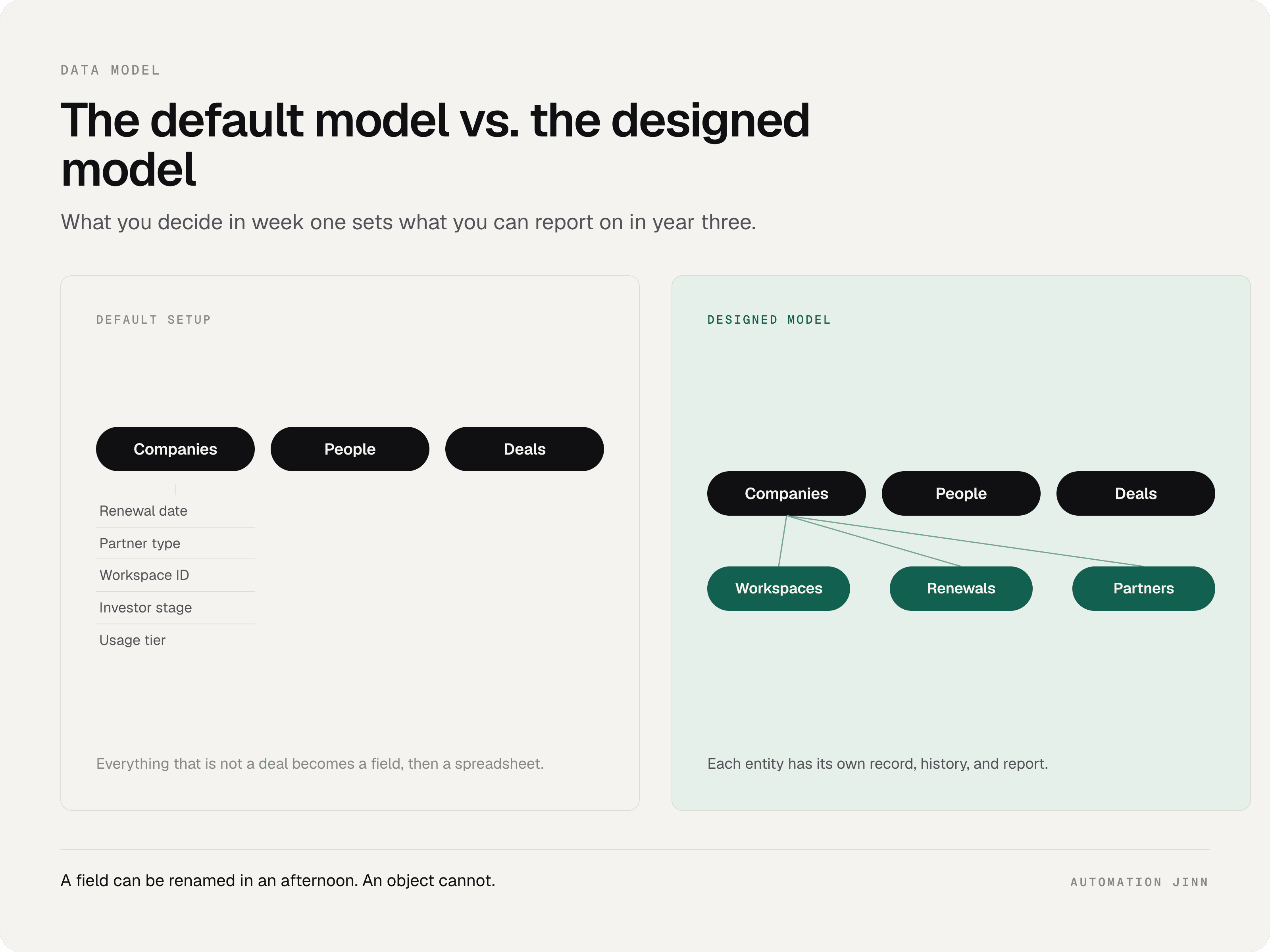
You bought a pipeline when you needed a data model. The team sets up Companies, People, and Deals, drags in the default stages, and calls it done. It works until the first thing that is not a deal shows up: a partner, an investor, a self-serve workspace, a renewal, a design partner. Now it lives in a spreadsheet, and you have two systems again.
You made twenty fields required and got twenty fields of garbage. A required field is a tax on the rep, and reps route around taxes. If a field is required at a stage where the answer is not yet knowable, you will get “TBD” and “n/a” forever. A field full of placeholder values is worse than an empty field, because it looks populated in a report.
You migrated a graveyard. Ten years of dead contacts, orphaned deals, and duplicates move across untouched, and the new CRM is as messy as the old one on day one. Migration is an editorial decision, not a technical one.
Nobody runs the business from it. If your weekly pipeline review happens on an exported spreadsheet, every rep learns within two weeks that the CRM is not load-bearing. No amount of training fixes this, because the reps are reading the situation correctly.
This is the part of CRM implementation that nobody writes about and everybody pays for later. Before you touch configuration, answer four questions.
What is the thing you sell to? For most B2B startups it is a company. For a PLG product it might be a workspace or an account that has no company attached yet. For a fund it is a portfolio company plus an LP. If the answer is not “company,” your CRM’s default object model is already wrong for you.
What is your unit of revenue? A one-off deal, a subscription that renews, a usage-based account that expands monthly, a retainer. This determines whether Deals is enough or whether you need a second object to hold the recurring relationship.
What repeats that is not a deal? Renewals, expansions, partner relationships, investor updates, implementation projects. Each of these is a candidate for its own object. Each one you force into Deals is a reporting problem you inherit.
What data arrives without a human touching it? Product usage events, enrichment, form fills, billing status. This data needs somewhere structured to land, and deciding that up front is the difference between clean automation and a pile of custom fields on the Company record.
Decision | Get it right | Get it wrong | Cost to fix later |
|---|---|---|---|
Core object for revenue | Reports match how you actually sell | Renewals and expansions distort pipeline | Rebuild reporting, re-migrate history |
Custom objects vs. fields | Each entity has its own record and history | Twenty fields bolted onto Company | Field-by-field data surgery |
Required fields per stage | Reps fill them because they can | Placeholder values in every report | Retrain the team, re-clean the data |
Where automated data lands | Usage and enrichment stay queryable | Overwritten fields, no history | Reconnect every integration |
The trap here is that the data model decision has a price tag, and it is set by the platform you picked in week one. Custom objects are not available on every plan, and where they sit in the pricing table varies enormously.
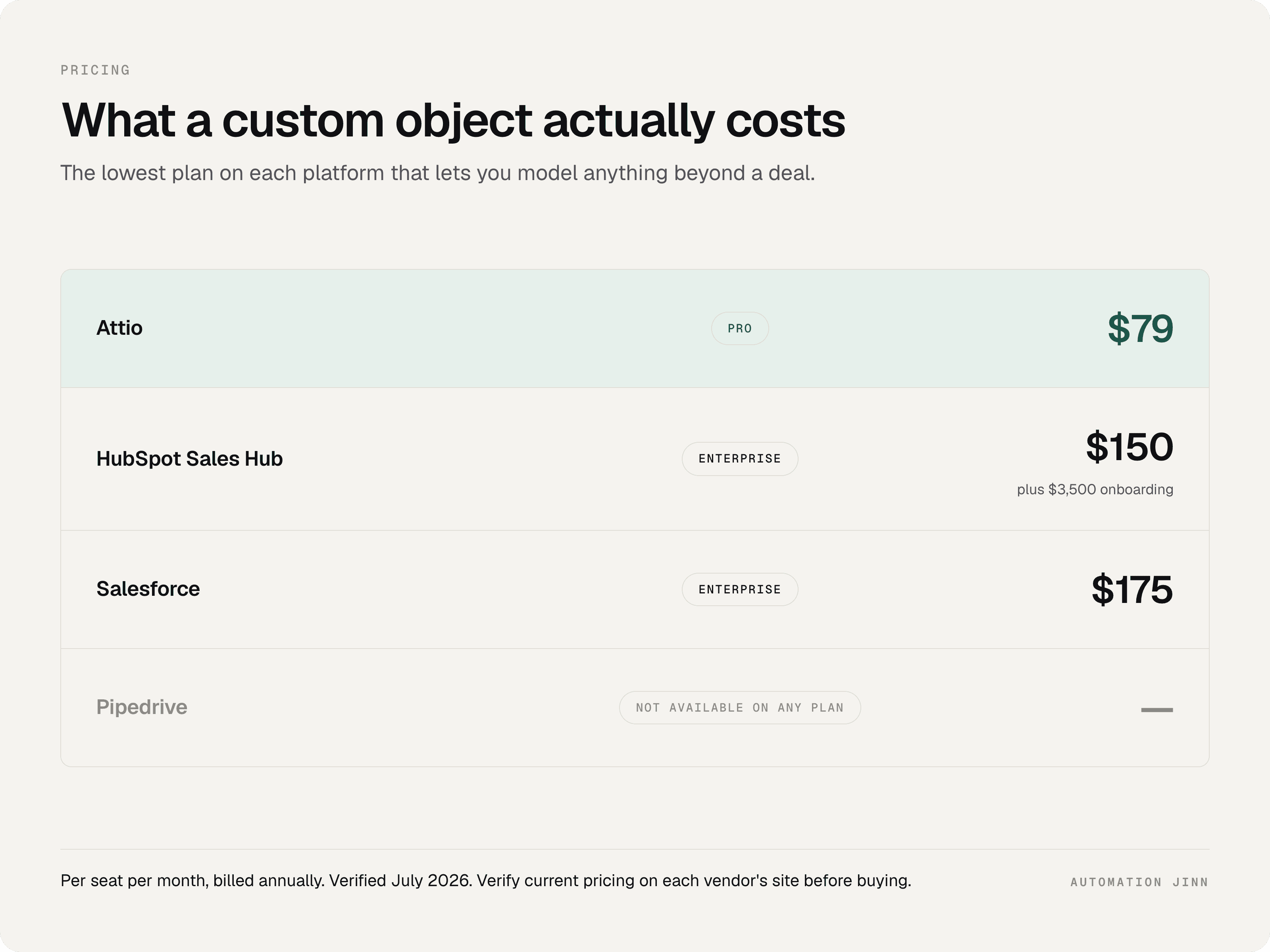
If your business needs a Workspaces object or a Renewals object, and you are on Pipedrive, no amount of good implementation work will get you there. If you are on HubSpot, the answer costs $150 per seat per month before the required onboarding fee. Attio puts them on the $79 Pro tier, capped at 12 objects in total including the standard ones, with unlimited objects on Enterprise. I cover the mechanics of building them in the guide to Attio custom objects and the data model, and the broader selection question in the best CRM for startups.
Pick the platform against the data model you sketched, not the other way around.
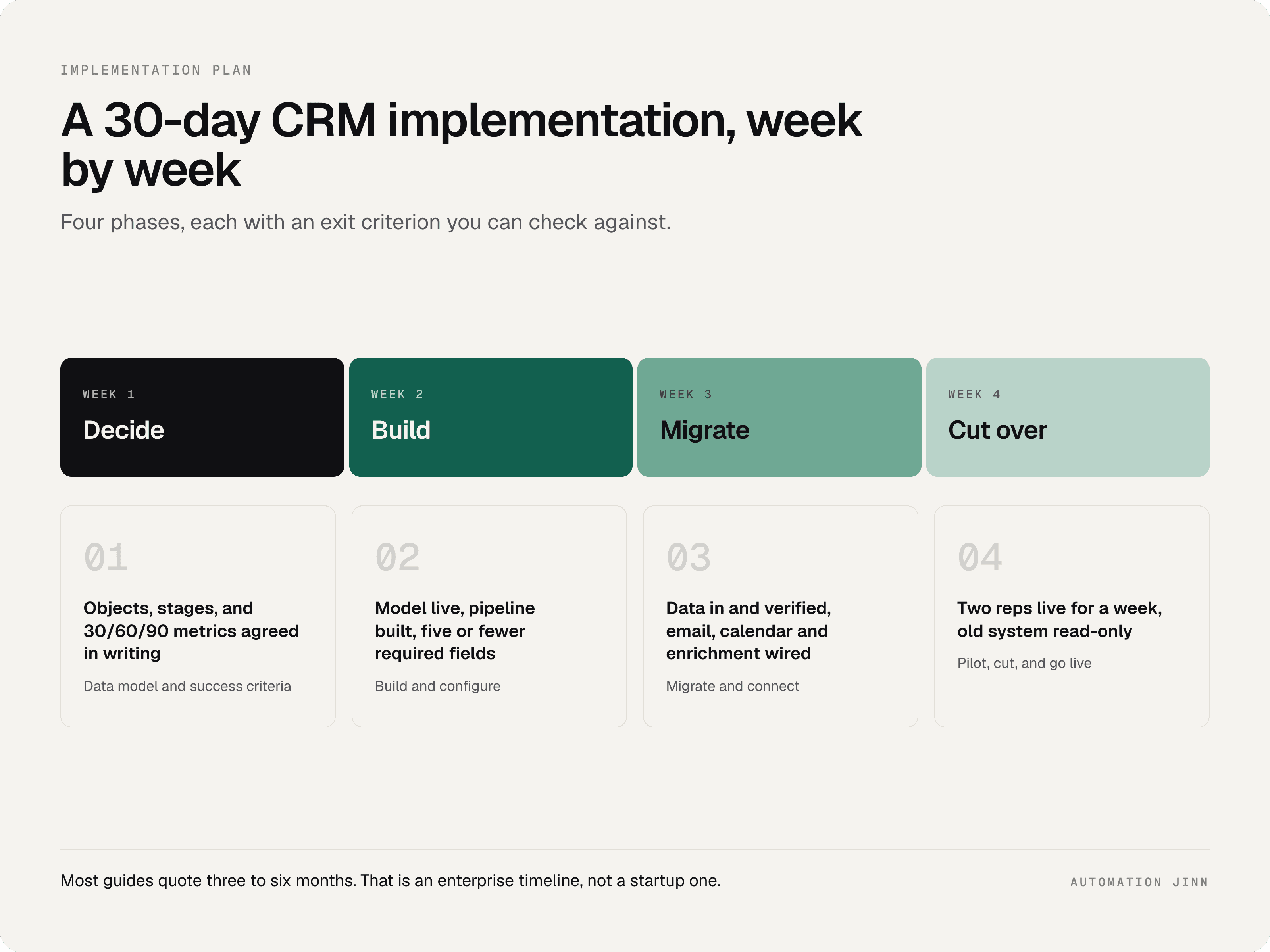
The AI Overview on this query will tell you a small team needs four to six weeks and a mid-market company eight to twelve. Those numbers come from implementations on platforms that require a partner to configure. On a modern CRM with a startup-sized team, 30 days is a comfortable schedule with slack in it.
Week | Focus | Exit criteria |
|---|---|---|
1 | Data model and success criteria | Objects, stages, and 30/60/90 metrics agreed in writing |
2 | Build and configure | Model live, pipeline built, five or fewer required fields |
3 | Migrate and connect | Data in and verified, email, calendar and enrichment wired |
4 | Pilot, cut, and go live | Two reps live for a week, old system read-only |
Run one working session per motion, not one per department. Map how a deal actually moves, not how the playbook says it should. Write down the objects, the stages with an entry condition for each, and the three to five numbers that will tell you in 90 days whether this worked. Resist the urge to open the CRM at all this week.
The output is a one-page spec. If you cannot fit the model on one page, it is too complicated for the size of your team.
Configure the objects and relationships first, the pipeline second, the fields last. When you get to fields, apply one test: for each required field, when in a real deal does your best rep actually know the answer? If it is stage four, it cannot be required at stage two.
Most startup pipelines need three to five fields a human types. Everything else should be captured, enriched, or inferred. Stage and next step with a date are the two judgments worth protecting a rep’s attention for.
Do not move everything. Set a rule before you export: anything with no activity in the last 18 months gets archived rather than migrated. Deduplicate before import, not after. Map fields explicitly and check that formula and calculated fields survive as formulas, because they often arrive as flat text and silently break everything downstream.
Import in sections, verify each one against a record count you took beforehand, and keep the old system readable for 30 days after cutover. If you are coming off HubSpot specifically, the HubSpot to Attio migration walkthrough covers the field-mapping traps in detail.
Connect email, calendar, and call capture in the same week. These are what make the CRM fill itself, and they do more for adoption than any training session.
Put two reps in the live system for a full week while everyone else carries on as normal. You are not testing whether the software works. You are testing whether a rep can run a real day inside it without opening a spreadsheet. Collect the friction, cut the fields that caused it, then set the old system to read-only. A soft cutover with two systems running in parallel is how you end up with neither being trusted.
Most cost articles quote a single scary figure with no basis. Here is the year-one license math for a startup, calculated from each vendor’s current published annual pricing as of July 2026.
Seats | Attio Pro | HubSpot Sales Pro | Salesforce Enterprise | Pipedrive Premium |
|---|---|---|---|---|
5 | $4,740 | $6,900 | $10,500 | $3,540 |
10 | $9,480 | $12,300 | $21,000 | $7,080 |
20 | $18,960 | $23,100 | $42,000 | $14,160 |
HubSpot’s figures include the required one-time Professional onboarding fee of $1,500, which rises to $3,500 on Enterprise. Salesforce’s column is licenses only and excludes implementation services, which are effectively mandatory at that tier. Pipedrive Premium looks cheapest until you remember it has no custom objects, and that features like lead routing and campaigns are priced as separate add-ons. Attio charges no onboarding fee on any tier. Verify current pricing on each vendor’s site before buying.
The line items that surprise people are not on any pricing page:
Admin time. A platform that needs a dedicated administrator has a salary attached to it, and at seed stage that person is usually a founder doing it badly at 11pm.
Feature gating. Conversation intelligence sits behind Salesforce’s $175 tier and Attio’s $79 tier. Which side of that line you land on changes the real cost more than the headline seat price.
Enrichment and credits. Most modern CRMs meter AI and enrichment usage. Budget for the add-on packs rather than discovering them in month three.
Middleware. Every integration you cannot do natively becomes a Zapier or n8n bill plus someone to maintain it.
The Ramp CRM category data is a useful sanity check on where teams are actually landing. As of July 2026, Salesforce holds 76% category adoption and HubSpot 35%, while Attio sits at 5% and is the fastest-growing vendor in the category. The incumbents still own the installed base. The movement is toward the lighter end.
The real question is not whether you are capable of following the plan above. It is whether your setup is a configuration job or a design job, because those are different disciplines and only one of them is safe to learn on your live revenue data.
Signal | Configuration job | Design job |
|---|---|---|
Sales motion | One pipeline, founder-led | Two or more motions, or PLG plus sales |
Data model | Companies, People, Deals covers it | Custom objects and relationships |
Migration | Under 5,000 records, one source | Multiple systems, formula fields, history that matters |
Product data | None flowing into the CRM | Usage or billing data driving triggers |
Timeline | No hard deadline | Board meeting, new AE class, or a renewal cliff |
Land in the right-hand column on even two rows and you are designing a system, not configuring an app. A configuration mistake is an afternoon to undo. A design mistake is invisible at go-live and surfaces at Series A, when leadership asks for a number the model cannot produce and the only fix is a re-migration with the whole team watching.
That second job is what I do. Automation Jinn builds GTM systems where the data model is designed first and the automation sits on top of it, and as an Official Attio Expert Partner I have run this on enough startup stacks to know which decisions you cannot walk back. If you are reading this because you already suspect the model is the hard part, you are right, and it is worth an hour before you build.
This is the part that has changed since 2024, and none of the page-one guides for this query have caught up.
Every CRM now ships agents, and every agent is only as good as the structure underneath it. Salesforce’s own research is blunt about this: 84% of data and analytics leaders agree AI’s outputs are only as good as its data inputs, 51% of sales leaders with AI say tech silos delay or limit their initiatives, and 74% of sales teams with AI are prioritizing data hygiene to support it. Sales leaders estimate that 19% of their company’s data is inaccessible.
Practically, implementing for agents means three things. Structure the data an agent needs to reason over, rather than leaving it in note fields. Give the agent a way in, which in Attio’s case means the API, webhooks, and the MCP server that lets Claude and similar tools read and write records directly. And decide which fields an agent is allowed to write, because an agent filling a field a human is also filling is how you get two sources of truth on the same record.
A CRM implemented in 2026 without this consideration is not wrong, it will just need doing again in eighteen months. The data model work is the same work either way, which is a reason to do it properly the first time.
Set these in week one and check them on schedule. Adoption is a measurement problem before it is a behavior problem.
Day 30: every active deal lives in the CRM with a stage and a dated next step. Pipeline review runs off the CRM screen, not an export.
Day 60: 90% of customer emails and meetings are logging automatically. No rep is maintaining a personal spreadsheet.
Day 90: you can answer a question leadership has not asked yet, without exporting to a spreadsheet to do it. Forecast is within a range you are willing to say out loud.
If day 90 still requires a spreadsheet, the data model is the problem, not the team. That is worth diagnosing before you add anything else to the system. Our complete Attio guide for startups goes deeper on the build itself once the model is settled.
CRM implementation is the process of designing your customer data model, configuring the platform around your real sales process, migrating existing data, connecting your other tools, and driving daily adoption. The configuration and data model work is the substance of it. Software installation is trivial on modern cloud CRMs.
A seed to Series B startup should plan for 30 days: one week to decide the data model, one to configure, one to migrate and integrate, one to pilot and cut over. Longer timelines of three to six months apply to enterprise platforms with heavy integration and governance requirements, not to a 10-person team.
Most fail quietly rather than dramatically. The common causes are a data model that does not match the business, too many required fields producing placeholder data, migrating dirty records wholesale, and leadership continuing to run pipeline reviews off spreadsheets. Research puts the rate at roughly 55% when failure means missing the project’s own objectives.
Discovery and data modeling, configuration, data migration, integration and automation, then adoption and optimization. Enterprise methodologies split these into nine or ten steps, but the sequence is the same. For a startup, the first phase deserves as much attention as the other four combined.
Licenses for a 10-seat startup run roughly $9,480 a year on Attio Pro, $12,300 on HubSpot Sales Professional including its required onboarding fee, and $21,000 on Salesforce Enterprise before implementation services. Add enrichment credits, any middleware, and either internal admin time or a partner engagement.
Bring in a CRM consultant as soon as the work becomes design rather than configuration: two or more sales motions, custom objects, product usage driving triggers, or a migration where history matters. Only a single founder-led pipeline with clean records runs safely from a playbook alone. Past that, a wrong model resurfaces as a rebuild.
Sparsh Gupta, Founder of Automation Jinn and an Official Attio Expert Partner, helps seed to Series B teams implement CRMs that hold up past the next funding round. If you want the data model designed properly before anyone starts configuring fields, book a discovery call.