7 Best Pipedrive Alternatives (2026): The AI-Native Shortlist


•
•
The best Pipedrive alternative for most B2B startups is Attio at $79 per seat, and I'll defend that below. But start with the number nobody quotes: Pipedrive's own top tier is also $79 a seat and at that price it still cannot create a custom object.
That is the whole argument of this post. Rank these tools by sticker price and Pipedrive wins comfortably. What you outgrow is the list of things your CRM is willing to call a record.
The pipeline is the best thing about Pipedrive. Every CRM below has copied it, and reps adopt it on day one without being asked twice. Teams do not call me because dragging a deal between stages stopped working.
They call because of what I find when we open the account. A deal called "Northwind, Q3 workspace expansion" that is plainly an account, carrying fourteen custom fields somebody added over two years. Half of them are some variant of Status. And next to the CRM, a spreadsheet. It holds whatever the CRM refused to model, which means it holds the real numbers. Then somebody asks how much revenue sits in accounts using the new product, and the honest answer takes a day and a CSV export.
That is what a fixed data model costs, and it never shows up as a line on an invoice. Pipedrive gives you six entities: deals, leads, persons, organizations, products, projects. You can add fields to any of them. You cannot create a new one. So the day your business needs a workspace, a fund, an LP commitment or a usage-based account to exist as a real record, you improvise, and every improvisation rots inside a quarter.
The second reason is the bill. Growth is $39 a seat, and then lead capture, documents, campaigns and projects turn out to be separate purchases.
Pipedrive add-on | Starting price | Per year |
|---|---|---|
LeadBooster | from $32.50/mo | $390 |
Smart Docs | from $32.50/mo | $390 |
Web Visitors | from $41/mo | $492 |
Projects | from $16/mo | $192 |
Campaigns | from $13.33/mo | $160 |
All five | from $135.33/mo | $1,624 |
Prices from Pipedrive's pricing page, checked August 2026. That $1,624 rides on top of every seat and does not shrink when the team does. In my experience it is the line item that turns a renewal into a hunt for alternatives to Pipedrive.
So this list is deliberately short. Seven tools, not twenty, judged on the three things that decide whether you run this evaluation again in eighteen months: the data model, the AI, and the fit for how a seed to Series B team actually sells.
Where most teams should start:
Top pick | Best for | Why it wins |
|---|---|---|
Attio | Escaping the object ceiling | Custom objects and native AI at Pipedrive Ultimate's price |
HubSpot | Marketing-led growth | One system for campaigns and pipeline, real free tier |
Close | High-volume outbound | Dialer, sequences, and CRM in one place |
Data model is whether the CRM can describe your business or only a generic sales team. Can you create the objects you actually track, and connect them properly? This is the thing you outgrow first. Pipedrive's answer is custom fields, which stretch a deal to hold more information and stop there.
AI is whether intelligence lives in the record layer or arrives as a chat window bolted to the side. The 2026 version of this question is whether Claude or ChatGPT can read and update your CRM directly. An AI-native CRM fills a field on every new lead at 2am. A CRM with AI added later summarises a record you are already looking at.
Fit is unglamorous and decides everything. Team size, budget curve, and whether your reps will open the thing every day. Pipedrive wins on that last one and that is why teams stay on it two years past the point where it stopped fitting.
Each tool is scored out of five on those three axes, for one specific reader: a seed to Series B B2B team, five to fifty people, currently on Pipedrive and starting to work around it. The scores are mine, from building these systems as an Official Attio Expert Partner.
I am an Attio partner and Attio is my top pick. So here is what would change that. If you sell one product on a linear cycle, Attio is the wrong answer. If you need marketing automation living in the same tool, it is the wrong answer. Both cases get argued below, and "Where Pipedrive still wins" is a real section rather than a courtesy.
Scores match our HubSpot alternatives shortlist, because a tool does not change just because the incumbent did.
Prices are the entry paid tier through the top self-serve tier, per seat per month on annual billing. Pipedrive is in the table as the baseline you are measuring against, scored on the same axes.
CRM | Best for | Data model · AI · Fit | Price from | G2 |
|---|---|---|---|---|
Attio | AI-native GTM, escaping the object ceiling | 5 · 5 · 5 | $0-$79 | 4.3 |
HubSpot | Marketing-led growth | 3 · 4 · 4 | $0-$90 | 4.4 |
Close | High-volume outbound teams | 2 · 4 · 4 | $9-$139 | 4.7 |
folk | Agencies and solo founders | 3 · 3 · 4 | $24-$80 | 4.5 |
Zoho CRM | Budget all-in-one breadth | 4 · 4 · 3 | $0-$52 | 4.1 |
Copper | Google Workspace teams | 2 · 3 · 3 | $23-$99 | 4.5 |
Salesforce | Teams heading to enterprise | 5 · 4 · 2 | $25-$175+ | 4.4 |
Pipedrive (baseline) | Simple visual sales pipeline | 2 · 3 · 4 | $14-$79 | 4.3 |
Ratings from G2, August 2026.
That baseline row is the whole argument in one line. Pipedrive scores a 4 on fit, higher than half this table, and a 2 on data model. It is a pleasure to use and it cannot describe your business.
Score: Data model 5/5 · AI 5/5 · Startup fit 5/5
Best for: Teams already faking an object with custom fields, or running the real numbers in a spreadsheet beside the CRM.
Pricing: Free up to 3 seats, Plus $35 (up to 10 seats), Pro $79 per seat/mo (annual), Enterprise custom. No onboarding fee (Attio).
Data model: Fully flexible. Custom objects on Pro, two-way relationships, models workspaces and usage natively.
AI: Native. AI attributes, a research agent inside workflows, call intelligence, and an MCP server on every paid tier.
The catch: Custom objects start at Pro, and Plus caps at 10 seats. Budget $79, not $35.
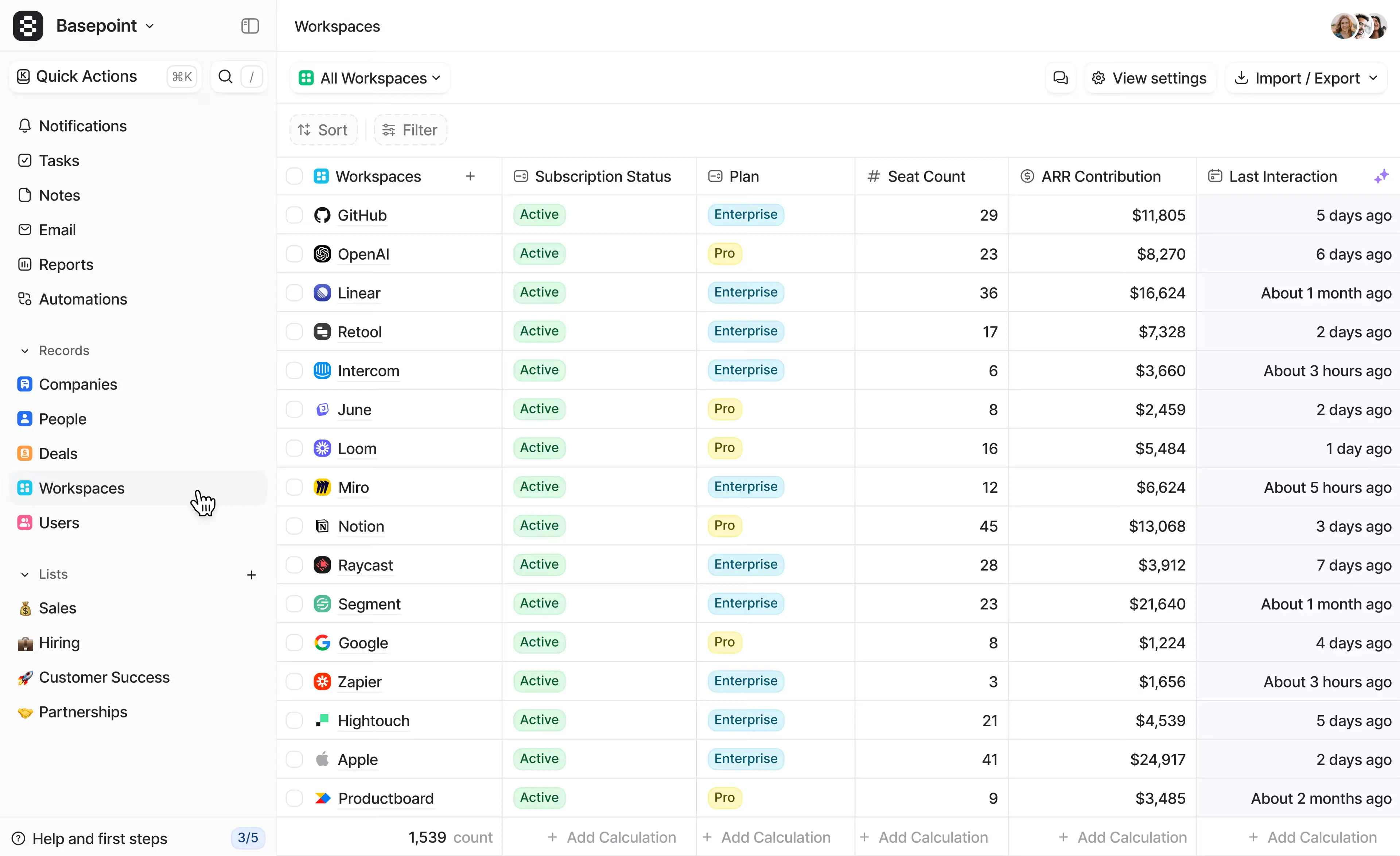
The difference that matters is that you decide what a record is. That Northwind account becomes an account, with its own fields and its own relationships to the deals underneath it, instead of a deal wearing a costume. Snackpass moved here from Salesforce and describes the result as freeing up a full-time position that had been maintaining the CRM. They tried HubSpot and Pipedrive first.
The AI sits in that same layer. You write a rubric in plain English and an AI attribute fills the field on every new record, so scoring runs on inbound whether or not anyone is watching. Attio is also the fastest-growing vendor in Ramp's CRM category, where Pipedrive is the fastest-shrinking one.
Bottom line: The $79 is a real premium over Pipedrive Growth and I would still pay it, for one reason: it is the only pick here that raises the ceiling instead of moving it. What decides whether that pays off is the model you build in week one. I have watched teams import their Pipedrive fields wholesale and rebuild the identical mess in a better interface, which is a fast way to spend a migration and change nothing. That first week is the Attio implementation work I do. The head-to-head is in Attio vs Pipedrive.
Score: Data model 3/5 · AI 4/5 · Startup fit 4/5
Best for: Teams where marketing owns as much of the funnel as sales does.
Pricing: Free (2 users), Starter, Professional $90 per seat/mo plus a one-time $1,500 onboarding fee, Enterprise custom (HubSpot).
Data model: Contacts, companies, deals. Custom objects in Sales Hub are Enterprise-only.
AI: Breeze agents, metered through credits priced separately from the seat.
The catch: Marketing Hub is a different product with its own bill.
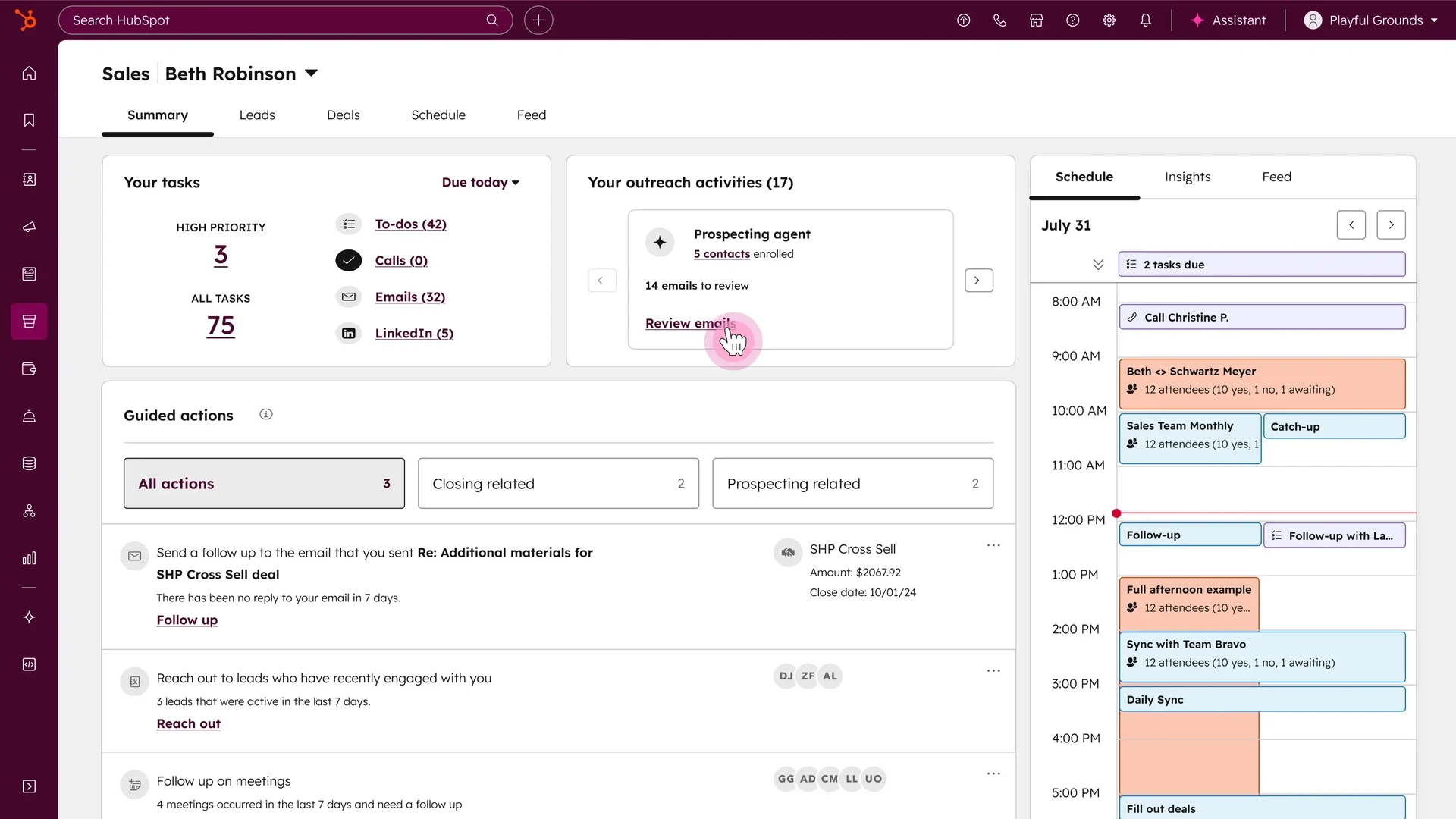
This is where most Pipedrive leavers land, and when the trigger is marketing it is the right call. Campaigns, forms, nurture and pipeline in one place, plus a free tier that is a real product rather than a trial in disguise. Nothing else here matches the integration library.
The teams I have seen regret it are the ones who moved for the data model and landed on Professional, where the object situation is the same as Pipedrive's with a bigger toolkit around it.
Bottom line: Watch the shape of the trap. If you are leaving because the data model would not bend, HubSpot's custom objects sit behind the Enterprise tier, which is sales-priced and a long way above what you are paying now. That is the same wall, repainted. Take HubSpot when inbound is the engine and your business really is contacts, companies and deals.
Score: Data model 2/5 · AI 4/5 · Startup fit 4/5
Best for: SDR-heavy teams where the number that matters is conversations per day.
Pricing: Solo $9, Essentials $35, Growth $99, Scale $139 per user/mo (annual). Calling is metered on top (Close).
Data model: Fixed and sales-shaped. A system of action rather than a system of record.
AI: Chloe, an AI sales agent, with monthly credits on every plan.
The catch: Wrong shape for product-led or account-based motions.
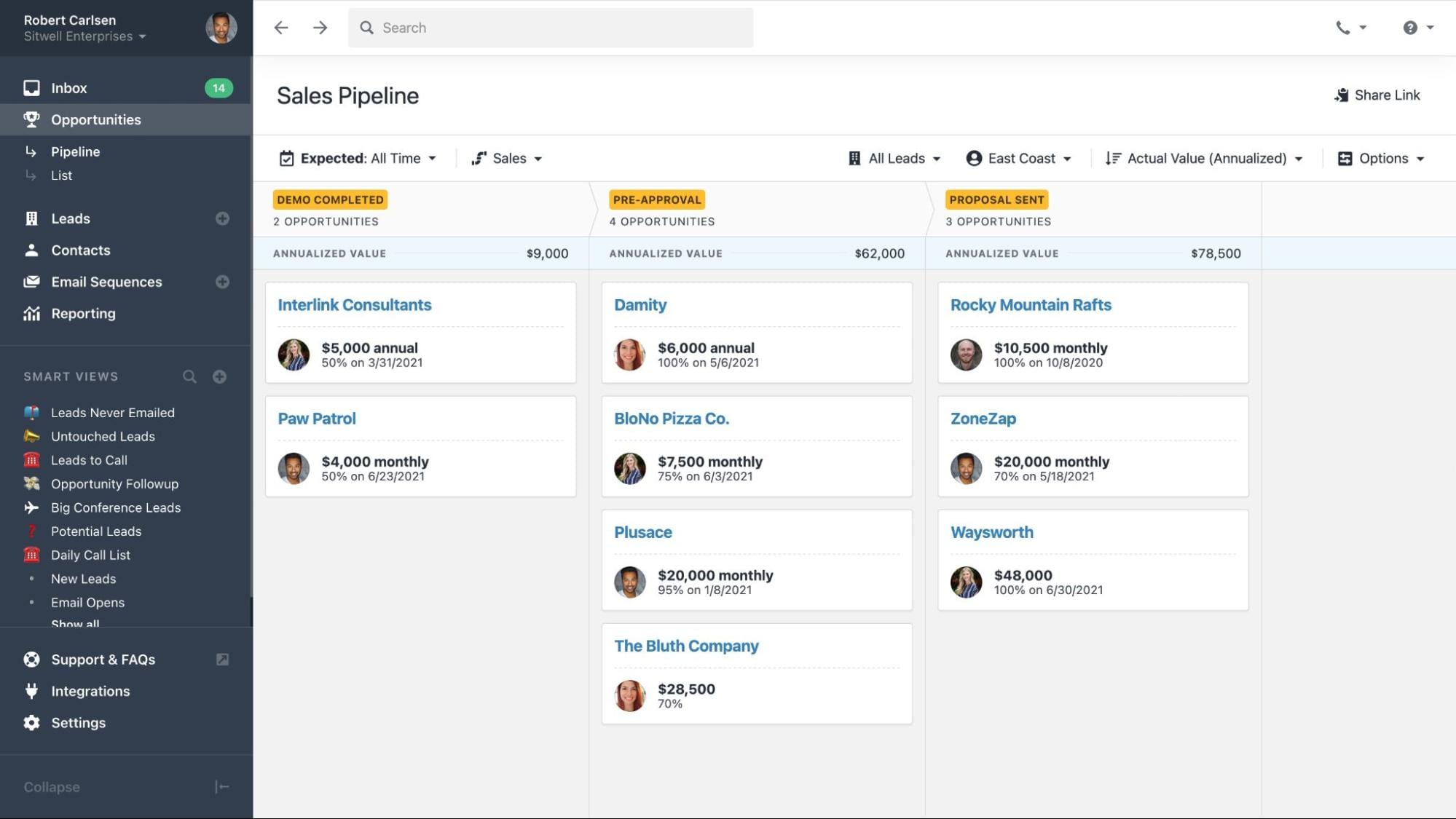
Calling, SMS, email and sequences are native rather than stitched in, which is the entire point for a team living on the phone. If your reps are currently paying for Pipedrive plus a dialer plus a sequencer, Close folds that into one bill and one interface, and it carries the highest G2 score on this page.
Bottom line: For five to twenty reps doing real call volume, Close wins on cost and wins by more on adoption, because reps stop tab-switching. Two things to know before you sign: metered calling means a heavy dialing team's invoice lands above the seat price and the object model is no better than the one you are leaving. Pick it for the motion, not for the flexibility.
Score: Data model 3/5 · AI 3/5 · Startup fit 4/5
Best for: Agencies, small funds and founder-led motions that run on network rather than process.
Pricing: Standard $24, Premium $48, Enterprise from $80 per member/mo (annual). 500 enrichment credits included on Standard (folk).
Data model: Light. Custom objects and deals need the Premium plan.
AI: Magic fields and assistants, plus a LinkedIn extension people actually use.
The catch: No free tier, and it stays light by design as you grow.
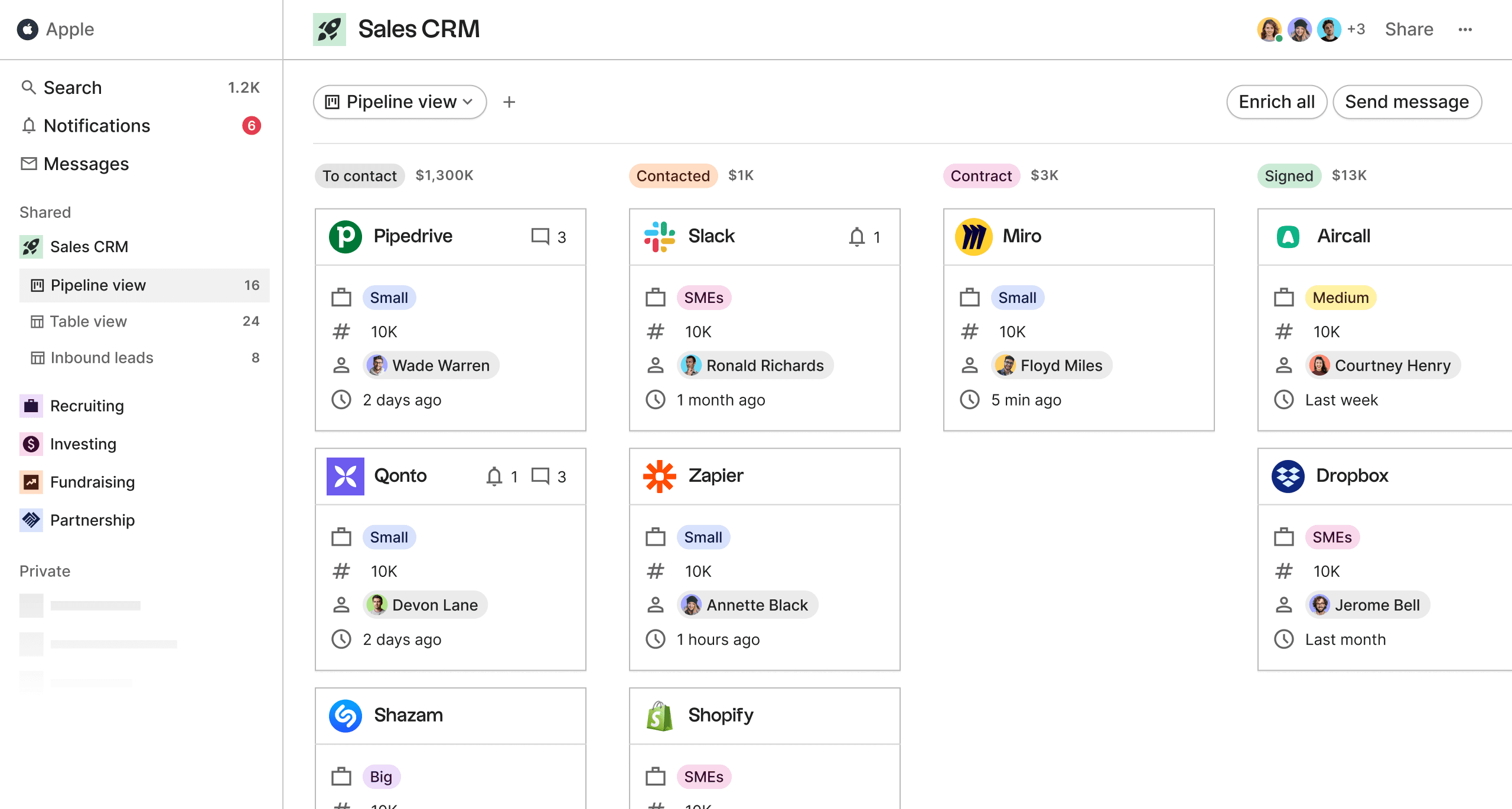
Most people leaving Pipedrive want more system. A real minority want less: fewer stages, less admin, something closer to a well-organised contact list that happens to have pipelines. folk is the best version of that, and the enrichment credits come bundled instead of sold back to you as an add-on.
Bottom line: The caveat you need, given where you are standing: folk is lighter than Pipedrive, not heavier. If you are leaving because the model would not stretch, this stretches less. It earns its place for the agency and deal-flow readers, and under about ten people with a relationship-driven motion it is the fastest thing here to get live. Where it runs out of room is the line we draw in Attio vs folk.
Score: Data model 4/5 · AI 4/5 · Startup fit 3/5
Best for: Cost-led teams that want the widest feature set per dollar.
Pricing: Free up to 3 users, Standard $14, Professional $23, Enterprise $40, Ultimate $52 per user/mo (annual) (Zoho).
Data model: Custom modules from Enterprise, which is real object-level customisation at $40.
AI: Zia for scoring and predictions, which starts at Enterprise.
The catch: A dense interface, and enough settings to configure that you will feel it.
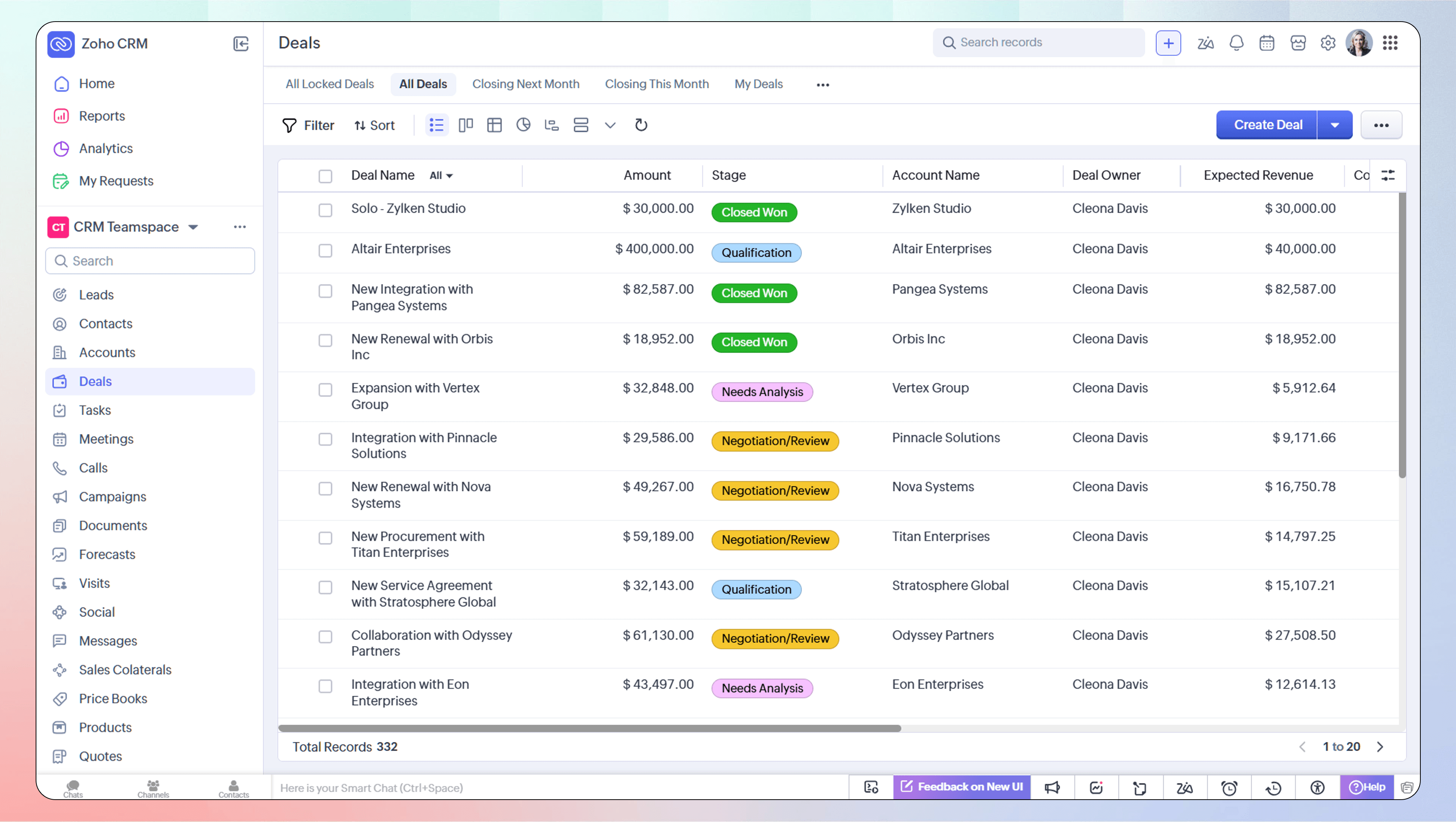
Pound for pound there is more software here than anywhere else on this page, and custom modules at $40 a seat undercut every other real object model on the list by half. It also carries one of the the lowest G2 score on this page and reading the reviews it is almost always the same complaint: everything takes too long.
Bottom line: Zoho is the cheapest honest route out of the object ceiling, and I include it for exactly that reason. The cost shows up as hours instead of dollars. If somebody on your team enjoys configuring software, the maths is hard to argue with. If you are five people and nobody wants that job, you will pay for it another way, and you left Pipedrive to stop working around your CRM.
Score: Data model 2/5 · AI 3/5 · Startup fit 3/5
Best for: Teams that live entirely in Gmail, Calendar and Drive.
Pricing: Basic $23, Professional $59, Business $99 per seat/mo (annual). Contact caps per tier (Copper).
Data model: Fixed entities with custom fields, plus contact limits the others do not impose.
AI: Light. Enrichment and basic automation rather than anything in the record layer.
The catch: Professional stops at 15,000 contacts.
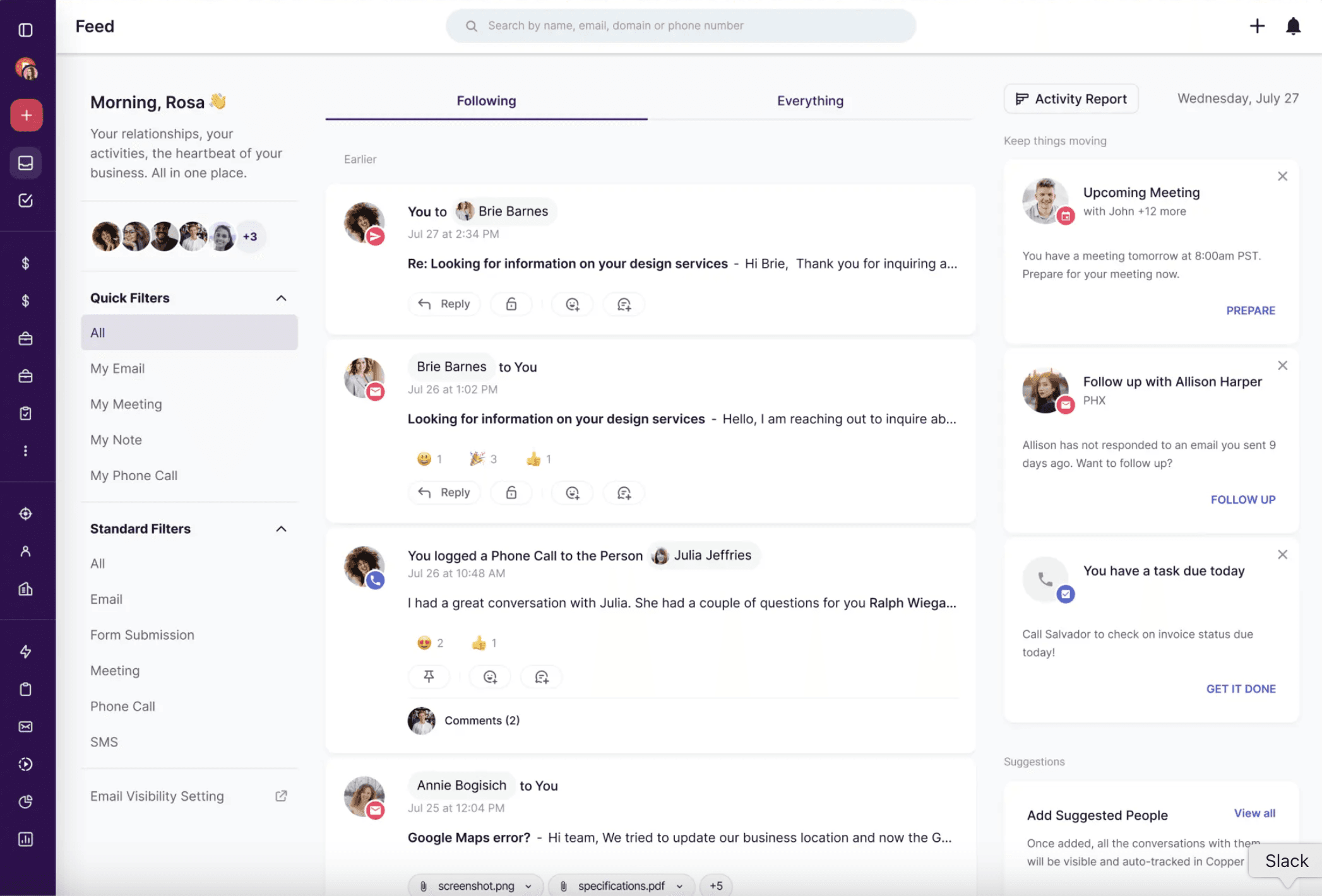
Copper is here for one reason: nothing else disappears into Google Workspace this completely. It runs as a Chrome extension over Gmail, so reps never really leave their inbox, and the adoption fight you were bracing for mostly does not happen.
Bottom line: A fair swap if your whole company runs on Google and you are under 15,000 contacts. Above that, Business is $99 a seat, more than Attio Pro for a much smaller data model, and you have bought yourself the same ceiling at a higher price. Pick it for the Gmail integration, and only if you can see that contact limit from where you stand.
Score: Data model 5/5 · AI 4/5 · Startup fit 2/5
Best for: Complex territories, strict compliance, an admin already on payroll.
Pricing: Starter Suite $25, Pro Suite $100, Enterprise $175, Unlimited $350, Agentforce 1 Sales $550 per user/mo (annual) (Salesforce).
Data model: Effectively unlimited, and it expects you to configure it.
AI: Conversation intelligence and Agentforce, gated to $175 and above.
The catch: The licence is the cheap half. Implementation runs five figures and a good admin is a salary.
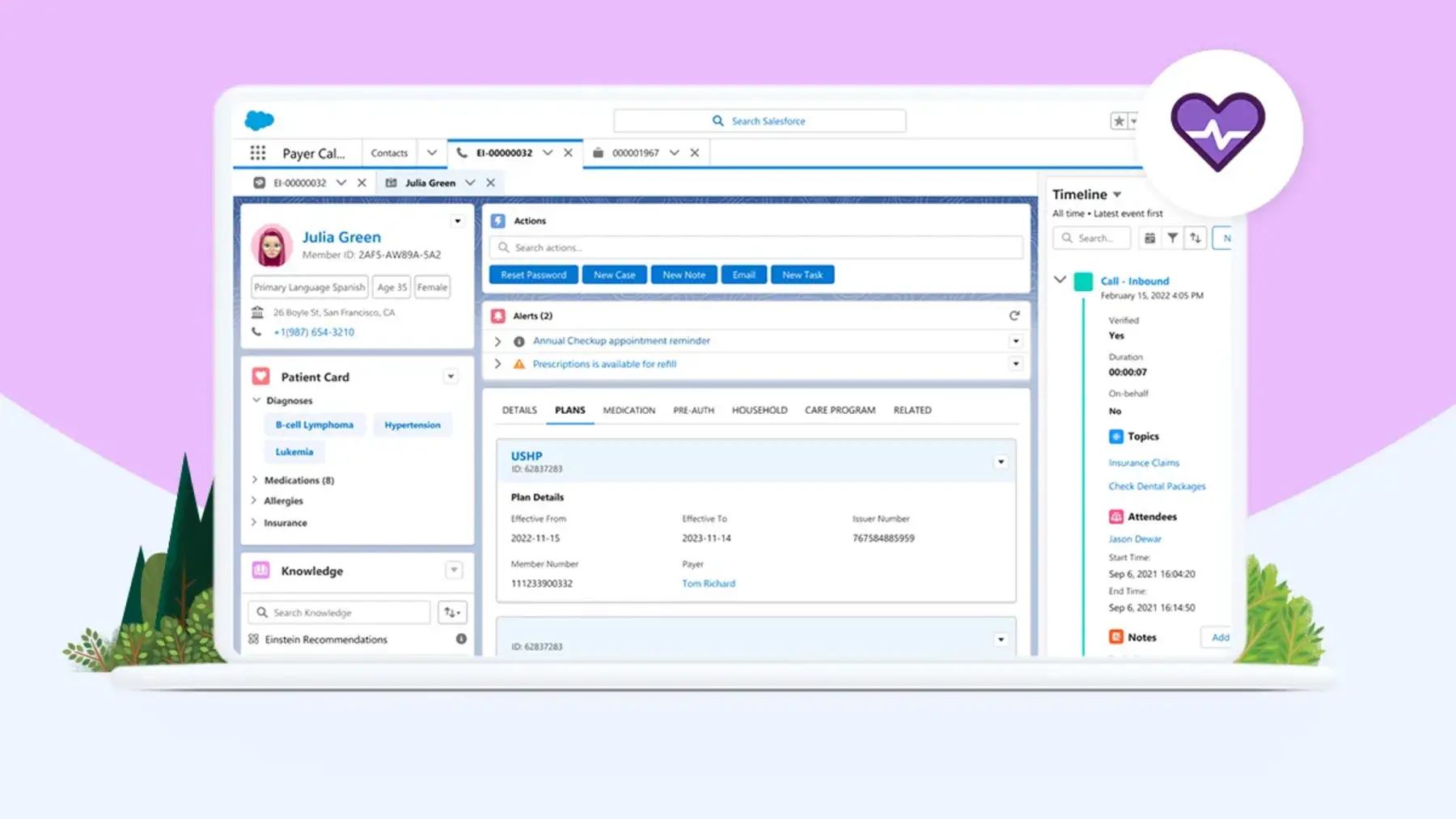
Salesforce is on this list because it is still the most-adopted CRM in Ramp's data at 76%, and leaving it out would tell you I was only counting tools that flatter my argument. The data model is the best on this page, without qualification.
Bottom line: For the team this post is written for, it is the wrong direction. You are leaving Pipedrive because a simple CRM could not hold your business, and the fix for that is not a system that needs a specialist you have not hired. Ten seats on Enterprise is $21,000 a year before anyone configures anything. Pick it when compliance or real enterprise complexity has already decided for you, and pick something above when it has not. We made the full case in Salesforce alternatives.
Before the numbers, the tier question, because getting this wrong is how most of these comparisons end up meaningless.
Pipedrive Growth at $39 is not a parity match for Attio Pro. The five add-ons above are the gap, and they run $1,624 a year on top of the seats. Attio Pro includes custom objects, call intelligence, sequences, workflows, AI agents and full API access in the seat price.
Here is year one at ten seats, with the add-on stack counted where it belongs.
Cost line (10 seats, year 1) | Pipedrive Growth | HubSpot Pro | Attio Pro |
|---|---|---|---|
Licences | $4,680 | $10,800 | $9,480 |
Add-ons to reach parity | $1,624 | $0 | $0 |
Onboarding | $0 | $1,500 | $0 |
Year-one total | $6,304 | $12,300 | $9,480 |
Now the part I am not going to dress up. Attio costs more.
Seats | Pipedrive Growth + add-ons | Attio Pro | Year-one difference |
|---|---|---|---|
5 | $3,964 | $4,740 | +$776 |
10 | $6,304 | $9,480 | +$3,176 |
20 | $10,984 | $18,960 | +$7,976 |
At ten seats that is $3,176 a year, about $265 a month, roughly one more seat's worth of software. Most comparisons stop here and hand it to Pipedrive.
Price that $265 against the afternoon somebody asks for revenue by account type and gets a CSV and a shrug. Against the spreadsheet nobody owns. Against the fourteen fields on a deal that is not a deal. It starts looking cheap.
And run it the other way, because it changes the conclusion for a chunk of readers. If you are already on Pipedrive Ultimate at $79, ten seats is $9,480 a year. Attio Pro at ten seats is $9,480 a year. The same number, to the dollar. At the top of Pipedrive's range the switch costs nothing at all and the object ceiling disappears, which is why Ultimate customers are the easiest migrations we run.
Two caveats I would rather give you than have you find. The add-on figures are starting prices, so treat $1,624 as a floor. And check every price yourself before you buy, because Pipedrive and Attio both repackaged their tiers this year and most comparison articles are still quoting lineups that no longer exist.
Leaving a system that fits you is its own expensive mistake, so here are the three cases where I would tell you to stay.
Your motion really is linear. One product, one cycle, deals that are actually deals. If nothing in your business needs to be a record except a company, a person and an opportunity, extra capability is a tax. Pipedrive scores a 4 on fit for a reason.
Speed of setup is the deciding factor. Five people can have Pipedrive configured and adopted before lunch. Attio, Zoho and Salesforce all ask you to make decisions about your data model first. That is money well spent when the model matters and pure drag when it does not.
Lite at $14 is the cheapest working pipeline here. A real CRM with a real pipeline for less than a team lunch, with no paywall three clicks in. For two founders selling one thing, it is hard to beat and nothing on this list beats it.
The teams who should move are the ones already faking an object with custom fields, already keeping the real numbers in a spreadsheet, or already buying three add-ons to get back features they thought they had bought.
The data transfer is the easy part, and it is the only part anyone worries about. Import2 is free on Attio paid plans and pulls contacts, organizations, deals and history straight across. Most others have something similar. That is a weekend.
Here is what actually goes wrong.
You copy the model. Export Pipedrive, import Pipedrive. Now you own the same fourteen custom fields in a product that supports objects, and you have paid for a migration that changed the typography. Decide what your objects should be before anything moves. This is the whole job.
Activity history is the fragile part. Deals and contacts land cleanly. Notes, calls and email threads attached to records are where the gaps open up, and you find them a month later when somebody asks what was agreed on a call in March.
Automations do not port. Any of them. Every workflow gets rebuilt by hand, and the add-ons you were renting have no equivalent to import. Budget for it, and treat it as the chance to delete the half nobody remembers writing.
A clean import of a workaround just gives you a tidy-looking workaround. Doing it as a redesign is what makes the switch worth the disruption, and it is the GTM systems work I do with teams making this move.
Attio is my pick for a startup leaving Pipedrive, because almost everybody leaving Pipedrive is leaving for the same reason: the business got more interesting than the data model. Everything else here wins a narrower lane, and winning a narrow lane properly is worth more than being adequate at everything.
Your situation | Best pick |
|---|---|
Faking an object with custom fields | Attio |
Already paying for Pipedrive Ultimate | Attio, at identical cost |
Marketing owns half the funnel | HubSpot |
High-volume outbound with calls and SMS | Close |
Agency, small fund, or relationship-led | folk |
Cost is the deciding constraint | Zoho |
The whole company runs on Google Workspace | Copper |
Regulated, or big enough to need it | Salesforce |
Linear motion, one product, small team | Stay on Pipedrive |
Whichever way you go, price the workarounds before you price the seats. The spreadsheet next to the CRM is a cost, the day-long export is a cost, and neither appears in any comparison table including the ones above. If you are weighing the wider category rather than just the exit, start with our best CRM for startups breakdown.
For most B2B startups, Attio. It costs the same $79 per seat as Pipedrive Ultimate but supports custom objects, which Pipedrive does not at any tier. HubSpot is better if you need a free plan or marketing automation, and Close is better for teams doing high-volume outbound calling.
Two stand out. The data model is capped at six fixed entities with custom fields, so anything that is not a deal has to be faked. And core features are sold as add-ons: LeadBooster, Campaigns, Projects, Web Visitors and Smart Docs together start at $135.33 a month on top of your seats.
Yes. Pipedrive has no free plan, only a 14-day trial. HubSpot's free CRM covers up to 2 users, Zoho CRM is free for up to 3, and Attio is free for up to 3 seats. Attio's free tier is the most capable of the three for a small B2B sales team.
Twenty, EspoCRM and Odoo CRM are the usual open-source options, and all three are free to self-host. The cost moves rather than disappears: you take on hosting, updates, security and integration work. For most funded startups the seat fee is cheaper than the engineering time.
The recurring complaint in r/CRM threads is per-feature upcharging rather than the product itself. Recommendations skew toward HubSpot for teams wanting a free tier, Close for outbound, and increasingly Attio for startups that need a flexible data model.
The licence difference is knowable: ten seats on Attio Pro is $9,480 a year against $4,680 on Pipedrive Growth, or exactly the same if you are on Ultimate. The real cost is the rebuild. Mapping custom fields to objects and recreating automations is typically two to four weeks of work for a team of ten.
Sparsh Gupta, Founder of Automation Jinn and an Official Attio Expert Partner, helps seed to Series B startups leave Pipedrive without inheriting the same ceiling somewhere else, rebuilding the data model and workflows so the new CRM earns its place. If you want your objects designed before you migrate rather than after, book a discovery call.