Lead Qualification (2026): A Process Sales Actually Trusts


•
•
Lead qualification is the process of deciding which leads are worth a rep’s time, using criteria both marketing and sales agreed on in advance. Most of it fails for one reason: fit and intent get added together into a single score, and a single score cannot tell a rep whether they are looking at a perfect-fit company doing nothing or a student reading your pricing page for the fourth time.
Split those two numbers and almost everything else falls into place. This guide covers what qualification actually is, the exact thresholds I use with seed to Series B B2B SaaS teams, why sales rejects leads marketing swears are qualified, and how to wire the whole thing into the CRM you already run.
Lead qualification is a decision. Lead scoring is a measurement. They get used interchangeably and they are not the same job.
Scoring runs continuously in the background, assigning numbers to every record based on who someone is and what they do. Qualification is the moment you draw a line and say this one goes to sales, that one goes back to nurture, this third one never hears from us again. Scoring produces a ranking. Qualification produces a yes or a no.
Lead scoring | Lead qualification | |
|---|---|---|
Output | A number | A yes or no decision |
Runs | Continuously | At defined handoff points |
Owned by | Marketing and RevOps | Both teams, jointly |
Fails when | Weights go stale | Criteria were never written down |
The practical consequence: you can have excellent scoring and terrible qualification. If nobody has agreed what score means “call this person,” the number is just decoration. That agreement, written down and enforced in the CRM, is the actual deliverable.
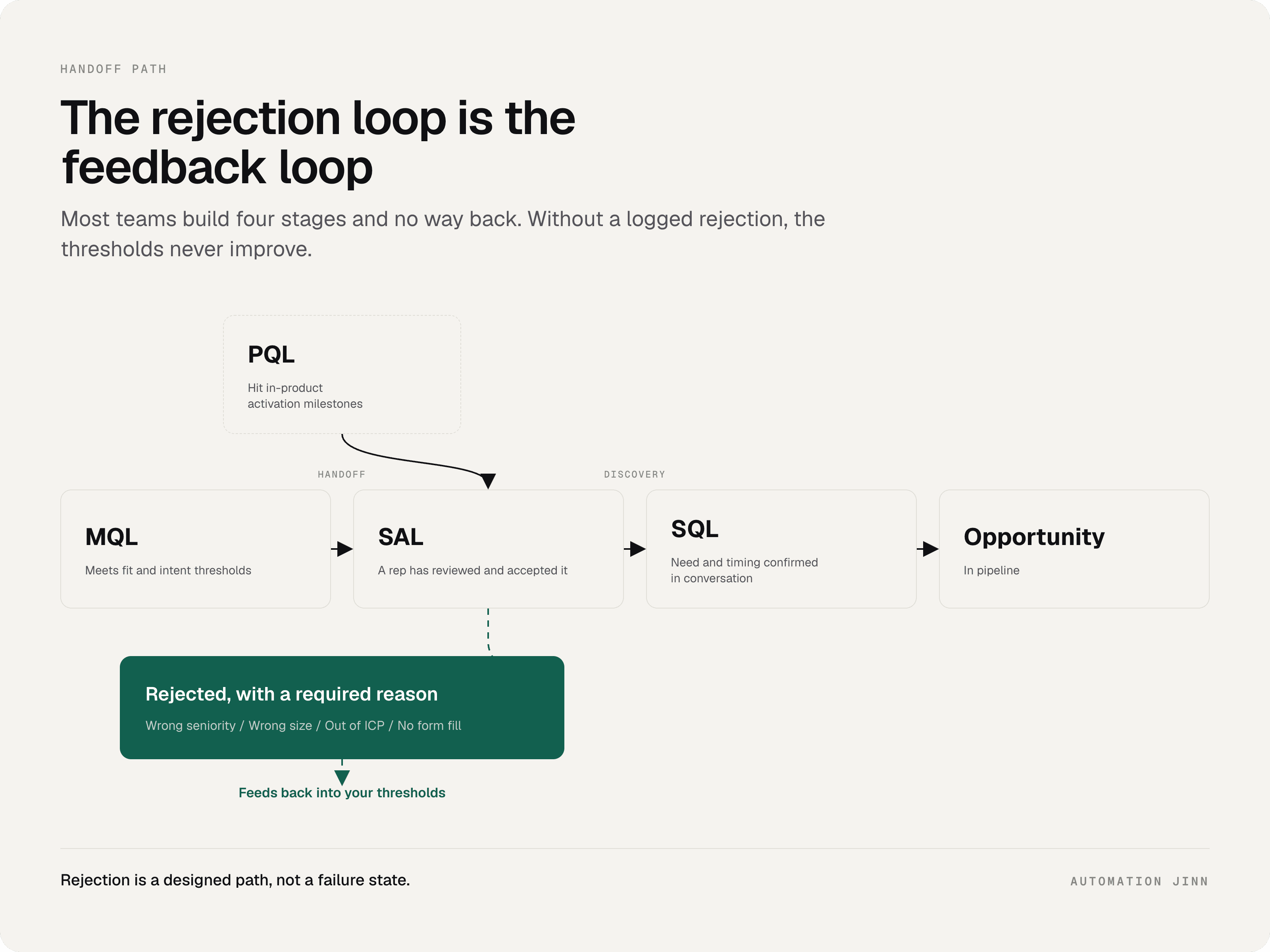
Most teams define two stages and then argue about everything in between. Four is the right number for seed to Series B, and each one needs an owner and an exit condition.
Stage | What it means | Exit condition |
|---|---|---|
MQL | Meets fit and intent thresholds | Passed to sales for review |
SAL | A rep has looked at it and accepted it | Rep starts working it |
SQL | Rep confirmed need and timing in conversation | Opportunity created |
PQL | Hit activation milestones in-product | Routed on usage, not forms |
The stage everyone skips is SAL, the sales-accepted lead. It exists so a rep can reject a lead without it silently vanishing. Without a rejection step you have no feedback loop, and without a feedback loop your thresholds never improve. Make rejection a logged action with a required reason, not a lead someone quietly ignores.
Here is the part page one leaves out. Every guide tells you to score on fit and behaviour. None of them publish numbers. These are the defaults I start from for a seed to Series B B2B SaaS team selling a $10k to $60k ACV product, and they are meant to be edited, not copied blind.
Fit is scored separately from intent. Never sum them.
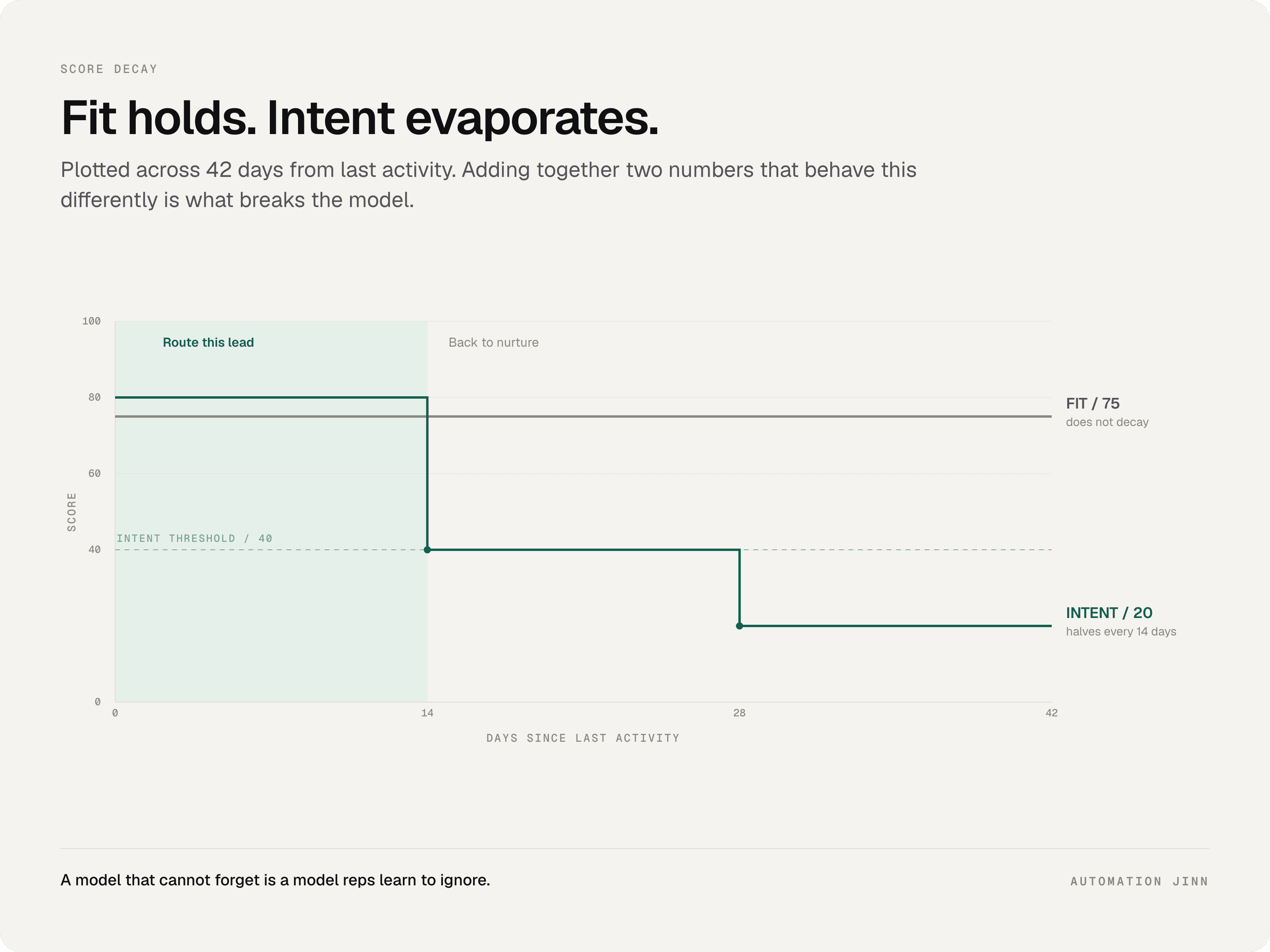
Fit answers one question: if this person bought, would they be a good customer? It changes slowly and it does not decay.
Signal | Points |
|---|---|
Headcount 50 to 500 | +25 |
Headcount 20 to 49, or 501 to 1,000 | +12 |
Title on the buying committee (VP, Head, Director of Sales, RevOps, Growth) | +25 |
C-level at under 200 headcount | +25 |
Individual contributor in a relevant function | +10 |
Industry is B2B SaaS | +20 |
Runs a CRM you integrate with | +15 |
Raised funding in the last 18 months | +15 |
Cap the total at 100. Fit of 60 or above means the account is in your ICP.
Intent answers a different question: are they looking right now? It is volatile and it must decay.
Signal | Points |
|---|---|
Booked a demo or submitted a contact-sales form | +50 |
Pricing page, 2 or more visits in 7 days | +25 |
Pricing page, single visit | +10 |
Product or feature pages, 3 or more visits | +15 |
Downloaded a case study or ROI content | +12 |
Attended a webinar (attended, not registered) | +12 |
Replied to an email | +15 |
Returned within 48 hours of a first session | +10 |
Intent of 40 or above means they are actively evaluating. Halve the intent score after 14 days with no activity, and halve it again after another 14. A lead who read your pricing page in March is not a hot lead in June, and a model that cannot forget is a model reps learn to ignore.
Note what scores highest on each axis. On fit it is title and headcount, not industry. On intent it is a reply or a booked meeting, not an email open. Opens and clicks are absent from this table on purpose: they are noisy, easily triggered by security scanners, and they inflate scores without predicting anything.
These are not negative points. Negative points let a strong signal elsewhere cancel them out, which is exactly what you do not want. These are hard exclusions.
A free email domain on a B2B form
Headcount under 10 or over 5,000, outside what you can serve
Student, intern, or job-seeker titles
A competitor domain
A country you cannot sell into or support
Careers page as the primary page viewed
Two axes give you four quadrants, and every quadrant has a different action. This is the whole point of not summing them.
Intent under 40 | Intent 40 or above | |
|---|---|---|
Fit 60 or above | Nurture, marketing keeps ownership | Route to a rep now |
Fit under 60 | Disqualify or long-cycle nurture | Point at self-serve, no rep |
The bottom-right quadrant is the one that saves the most rep hours. High intent with low fit looks exciting on a dashboard and converts badly. Sending those to a rep is how you teach your team that the score means nothing.

Pull your last 50 closed-won deals and your last 50 closed-lost. For each signal above, check how often it appeared in each group. Signals that show up in most wins and few losses earn more points. Signals that appear evenly in both are noise, whatever your instinct says. Most teams discover that one or two of their favourite criteria have no predictive value at all, and cutting them improves the model more than adding anything new.
This is where qualification actually breaks, and it is not usually a scoring problem.
When RollWorks surveyed 527 salespeople and 323 marketers, the top reasons reps rejected leads were that the lead did not fit target account criteria (industry, company size, revenue) and did not fit target individual criteria (role, seniority). Both are fit failures, and both are knowable before the lead is ever sent. The interesting finding is the third reason: reps also reject leads that never filled out a content form, and marketers in the same study underestimated how much that mattered. Reps want evidence of a deliberate action, not an inferred signal.
That maps directly onto the grid above. Fit failures are the top two rejection reasons, which is the argument for a hard ICP gate before anything reaches a rep. And the form-fill finding is why a submitted form scores +50 on intent while a page view scores +10.
The buying context makes the gate more important, not less. Gartner’s research on the B2B buying journey puts a typical buying group at six to ten stakeholders, with buyers spending only 17% of their time meeting potential suppliers. A March 2026 Gartner survey of 646 buyers found 67% now prefer a rep-free experience. Rep attention is the scarcest thing you have. Spending it on a lead that fails a headcount check is the most expensive mistake in the funnel.
Frameworks structure the conversation after a lead reaches a rep. They do not replace the scoring above, they sit downstream of it. Most guides list seven and recommend none, so here is the short version.
Framework | Use when | Skip when |
|---|---|---|
BANT | High inbound volume, short cycles | Asking budget before need kills the call |
CHAMP | Buyers are early and need educating | You need budget confirmed fast |
MEDDIC / MEDDPICC | ACV above roughly $50k, many stakeholders | Two-call transactional deals |
GPCTBA/C&I | Senior, strategic discovery | Reps have 15 minutes |
SPICED | Consultative, expansion-heavy motions | You need a hard qualify or disqualify gate |
BANT is the oldest of these, developed inside IBM, and its weakness is structural rather than fashionable: it leads with budget, and in most modern B2B deals budget gets allocated after need is proven. MEDDIC is the opposite end. It was created at PTC in 1996 by Dick Dunkel and Jack Napoli under SVP John McMahon, built specifically for complex multi-stakeholder deals, and it asks for far more per opportunity than a $12k ACV motion can justify.
Pick one and put it in the CRM as required fields on the opportunity. A framework that lives in a Notion doc is a framework nobody uses. A framework that lives as four dropdowns a rep fills before advancing a stage is a framework you can report on.
Almost none of this needs a new CRM. It needs three things your current one can already do.
One, computed fields rather than raw ones. Store fit_score, intent_score, and icp_tier as their own fields, calculated once. Every downstream rule reads those instead of re-deriving headcount bands and title matches. When your ICP changes, you edit one calculation instead of hunting through nine workflows.
Two, a rejection path with a required reason. Sales-accepted and sales-rejected need to be real, logged states with a mandatory reason picklist. That picklist becomes your tuning data. If forty percent of rejections say “wrong seniority,” your title weights are wrong and you now have proof.
Three, decay that actually runs. Intent scores need a scheduled job that halves them on a fourteen-day timer. This is the piece most teams never build, and it is why so many scoring models drift into uselessness within two quarters.
HubSpot, Salesforce, Attio, and Pipedrive can all do this. The constraint is rarely the platform, it is that qualification logic ends up spread across a form, a marketing automation rule, three workflows, and a rep’s memory, with no single place that answers “why was this lead qualified?” Consolidating that into computed fields and a documented threshold is the bulk of what a RevOps and GTM systems engagement actually delivers, and it happens inside the CRM you already have. If your data model cannot answer “which ICP tier is this account” in one field, fix that before you touch the scoring rules, the same sequencing any CRM implementation follows: model first, then fields, then automation.
Qualification also has to hand off cleanly. A lead that clears your thresholds and then sits unassigned has not been qualified, it has been filed. The rules that decide who picks it up are a separate system with its own failure modes, and it is worth building both together rather than discovering the gap after a deal goes missing.
Two situations where everything above is overhead.
Under roughly 20 inbound leads a month. A founder can read twenty leads personally and will do it better than any model. Build the ICP definition, skip the scoring engine, revisit when volume makes reading each one impractical.
Founder-led sales with a still-moving ICP. If you are changing who you sell to every quarter, a scoring model trained on last quarter’s wins encodes a target you have already abandoned. Write down the disqualifiers, which stay stable, and hold off on the point weights until the ICP settles.
In both cases the disqualifier list is still worth building on day one. It is five rules, it never goes stale, and it stops the worst leads without pretending to be a model.
Do not launch a new threshold on live traffic. Run it backwards first.
Take last quarter’s closed-won deals and score them with the rubric as it stands. If a meaningful share of the deals you actually won would have failed your MQL threshold, the threshold is wrong, not the deals. Then score last quarter’s closed-lost and disqualified leads. If most of them would have passed, your gate is too loose to be doing anything.
Once it is live, review three numbers monthly: the sales-acceptance rate on leads you route, the rejection reasons breakdown, and the share of closed-won deals that entered as MQLs. The first tells you whether reps trust the gate. The second tells you which weight to change. The third tells you whether qualification is aligned with revenue or just with activity.
Re-run the backward test every quarter, and any time you change pricing, packaging, or target segment. Qualification is not a project you finish. It is a model with a maintenance cost, and the teams whose reps trust the handoff are the ones who pay it.
Lead qualification is the process of evaluating whether a lead is worth a sales rep’s time, based on criteria marketing and sales agreed on in advance. It combines fit, meaning whether the account matches your ideal customer profile, with intent, meaning whether they are actively evaluating a purchase right now.
You need four things: a written ICP definition, a fit threshold, an intent threshold, and a rejection path. Without the rejection path there is no feedback, and without feedback the thresholds never improve. Frameworks like BANT or MEDDIC structure the conversation afterwards, they do not replace the thresholds.
Fit criteria are headcount, job title and seniority, industry, technology stack, and funding recency. Intent criteria are demo requests, repeat pricing page visits, email replies, and content downloads. Score them separately. Disqualifiers such as free email domains and out-of-range headcount should exclude a lead outright rather than subtract points.
Scoring assigns numbers to fit and behaviour continuously. Qualification uses those numbers to make a yes or no routing decision at a defined handoff point. Scoring is the measurement, qualification is the decision. A team can have accurate scoring and still fail at qualification if nobody agreed what score means “call this person.”
Company size against your serviceable range, job title against your buying committee, a recent deliberate action such as a form fill or demo request, budget or ability to pay at your price point, and a real timeline. Missing any of the first three usually means the lead is not ready for a rep.
Your CRM will almost certainly do it. HubSpot, Salesforce, Attio, and Pipedrive all support computed fields, thresholds, and scheduled score decay. Dedicated tools earn their cost at high inbound volume or when you need identity resolution across anonymous traffic. Fix the data model first, since most qualification problems are field problems.
Sparsh Gupta, Founder of Automation Jinn, helps B2B SaaS teams build GTM systems that qualify, route, and follow up without anyone babysitting them. If you want your MQL definition rewritten, agreed by both teams, and wired into the CRM you already run, book a discovery call.


