AI Implementation Consultant (2026): What They Do and When to Hire One


•
•
An AI implementation consultant builds and ships the AI systems your business runs on. Not a strategy deck, not a pilot that dies in a sandbox. They pick which workflows are worth automating, build them inside the tools you already own, and get them into production. You hire one when you have a repetitive, expensive process and nobody free to own it.
Here is the part most articles on this topic will not tell you. AI implementation is rarely an AI problem. Buying AI is not the work. The work is retiring the operational debt underneath it: the processes nobody wrote down, the tool you bent your workflow to fit, the data three teams quietly disagree about. Once you see that, it changes who you should hire and what you should ask them.
Nobody wakes up wanting an AI implementation consultant. They want one of these four things to stop happening.
Your best operator is your documentation. How the work actually gets done lives in one or two people’s heads. When they are on holiday, things stall. When they leave, you rebuild from memory.
You bent your process to fit your tools. Somewhere you stopped asking what the right workflow was and started asking what the CRM would allow. Every new hire gets an apology and a workaround on day one.
Your automations are archaeology. A Zap someone built in 2024 that nobody dares turn off. A spreadsheet feeding a report feeding a decision, maintained by a person who has since changed roles.
Every number comes with a caveat. Revenue in one system, usage in another, tickets in a third. Anyone who wants the full picture assembles it by hand, and it is stale before the meeting starts.
If two or more landed, you do not have an AI problem. You have an operations problem that AI is now good enough to fix, which is a different and much more solvable thing.
MIT’s Project NANDA reviewed over 300 publicly disclosed AI initiatives and found that roughly 95% of enterprise generative AI pilots produced no measurable P&L impact. Gartner predicts that more than 40% of agentic AI projects will be cancelled by the end of 2027.
Both get quoted as proof that AI is overhyped. I read them differently. Look at what actually goes wrong and it is almost never the model.
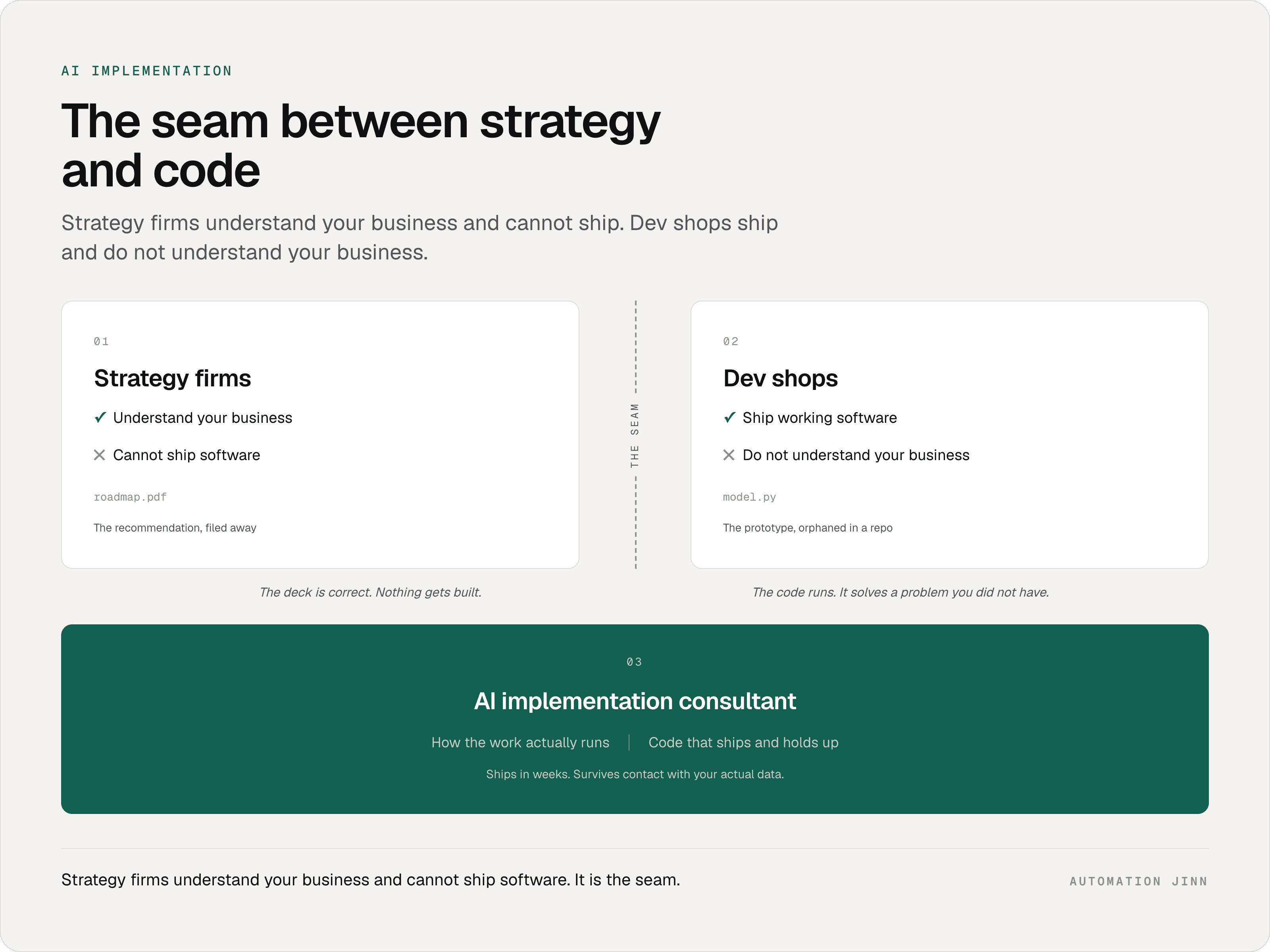
It is the seam. Strategy firms understand your business and cannot ship software. Dev shops ship software and do not understand your business. Most AI work falls into the gap, where either the deck is correct and nothing gets built, or the code runs beautifully and solves a problem you did not have.
What people blame | What usually broke |
|---|---|
The model was not good enough | The process was never defined |
The technology was not mature | The data underneath it was wrong |
Users resisted the change | Nobody owned the output |
We were too ambitious | The scope was never written down |
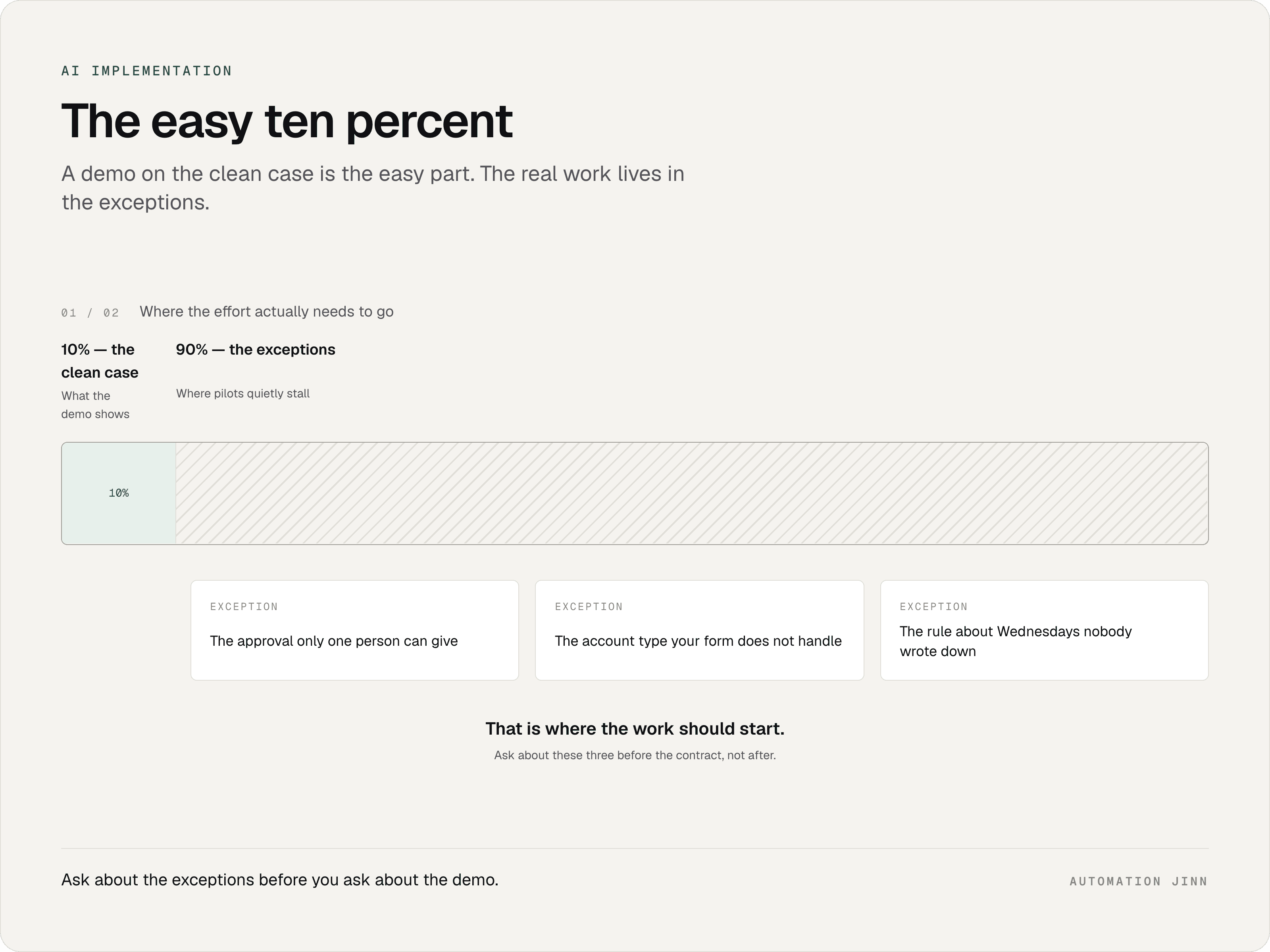
There is a second seam, further in. A demo on the clean case is the easy ten percent. Real work is exceptions: the approval only one person can give, the account type your form does not handle, the rule about Wednesdays that nobody wrote down. That is where pilots quietly stall, which means it is where the work should start.
None of that needs a data scientist. Which is the most useful thing to know walking into a hiring conversation: you are not shopping for AI expertise. You are shopping for someone who will make you answer uncomfortable questions about your own operations before they build anything.
The consultants worth paying are the ones who slow you down at the start.
They take AI from decision to production: audit your workflows to find where AI pays back, design the system, build it inside your existing stack, and stay on to fix it when reality disagrees with the plan.
Three separate roles get sold under this one banner, priced roughly the same.
Strategy consultant | Implementation consultant | Transformation partner | |
|---|---|---|---|
Deliverable | Roadmap and business case | Working system in production | A compounding programme |
Ends when | The deck is presented | The workflow runs without you | It does not; it renews |
Fails when | Nobody builds it | The system breaks in month three | Build two costs as much as build one |
Ask them for | Prioritisation and buy-in | A live demo on your own data | What they would refuse to build |
Underneath the labels, AI implementation services bundle roughly the same six components. Knowing the parts makes proposals comparable, which is exactly why vendors avoid itemising them.
Component | What it means | Typical duration |
|---|---|---|
Workflow audit | Finding which processes justify AI, and which do not | 1-2 weeks |
Data and systems cleanup | Making your CRM trustworthy enough to build on | 2-4 weeks |
Agent and automation build | The working system, inside tools you already own | 2-6 weeks |
Integration and API work | Connecting tools with no native connector | 1-3 weeks |
Reporting | Measuring whether the thing actually worked | 1-2 weeks |
Run and expand | Monitoring, fixing, adding the next workflow | Ongoing |
The first two get skipped constantly. The audit goes because it feels like paying someone to tell you what you already know. The cleanup goes because nobody wants to hear that their CRM is the actual problem. Skip either and you get a system that works in the demo and produces confident nonsense in production.
Most failed AI projects start at the build. If a proposal opens there, ask what it is based on.
Generic advice is useless here, so here are the specific ones. For seed to Series B B2B teams, these six come up again and again.
Workflow | What it kills | Hours I usually see reclaimed |
|---|---|---|
Inbound lead research and CRM entry | Manual enrichment, copy-paste, slow follow-up | 8-15 per week |
Meeting notes to owned tasks | Recaps written twice, action items lost after calls | 5-10 per week |
Quote and document generation | Rebuilding the same document from scratch | 4-8 per week |
Reporting that reconciles itself | Weekly spreadsheet assembly nobody trusts | 6-12 per week |
Incident and issue logging | Reconstructing what went wrong from Slack scrollback | 3-6 per week |
Renewal and churn-risk flags | Surprise cancellations, reactive saves | Revenue, not hours |
Those ranges are what I see across engagements, not a published benchmark. The pattern that holds is the shape: high frequency, low judgement, currently done by someone expensive. That is where AI agents and automation pay back in weeks rather than quarters.
The workflows that look most exciting are usually the worst first choice. Customer-facing AI, anything touching pricing, anything where a wrong answer is expensive and public. Those come later, once the plumbing exists and the team trusts it.
Market rates vary more than sixfold. Independents and boutique specialists sit in the low hundreds per hour, mid-tier firms a few hundred, Big Four and MBB partners past a thousand for the same calendar hour. Much of what you buy at the top end is institutional credibility rather than engineering.
I do not think hourly is the right way to buy implementation work at all. You are not buying hours, you are buying a system that runs. Hourly also puts you and your consultant on opposite sides of the same incentive, where every hour of their inefficiency lands on your invoice.
We scope fixed instead, and there is no wrong place to start.
Start with | Typical range | What you get |
|---|---|---|
A single system | $5,000-$8,000 | One system, end to end, in production |
A multi connected systems | $8,000-$15,000 | Several systems sharing clean data |
A whole function | $20,000+ | Agents, systems and reporting, sequenced |
Ongoing work runs separately, on a fractional retainer for teams who want a continuous build partner rather than a defined project. None of this is the cheapest number you will find. Cheap implementation is the most expensive kind, because you pay for it twice.
Every hour someone spends being the integration between two systems is a tax. Copying a number out of one tool into another. Chasing an approval. Reformatting a report so somebody else can read it. Each instance is trivial. Together they are one of the largest uncosted line items in your business.
Calculate your ROI below-
So measure it. Hours per week across everyone who touches the process, times loaded hourly cost, times 52. Loaded cost means salary plus the standard 1.25-1.4x employer burden divided by 2,080, not the number on the offer letter. Be generous with the hours; people underestimate their own by roughly half.
Worked through: three people spending five hours a week each on lead research and CRM entry, at $75 loaded, is 15 hours a week. That is $58,500 a year on one process, before the deals lost to slow follow-up. A $5,000 build pays that back in under five weeks and keeps paying every year after.
Run this before you speak to anyone, including me. Under about $10,000 a year, do not hire a consultant; buy a template and wire it up yourself. Past $50,000, the question stops being whether to hire and becomes who. And if three or four workflows each clear that bar, you are not looking at a project. You are looking at a transformation programme, which is a different budget and a different conversation.
All four are legitimate. They fail in different ways, which is the part worth knowing before you choose.
Route | Best when | The failure mode |
|---|---|---|
DIY with templates | The workflow is worth under $10k a year | It becomes someone’s unofficial second job |
Freelancer or marketplace | One defined task, you manage delivery | Single point of failure, nobody owns the outcome |
Implementation partner | Connected workflows, no internal AI capacity | Scope creep if build one is loosely defined |
Large consultancy | Board mandate or a regulated programme | You end up owning a deck, not a system |
Hire when you can describe the workflow in one sentence and it costs real money. “Every inbound lead gets manually researched and typed into the CRM.” That is scoped, buildable, measurable. “We should use AI more” is not.
Hire when your team already tried and it half works. Someone built a Zap, it runs, and it breaks quietly every few weeks. Rescuing a half-built system is usually faster than starting over.
Hire when your data lives in five places and none of them agree. AI on a broken data model produces confident nonsense at speed. This is why GTM systems work and AI work turn out to be the same project more often than anyone expects.
Now the other side, which matters as much.
Do not hire when you cannot name the metric. If nobody can say what number should move, nobody can hit it. Spend an afternoon writing down where the hours go. That costs nothing and makes any engagement twice as effective.
Do not hire when the process is about to change anyway. Automating something you are mid-redesign on means building it twice.
Do not hire when you are in a heavily regulated, audit-heavy environment. Formal conformity assessments and named accountable officers are a different discipline with a different cost base. A specialist regulated-AI firm is the right call, and enterprise pricing comes with it.
None of these mean AI is not for you. They mean the sequencing is off, and there is a smaller first step available. Any consultant worth hiring will tell you that instead of selling you the big engagement.
This objection is not imaginary. The top-ranking discussion on this exact search is an r/consulting thread on the AI consulting gold rush, where the sharpest complaint is about people with a few months of ChatGPT experience charging five figures for a single automation. That happens a lot.
Give any candidate twenty minutes and five questions.
“Here is my messiest process. What did I leave out?” Describe it for five minutes and stop. A real implementer interrupts with questions about exceptions, approvals and who fixes it at 2am. A weak one starts naming tools.
“What on my list would you refuse to build?” If everything is a yes, you are talking to someone selling capacity, not judgement.
“Where did your last build break?” Everything breaks. If the answer is “nothing has”, they have not run anything long enough to find out.
“Whose account does this live in?” Yours, or you are renting. If the build sits inside the consultant’s workspace, you could not fire them on Friday and still be running Monday.
“What is the smallest version that proves this works?” If they cannot name a two-week slice, they do not understand your problem yet. That question is also the cheapest risk you will ever buy, and nobody good is afraid of it.
Platform partner status helps. I hold Zapier Solution Partner status, Make advanced certification and an n8n Ambassador role, and I would still say those are the second thing to check. They prove someone has shipped enough volume that a vendor noticed. They do not prove judgement.
The first thing I would check is whether the person can work below the no-code layer. My own background is an engineering degree in computer science, and the practical value of that is not writing everything from scratch. It is that when the off-the-shelf connector does not do what you need, which happens on close to every real project, the answer is to read the API docs and write the twenty lines that fix it, rather than redesigning your process around a tool’s limitation. Plenty of people selling AI implementation cannot do that. Find out early.
Buyers instinctively want someone who has worked in their industry. For implementation work I think that instinct is usually wrong.
The hard part is almost never the domain, it is the pattern. A churn-risk bot reading a fintech’s merchant book is the same shape as a usage-decline alert for a SaaS product. An agent turning meeting transcripts into routed tasks works identically whether the meeting is a client call or a sprint review. Someone who has only worked in your vertical has one pattern, seen repeatedly. Your domain knowledge transfers to a good consultant in a two-hour call; their pattern knowledge takes years and cannot be briefed in.
Ask a candidate to describe a build from an industry nothing like yours, then ask what they would carry over. The answer tells you whether they have patterns or just projects.
Three examples at different sizes. The tools matter less than the shapes, which transfer.
AI assembles the context. People still decide what the client hears.
A US agency was writing status-call agendas from scratch weekly, then losing half the action items between the call ending and the follow-up going out. Three agents now close the loop.
Before the call, one assembles the agenda from what closed, what is blocked, the relevant threads, and what was said last time, then tags the account lead for review rather than publishing on its own.
After the call, a second reads the transcript, extracts action items, drafts the recap, and prepares the follow-up with the right participants on it. Tasks land in that client’s folder rather than a generic dump list, because the agent identifies the client from the title and attendees.
Continuously, a third logs client-reported issues into a standardised incident record, reads those incidents against the agency’s own SOPs, and proposes specific edits for a human to accept or reject.
That third one is what I would point at. The first two save time. The third changes how the business learns.
AI spots the drift. People make the save.
For Klearly, an Amsterdam fintech, the work started with outbound lead flow and automatic deal creation, removing over 200 hours of manual effort on its own. Then a bot reading the merchant book to flag accounts drifting toward churn while there was still time to act. Then a retention dashboard.
The dashboard mattered most, and not for the reason you would guess. What it surfaced was significant enough that Klearly created a dedicated Customer Success Manager role off the back of it. The automation saved hours. The visibility changed the org chart.
AI does the production. A person still presses publish.
At enterprise scale the wins are less exotic and worth more. One workflow takes a product page URL, pulls the copy and imagery, drafts a newsletter, and pushes it into the marketing team’s email platform as a draft, with email approval before anything reaches a subscriber. Another watches a shared drive for new imagery, reads the photo credit from the filename, resizes to spec, writes the caption, and publishes to the right board.
Neither is frontier AI. Both remove recurring manual production from specialists hired to do something else, and both keep a person on the publish button. You can read more of the case studies, including a document pipeline that cut delivery from hours to seconds.
Adoption is the failure that never appears in a proposal. The build works, the demo lands, and four weeks later half the team is back on the spreadsheet.
That is almost never fear of change. People route around any system that costs them more than it saves, and they are usually right to. An automation saving the company six hours a week while adding twenty minutes to one person’s morning will lose every time, and it will lose silently.
So watch for the silence. The signal after launch is not what people complain about, it is what they stop using without mentioning it. Complaints get fixed because somebody raised them. Quiet abandonment does not.
A consultant who hands over at go-live and disappears has handed you the riskiest part of the project. Ask what happens in week five before you sign anything.
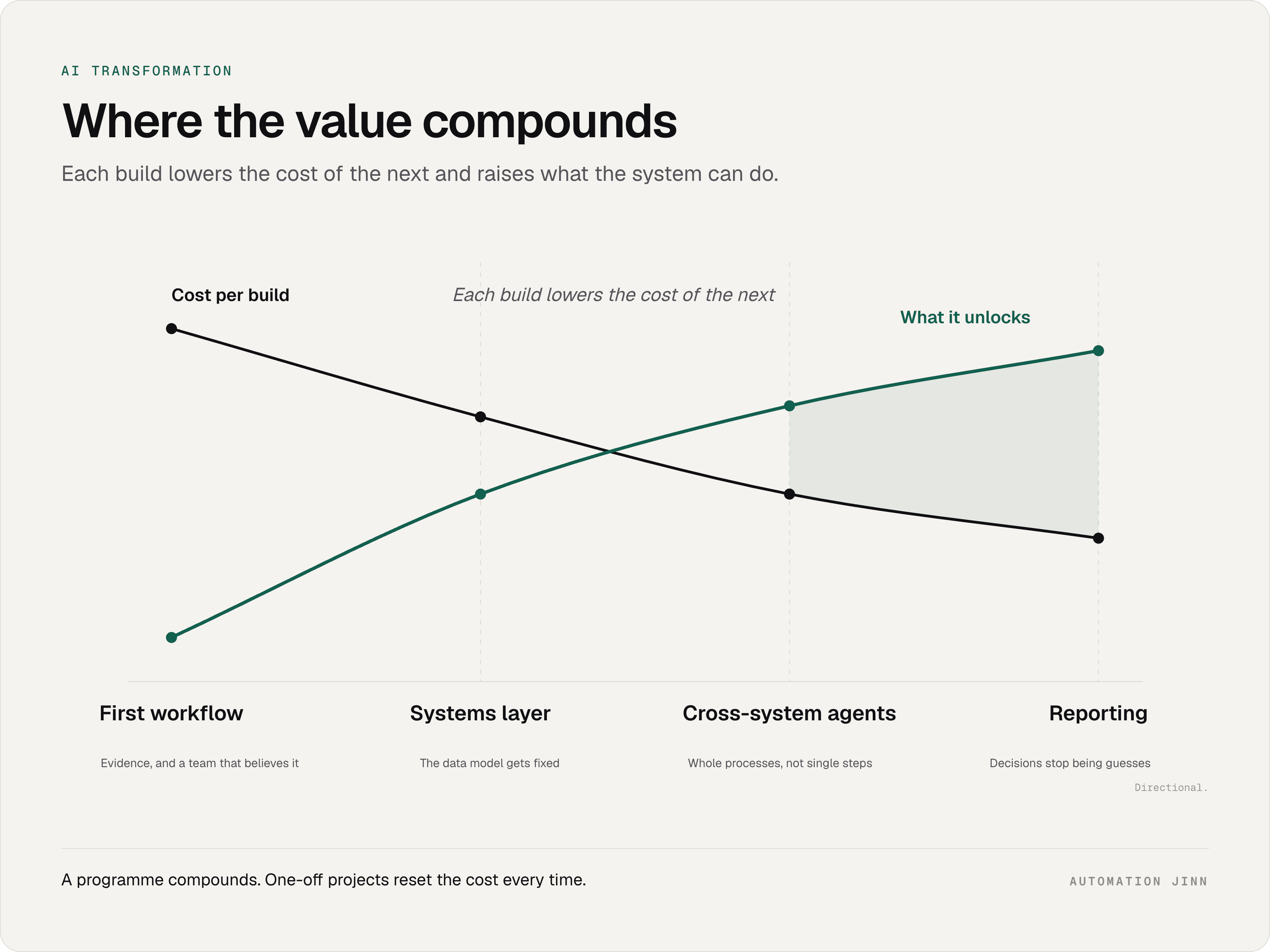
Implementation is a project. AI transformation is what the projects add up to, and the gap between them is where most of the money is won or lost. It is also not the same as buying more AI tools. Most companies with an impressive AI stack have no transformation at all, because nothing they bought talks to anything else.
The arc is predictable once the first build lands. Fixing one workflow forces you to fix the data underneath it, so the second starts from clean ground and costs less. By the third, the plumbing exists and agents work across systems instead of inside one. Reporting starts reflecting reality.
Stage | What changes | What it unlocks |
|---|---|---|
First workflow | One process runs itself | Evidence, and a team that believes it |
Systems layer | The data model gets fixed | Every later build costs less |
Cross-system agents | Work moves between tools | Whole processes, not single steps |
Reporting | Numbers reflect reality | Decisions stop being guesses |
An implementer builds what you ask for. A transformation partner tells you which of the six things on your list to build, which two to drop, and which one to keep doing by hand another quarter because the process is not stable enough to automate.
Turning down work is most of the value, and it is the one thing you will never get from someone billing by the hour.
The rest is sequencing. Each build should lower the cost of the next. The data model gets fixed early because everything downstream depends on it, which is most of what GTM engineering means once you strip the label off. The highest-frequency workflow goes first because it produces evidence fastest. The use case that would look good in a board deck usually goes last. That ordering is a strategic judgement, not a technical one, and getting it wrong is what turns a programme into an expensive collection of pilots.
The measure changes too. An implementer reports automations shipped. A partner reports the business metric you agreed before anything got built, and says so when a build did not move it.
Companies that open with an enterprise-wide programme, a governance board and a two-year roadmap are the ones filling out that 95% statistic. The roadmap gets written before anyone has evidence, so it optimises for what sounds credible in a steering committee. Transformation is the destination. It makes a poor starting point.
Fifteen minutes of prep changes the quality of every conversation you have, with me or anyone else. Bring three things.
One process, written as a sequence of steps. Who does what, in what order, where they get stuck. Writing it down surfaces half the problems on its own.
The annual cost of that process. The manual tax number from above.
The systems it touches, and who holds admin access to each. This delays more projects than anything else, and nobody thinks about it until week two.
Here is what a scoping call should give you back, whether or not you hire the person on the other end: which workflow to do first and why, a range and timeline you can take to whoever controls budget, and a clear statement of what would have to be true for it to fail. If you leave without those three, you were in a sales call.
And if you have none of it ready, that is not a reason to wait. Bring a workflow, a department, or just a suspicion that something is costing more than it should. Working out which of those you actually have is the job.
Book a discovery call below and we will map where AI fits, where it does not, and what is worth doing first. Half an hour is usually enough to tell whether there is something worth building, and I will say so if there is not.
An AI implementation consultant is a technical partner who takes AI from decision to production. They select which workflows justify automation, design the system, build it inside your existing tools, and support it afterwards. Unlike strategy consultants, they ship working software and own a measurable business outcome.
Fixed-scope projects are the usual shape for growing teams: roughly $5,000 to $8,000 for a single system in production, $8,000 to $15,000 for a multi-system build, and $20,000 upward for an AI transformation programme. Hourly rates, where firms still use them, run from a few hundred dollars to over a thousand at the largest firms.
Implementation delivers one working system. Transformation is a sequenced programme where each build lowers the cost of the next, the data model gets fixed along the way, and agents begin working across systems rather than inside one. Implementation is a project. Transformation is a direction with a budget.
Not soon. AI is already absorbing the analyst-level tasks in consulting, like drafting documentation and writing first-pass code. What it does not do is sit with your team, work out which of your workflows is worth automating, or take accountability when a production system misbehaves at scale.
Simple automations go live in days. A full agent system typically takes weeks. A broader AI transformation runs over quarters, but it should still ship its first working workflow within weeks. Any timeline that has you waiting months before seeing something run on your own data is a timeline to reject.
Hire an individual consultant for one defined technical problem where you have internal capacity to manage delivery. Hire an agency or boutique when the work spans several systems, needs coordinated workstreams, or you have no internal AI expertise to oversee it. Cost tracks scope more than it tracks headcount.
Sparsh Gupta, Founder of Automation Jinn, builds AI agents and GTM systems for seed to Series B B2B teams who want manual work off their plate without adding headcount. If you have one workflow costing you hours every week and you want to see it running before committing to anything, book a discovery call.