Lead Routing (2026): How to Design Rules That Don't Break


•
•
Lead routing is the automated assignment of every inbound lead to the right rep, using rules your team defines in advance. Good routing is not a strategy question. Every team lands on round robin, territory, or account ownership within an afternoon. Routing breaks on the boring parts: what happens when nobody matches, when a rep quits, when the enrichment has not landed yet.
This guide covers the five strategies briefly, then spends most of its time on the twelve failure modes that take routing down in production, and how to build against each of them. I have rebuilt enough broken routing setups to know the strategy was almost never the problem.
Lead routing, also called lead assignment, is the process of distributing incoming leads across a sales team automatically instead of by hand. A lead arrives from a form, a webhook, or an import. Your CRM evaluates it against a set of rules. The rules pick an owner, write that owner onto the record, and tell them.
Every routing system has the same four parts, and it is worth naming them because most failures are traceable to exactly one:
A trigger that decides when routing fires.
A qualifier that decides which leads get routed at all.
A selector that picks the owner.
A set of writes that make the assignment real: the owner field, a task, a notification.
The speed argument for routing is real but older than most people citing it realize. The Harvard Business Review study everyone traces the “respond fast” rule back to audited 2,241 US companies and found that firms contacting a lead within an hour were nearly seven times as likely to qualify it as firms that waited one hour longer, and more than sixty times as likely as those waiting a full day. Twenty-three percent never responded at all. That research was published in 2011. The widely repeated “five minute rule” is a derivative of it, not a separate finding, and I would treat the exact threshold as directional rather than gospel.
What has not aged is the shape of the finding. Latency destroys conversion, and routing latency is the part of total response time you actually control with a system rather than with discipline.
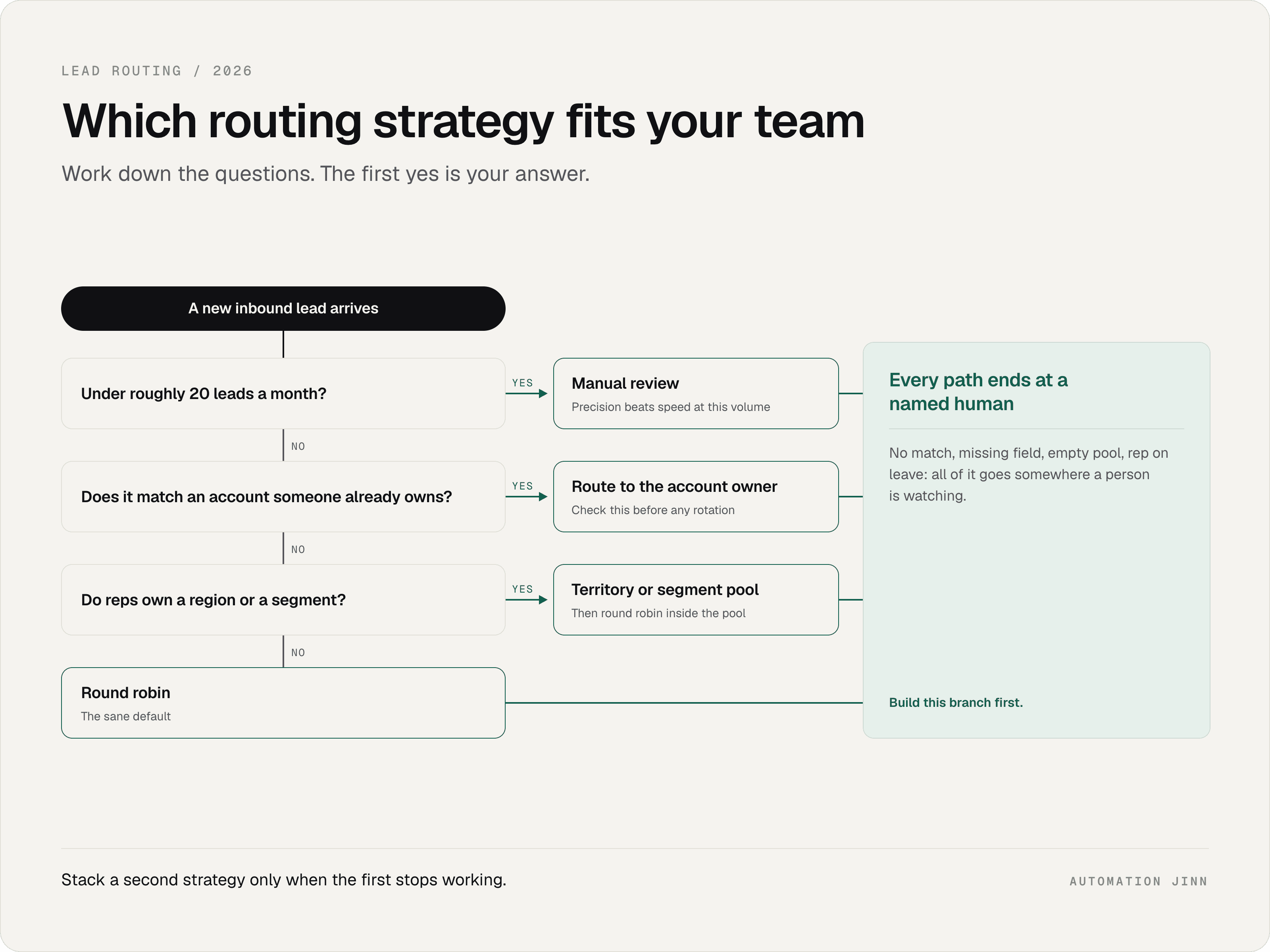
Most guides list ten strategies. In practice teams use two or three of these stacked, and each has a specific condition where it stops working.
Strategy | Assigns by | Where it breaks |
|---|---|---|
Round robin | Next rep in a rotation | Ignores expertise and territory; skews when the roster changes |
Territory | Region, country, or zip | Dead zones when a lead arrives outside that region’s working hours |
Segment | Headcount, revenue, industry | Fails silently when the firmographic field is empty or stale |
Account-based | Existing account owner | Misses on domain variants, subsidiaries, and personal email addresses |
Manual | Human review | Does not survive volume; the reviewer becomes the bottleneck |
Pick based on volume and team shape, not sophistication. A five-rep team running one product does not need segment routing, and building it early is how you end up with logic nobody can debug two years later.
This is the part page one skips. Every setup I have audited failed on at least three of these, and most teams do not find out until a deal goes missing. Run your current routing against the list and count.
They are grouped by the four stages above, because the stage is where you go to fix them. Note how they cluster: five of the twelve sit in the selector, the one stage most teams treat as a dropdown rather than a design decision.

1. The trigger fires on update instead of creation. Routing that listens for record updates will re-route leads that already have an owner every time anyone edits them. Attio’s own docs flag a related trap: the Record updated trigger does not fire when an attribute is set for the first time during creation, so a rule built on it misses new leads entirely and then fires on old ones.
2. Enrichment has not landed when the router fires. This is a race condition, and it is the one people diagnose last. If routing depends on an enriched field, routing has to wait for enrichment, either by triggering on the enriched attribute changing or by holding the run with a delay.
3. There is no “owner is empty” guard. Without it, an automated rule will happily overwrite the owner a manager assigned by hand ten minutes ago. Every routing filter should exclude records that already have an owner unless reassignment is the explicit intent.
4. Field formats do not match across systems. The router expects an integer for headcount and the ad platform passes a range. The condition never matches, the lead falls through, and no error is raised. Normalize routing fields in one place and let every rule read from the normalized value.
5. Duplicate records route twice. The same person exists twice with different data, two rules fire, two reps call. Deduplication belongs before routing, not after.
6. There is no fallback owner. A lead matches nothing, so it gets no owner, so it appears in nobody’s view. This is the single most common failure in the whole list and the cheapest to fix. Every routing path needs a terminal branch that assigns to a named human, not a queue nobody watches.
7. A roster change silently resets the rotation. This one is documented and almost nobody accounts for it. HubSpot’s own workflow documentation states that if you add or remove owners from a Rotate record to owner action after the workflow is live, the assignment counts reset and distribution starts over. Hire a rep or offboard one, and the fairness your team was promised quietly restarts.
8. Out-of-office reps stay in the pool. A lead routed to someone on leave is a lead that sits for a week. Availability has to be modeled somewhere, either in the routing tool or as a status field the rules read.
9. Territory routing creates timezone dead zones. A lead lands at 3am in the only region qualified to take it. The rule fired correctly and the outcome is still an eight-hour delay. Global teams need availability layered on top of geography, not instead of it.
10. Lead-to-account matching misses on domain variants. Someone from an existing enterprise account fills in a form with a personal address, or from a subsidiary domain. Without fuzzy matching on company name and domain, that lead skips the account owner and enters the general rotation.
11. There is no audit trail. When a rep asks why a lead went to someone else, you need to answer from the record, not from memory. If your system cannot show who owned a lead at creation, what reassigned it, and which rule decided, routing becomes a trust problem rather than a technical one. That is when shadow processes start.
12. Burst traffic serializes. HubSpot’s documentation notes that only one object is allowed through a rotate action at a time, so simultaneous records queue and retry. A webinar or a launch pushes a hundred leads through at once, and the last one in line waits. Test your routing at the volume of your worst day, not your average one.
Count how many of these your current setup would survive. Anything above three and routing is already costing you pipeline you cannot see. Auditing and rebuilding routing against this list is standard RevOps and GTM systems work, and it happens inside the CRM you already run. Nobody needs to migrate anything to fix a fallback path.
The failure list is long, but the defenses against it are short. Five principles cover almost all of it.
Normalize upstream, route downstream. Routing rules should read one clean field, not six raw ones. Compute segment and territory at the point of data entry or enrichment, then let every rule branch on those values. This is what makes routing readable a year later.
Design every path to terminate at a human. Build the fallback before you build the happy path. If you write the catch-all first, it is impossible to forget it.
Route on creation, guard on ownership. Fire when the record is created or when the attribute you depend on changes, and filter out anything that already has an owner. Those two decisions eliminate the most common class of bug.
Build the pool before you need the pool. Create a routing group even when it has one member. When you hire the second rep, you add a user ID instead of rebuilding the rule. This is a habit worth borrowing from RevOps teams who have been through a few reorgs.
Make every decision inspectable. Field history on the owner attribute, run history on the workflow, and a Slack message that names the rule as well as the rep. Auditable routing is routing people trust.
Every routing system worth trusting is the same six steps in the same order. The block names differ by CRM, the sequence does not. Build it in this order and you have defended against nine of the twelve failure modes before you write a single branch.
Step | What it does | Guards against |
|---|---|---|
1 | Trigger on creation, or on the field you depend on changing | #1, #2 |
2 | Filter to qualified AND unowned | #3, #5 |
3 | Branch on one normalized segment or territory field | #4 |
4 | Select an owner from a pool, with a no-match branch | #6 to #10 |
5 | Write the owner to the record | Making assignment real |
6 | Create a task and notify, naming the rule | #11, #12 |
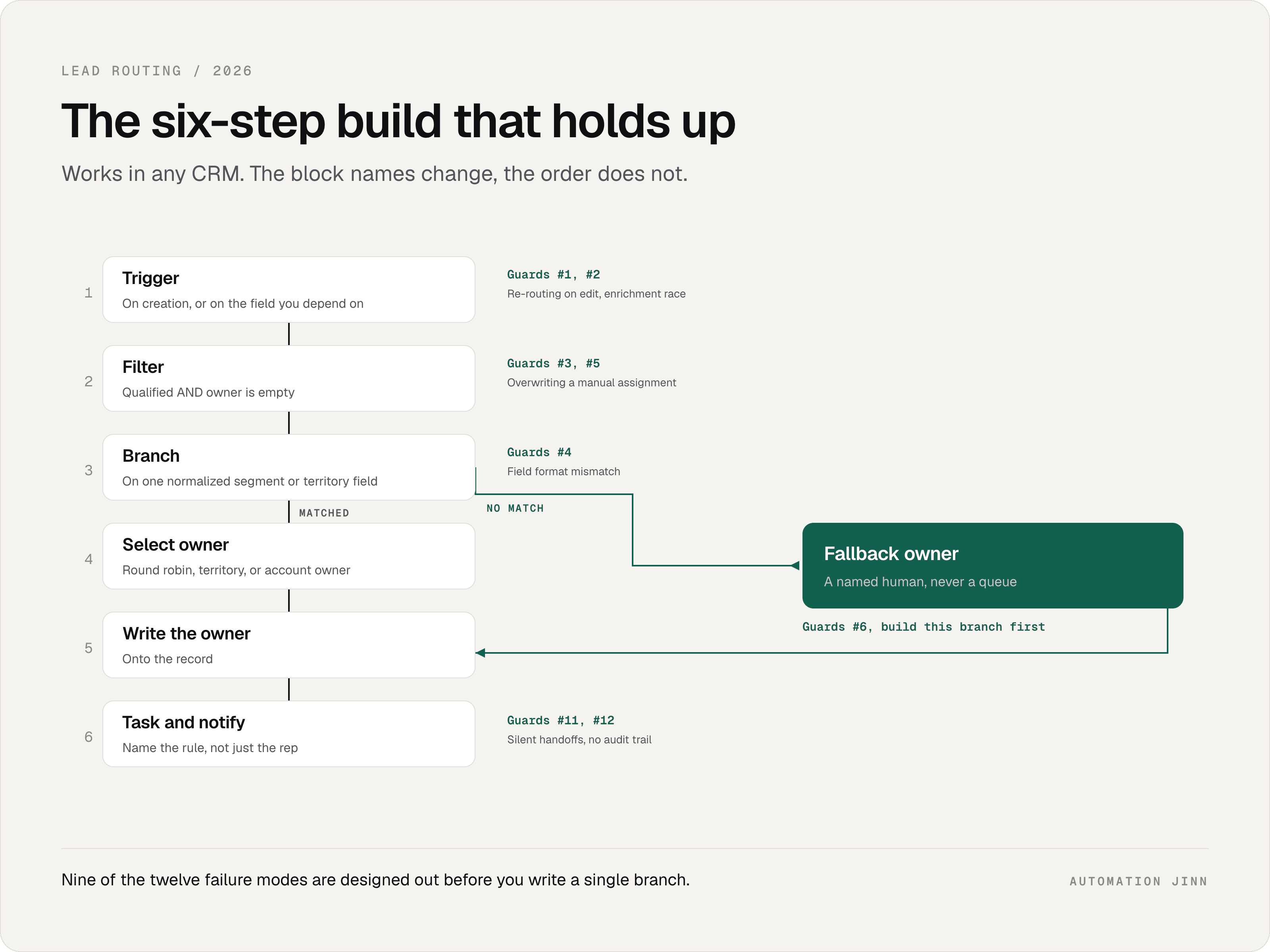
Three of those steps do most of the work. The filter goes before the selector, always. If a disqualified lead reaches your rotation, it consumes a rep’s turn and distribution skews without anyone noticing. The no-match branch gets built first, before the happy path, because a branch you write first is a branch you cannot forget. And step one is a real decision, not a default. If any routing condition depends on an enriched field, trigger on that field changing rather than on record creation. That single choice resolves the enrichment race condition without a delay timer you have to tune and retune.
Notice what is not in the list: the routing strategy. Round robin, territory, or account ownership all slot into step four. The strategy is the easy part, which is why every guide leads with it and why so few routing systems actually work.
We design the fallback paths and audit trail most teams find out they need after the first lead goes missing. Book a discovery call from below.
You do not need a new CRM to fix routing. You need to know what your current one does badly. All three of the platforms below route competently once configured, and all three have a specific constraint that catches teams out.
HubSpot | Salesforce | Attio | |
|---|---|---|---|
Mechanism | Rotate record to owner | Lead assignment rules | Round robin block in Workflows |
Plan gate | Sales Hub Professional | Broadly available | All plans |
Native even distribution | Yes, plus load balanced | No | Yes |
Watch out for | Rotation resets on roster change | One active rule at a time | Runs consume workspace credits |
HubSpot. The Rotate record to owner action requires Sales Hub Professional or Enterprise, so routing is off the table on Starter. Three behaviors to plan around, all documented and all easy to miss: the rotation counter resets when you change the owner list, only primary team members are eligible when rotating to a team, and the action processes one object at a time, so burst traffic queues behind itself.
Salesforce. The constraint here is architectural. Only one lead assignment rule can be active at once, so every path lives inside a single ordered rule where the first matching entry wins. There is no native round robin, which means even distribution costs you a Flow, Apex, or a third-party router. The one thing Salesforce makes easier than anyone: set the Default Lead Owner in Lead Settings and your fallback exists for free. Practitioners on the r/salesforce thread that ranks for this topic land in the same place, that a Flow querying matching accounts works fine for simple cases and gets fragile as rules multiply.
Attio. Workflows are available on every plan, including Free, which is unusual in this category. The Round robin block holds its position across runs rather than resetting, and runs consume workspace credits.
One detail to know before you build: the Record updated trigger does not fire when a field is set for the first time during creation, so use Attribute value changed for anything enrichment-dependent. That single swap prevents the most common Attio routing bug I see. The full block reference is in the Attio Workflows guide, and routing is usually the first thing we wire up in an Attio implementation.
Whichever you are on, the fix is almost never the platform. In every routing audit I have run, the rules were being asked to compensate for a data model that could not answer “which segment is this” in one field. Fixing that upstream is cheaper than fixing it in the router, and it is the bulk of what a RevOps engagement actually does.
Never activate routing without sending fake leads through it first. Build a test record you can delete, then verify each path deliberately.
Send one lead that should match your primary path and confirm the owner, the task, and the notification all landed on the same person. Send one with the routing field empty and confirm it reaches the fallback owner rather than disappearing. Send one that should be filtered out and confirm the run stopped and the rotation did not advance. Then send five at once and confirm all five got owners.
After that, put it on a schedule. Flag unrouted leads daily, check distribution across the pool monthly, and re-test end to end after any field rename, form change, or integration update. Routing is not a build, it is a system with a maintenance cost, and the teams that treat it that way are the ones whose leads keep landing.
Lead routing means automatically assigning each incoming lead to a specific sales rep based on rules you define in advance, such as territory, company size, or an even rotation. It replaces manual assignment so leads reach an owner within seconds rather than hours.
The three most common are round robin, which rotates leads evenly across reps; territory-based, which assigns by geography; and account-based, which sends a lead to whoever already owns the account. Most teams combine two of these rather than relying on one.
Scoring decides whether a lead is worth routing, and routing decides who gets it. Scoring runs first, using fit and engagement data to rank the lead. Only leads above your threshold enter the routing rules, which keeps reps from being buried in unqualified handoffs.
Create a pool of eligible reps, add a rotation step to your workflow after a filter that screens for qualified and unowned leads, then write the selected rep to the owner field. Place the filter before the rotation so disqualified leads do not consume a rep’s turn.
For most seed to Series B teams it is the CRM you already run. HubSpot needs Sales Hub Professional, Salesforce needs a Flow for even distribution, and Attio includes Workflows on every plan. Dedicated tools like Chili Piper earn their cost once you are booking meetings live from the form.
Almost never. Broken routing is usually a data model problem wearing a rules costume, and the fix is normalizing the fields your rules read plus adding a fallback path. Both happen inside your current CRM. Switch platforms for reasons bigger than routing.
Sparsh Gupta, Founder of Automation Jinn, helps B2B teams build GTM systems that route, score, and follow up without anyone babysitting them. If you want your lead routing audited against every failure case above and rebuilt in the CRM you already run, book a discovery call.