Hire a GTM Engineer vs Agency: When Each Works (2026)

•
•
Hire a full-time GTM engineer when you have more than one motion running, enough weekly volume to keep a builder busy, and someone senior to own their backlog. All three. Below that, buy the build instead: a hire costs roughly $190,000 in cash in year one and ships nothing for five to eight months, while a scoped build runs $6,000 to $15,000 and puts live plays in production inside a quarter.
But the cost gap is not really why most of these hires go wrong. The reason is less comfortable, so let me start there.
Here is the pattern. Something in the revenue motion is broken. Leads are landing and nobody knows which ones matter. Reps are spending Tuesday building lists. The founder can feel the problem but cannot name it precisely, because naming it would mean deciding what an account is, which signals count, and what should happen when one fires.
So they open the role. Posting a job feels like progress feels like progress, because it has an obvious next action: write the job description, post it, book interviews. Deciding what a signal is has no obvious next action at all. It just sits there.
Eight months later there is a person in the seat, and the decisions are still unmade. Now they are being made by someone in their first sixty days who has never seen your motion work, and who will encode their best guess into the object model that everything else gets built on top of.
You were not short a person. You were short a decision. Hiring is a very expensive way to postpone one.
That is not an argument against ever hiring. I will get to the version where hiring is correct, and it is a real version. It is an argument for being honest about which problem you have, because the two problems look identical from the outside and cost wildly different amounts to solve.
The postings compound the problem. The typical GTM engineer job description wants Clay, SQL, Python, CRM administration, outbound strategy, paid acquisition, lifecycle automation and attribution, from one person.
That is three jobs. A data engineer, a marketing ops lead and an outbound strategist, advertised as one hire, frequently with four or more years of experience requested in a title that is barely three years old. The arithmetic does not work, and the search length reflects it.
The way out is to stop hiring for the title. Strip the label off most of these descriptions and the underlying work is familiar: solutions engineering, sales engineering, integration consulting, technical ops. Plenty of people have done exactly this for six years under a name nobody is currently bidding up, and they are not in the pool you are fishing in because they do not have the three-year-old phrase in their headline.
That only helps if you know what you are hiring for. Which brings us back to the decision you have not made.
Salary is the number everyone quotes and the smallest part of the answer.
The median advertised base across 1,000 analysed GTM engineering postings is $127,500. The headline numbers that circulate on LinkedIn belong to companies with a RevOps team, a data warehouse and a CRO. If you are Series A, the median is your row.
Here is the full cash cost at that median, in a US market, over the first twelve months.
Line item | Year one | Basis |
|---|---|---|
Base salary | $127,500 | Median across 1,000 public postings |
Employer payroll tax | $9,750 | 7.65% FICA on base |
Benefits, insurance, 401k | $19,000 | ~15% of base, conservative |
Recruiting fee | $25,500 | 20% contingency, within the 15-30% tech norm |
The stack the role needs | $8,000 | Enrichment, CRM seats, sending, credits |
Total cash, year one | ~$189,750 | Equity excluded |
Two of those lines get left out of most versions of this calculation, and both are the kind of thing you discover in month three.
The recruiting fee is real money. Contingency search for technical roles runs 15% to 30% of first-year base, so $19,000 to $38,000 at the median before the person writes a line of logic. You can skip it by sourcing yourself, which trades cash for founder hours at exactly the stage when founder hours are the scarcest thing you own.
A GTM engineer without a budget is an expensive spectator. The role runs on tooling. Clay starts at $167 a month on Launch and $446 on Growth with data credits metered on top, per Clay’s pricing page. Add CRM seats, a sending platform, enrichment credits and an orchestration layer, and $8,000 a year is conservative. Hiring the person and then arguing about their tooling budget in month two is the most common self-inflicted wound I see, and it is entirely avoidable by putting the number in the same board slide as the salary.
Equity sits outside the table because no blog post can price it for your cap table. Treat $190,000 as the cash floor, not the whole number.
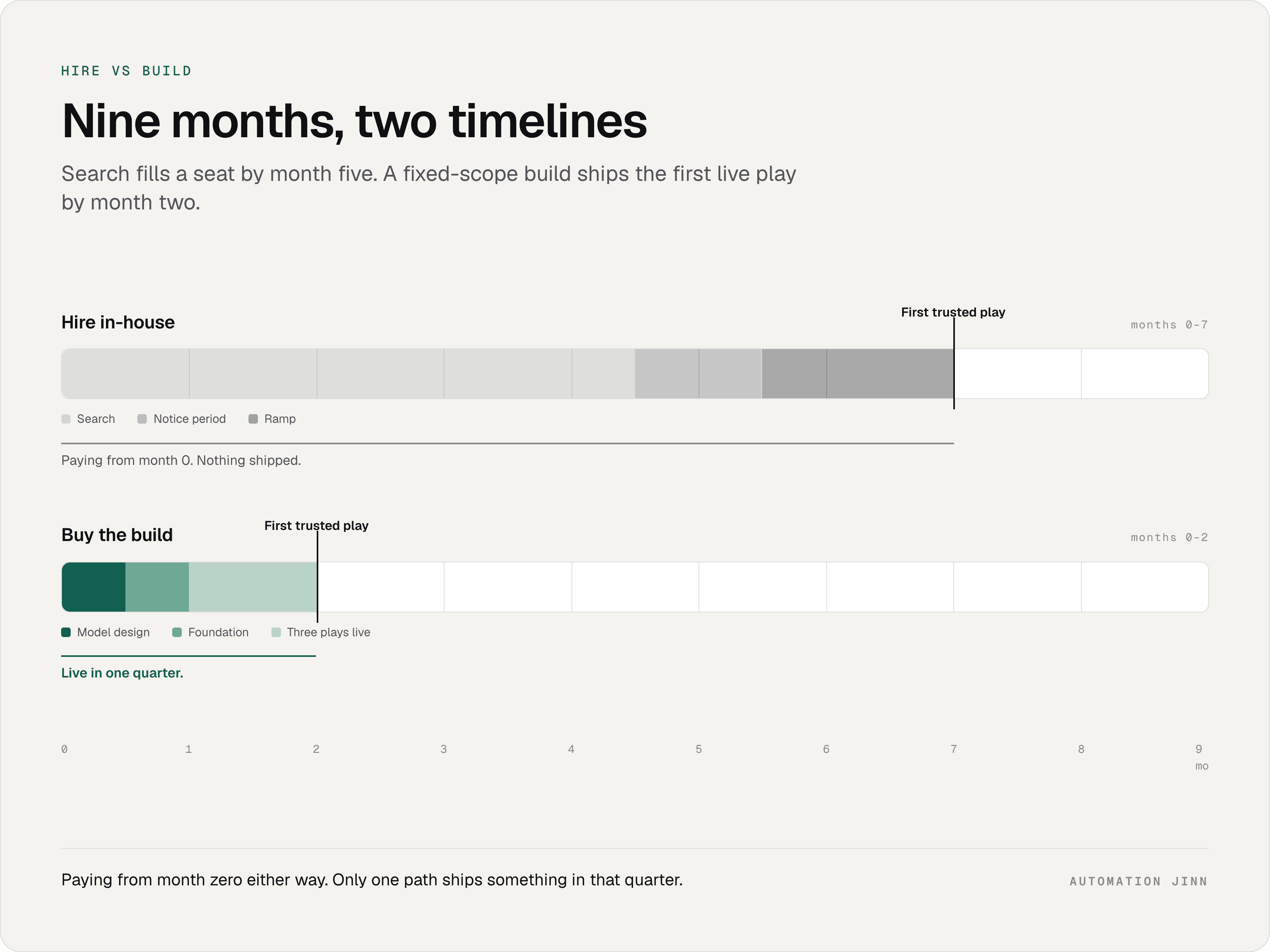
Cost per year is the wrong unit. Cost per shipped play is the right one, and on that measure the hire looks very different.
This is the sequence I watch play out from the client side, and it is depressingly consistent.
Stage | Typical | Running total |
|---|---|---|
Search to signed offer | 3 to 6 months | 3 to 6 months |
Notice period | 1 month | 4 to 7 months |
Ramp to first trusted play | 1 to 2 months | 5 to 8 months |
Five to eight months from opening the req to the first thing that works. Through all of it you are paying recruiter fees, then salary, and getting no pipeline back. The manual process you were trying to kill is still running the whole time, and your reps are still the ones running it.
Put that next to the thing you were originally annoyed about. If the problem was reps losing a day a week to list building, that problem now gets to live for another two quarters while you interview.
Four ways to get this built, with the in-house row carried down for comparison.
Path | Cost | What you own afterwards |
|---|---|---|
Full-time hire | ~$190,000 year one | Everything, until they leave |
Freelancer | $50 to $150 per hour | Whatever they documented, usually little |
Retainer agency | $3,000 to $12,000 per month | Nothing. Stop paying and it stops |
Fixed-scope build | $6,000 to $15,000 once | Everything, documented, from day one |
The bottom two rows are my own prices, so I will name them rather than hide behind a range. A Clay implementation build starts at $6,000 and is usually live in two to three weeks. A full GTM systems architecture and build, covering the data model, enrichment, three instrumented plays and handover, runs $8,000 to $15,000 depending on the state of your data. A rebuild on a messy five-year-old CRM costs more than a greenfield one, and the honest estimate comes after looking at your data rather than before.
Read the retainer row carefully, because it is the one that quietly compounds. Eight thousand a month passes the cost of a scoped build in month two and then keeps going, forever, for a system you do not own. That is a fine trade when you need continuous capacity and know it. It is a bad one when what you actually needed was a system built properly once.
I build these systems for a living and I still tell people to hire maybe a third of the time. Three conditions, and you want all three, not two.
More than one motion. Inbound, outbound and expansion, each with its own model and its own plays, generates enough work to keep a builder occupied every week of the year. One outbound motion does not, and a good engineer with not enough to do will invent work to fill the gap.
Volume that sustains rather than spikes. North of a few hundred relevant accounts a month with signals firing continuously, the work stops being a project and becomes an operation. Operations need owners.
A named manager and a real backlog. This is the one people skip. A GTM engineer reporting to nobody in particular will spend six months building impressive things nobody asked for. That is not a hiring failure, it is a management vacuum, and no candidate quality fixes it.
Miss any of those and you are paying full-time rates, permanently, for work that arrives in bursts.
An external build has real limits and I would rather name them than have you find them.
Context compounds in a way no partner can replicate. Someone in the seat for two years knows why the pricing model changed, which enterprise deal forced the weird custom object, and which rep will silently ignore any workflow that adds a click. By year two that knowledge is worth more than the architecture was.
Response time differs too. When a play breaks the morning of a board meeting, an employee is in Slack. A partner is in a queue.
And past Series B with a real RevOps function, the whole calculation flips. The workload is permanent, the management structure exists, and the standard playbook applies. Hire.
The argument here was never that hiring is wrong. It is that hiring first, before there is a system to inherit, is what makes the role brutal to fill and easy to fail in. Build first, hire second, and the job you are advertising becomes “own and extend a documented system that already produces pipeline” instead of “here is a blank workspace and a mandate, good luck.” One of those roles closes in six weeks. The other is the one you have open right now.
Whichever path you pick, hold it to the same test. By day ninety there should be three things you can point at.
A data model that can express your actual motion, written down somewhere a new hire can read. At least one play running end to end, from signal to owned action with a clock on it, that nobody has to remember to trigger. And a number that moved, even a small one, that someone outside the ops function can name.
If ninety days produce a beautifully organised CRM, a tool audit and a roadmap, something has gone wrong. That is preparation, not output, and preparation expands to fill whatever time you give it.
Both paths have a failure mode, and they are the same failure wearing different clothes.
The single-threaded hire. One person builds everything, documents none of it, and holds the model in their head. It works beautifully for eighteen months. Then they take another job, and the systems keep running right up until the first thing breaks, at which point nobody can fix it because nobody knows how it was wired. What you lost was never the person. It was every decision they made and never wrote down.
The rented system. The agency version. Workflows live in the agency’s accounts, credentials are theirs, the documentation is a slide deck, and the day the retainer stops the system starts to rot. You were not buying infrastructure. You were renting it, and the lease was month to month.
Same root cause both times: nobody scoped the system to outlive whoever built it. That is a decision made in week one, not a surprise discovered in month twenty.
Make these non-negotiable with an employee, an agency, or with me. I write all five into scope.
You own every account and credential from day one, with no partner-held logins. The data model is documented, not just built. Every workflow has a named owner on your team before handover. The handover is a recorded working session rather than a PDF. And if the engagement ended tomorrow, everything keeps running and you keep all of it.
Anything that cannot survive those five conditions is selling you a dependency. That is the principle my fractional GTM systems work is built around, and every build is designed to end with your team owning the thing outright.

How many distinct motions are you running? One, buy the build. Three, hire.
Is the value in decisions made once, or in a weekly stream of new work? Front-loaded is a deployment. Continuous is a seat.
Who manages them on day one, and what is in their backlog? If you cannot name both, hiring is premature no matter what the first two answers were.
Two or more pointing towards buy, and you have your next two quarters. Build the system, prove the motion, then hire someone to own something that already works. If you want the architecture underneath all of this, the complete GTM engineering guide covers the four layers and what to build in what order.
Roughly $190,000 in cash in year one at the US median: $127,500 base, about $9,750 in employer payroll tax, around $19,000 in benefits, a $25,500 recruiting fee at 20% contingency, and $8,000 for the tooling the role needs to function. Equity sits on top.
The median advertised base across 1,000 postings is $127,500, with 4.11 years of experience typically requested. Well-funded AI and developer-tool companies pay far more, with Vercel at $252,000 and OpenAI at $250,000. Seed and Series A teams should budget against the median, not the headlines.
Retainer agencies typically run $3,000 to $12,000 a month, which passes the cost of a one-off build by month two and never stops. Fixed-scope builds are cheaper and finite: my Clay implementations start at $6,000, and a full GTM systems architecture and build runs $8,000 to $15,000, priced before work begins.
When you have more than one motion running, volume that sustains rather than spikes, and a named manager with a real backlog. All three. Missing any one means you are buying a full-time seat for work that arrives in bursts, which is the most expensive way to solve a part-time problem.
For the architecture, usually better, because those decisions get made by someone who has made them before rather than someone in their first sixty days. What fractional cannot replicate is accumulated company context and same-hour response when something breaks. That is the case for build first, hire second.
SQL and Python each appear in 38% of postings, so treat technical fluency as real. Beyond that, look for commercial judgment: someone who asks whether a workflow actually helps close a deal. Since nine of ten responsibilities overlap with RevOps, widen the search to solutions engineers, sales engineers and ops leads rather than bidding on the title.
Sparsh Gupta, Founder of Automation Jinn, works as a fractional GTM engineer for seed to Series B B2B SaaS teams, building the data model, workflows and agents and handing them over documented. If you are hiring for this and nothing is shipping yet, book a discovery call and we will work out what you are actually short of.