GTM Engineering: What It Is and How to Build the Function (2026)


•
•
GTM engineering is the practice of building the systems that turn buying signals into revenue motion: the data model, the enrichment, the workflows, and the AI agents that run a go-to-market without a person copying rows between tabs. A GTM engineer builds those systems. RevOps runs the process on top of them.
That is the definition. The more useful thing to know is that the title is about three years old and the job is about twenty, which changes who you should hire, when, and whether you should hire at all.
GTM engineering applies engineering practice to how a company sells. Instead of connecting tools with one-off hacks that break the week their author is on holiday, it designs durable systems: a data model that can hold the motion, data that stays clean, workflows that survive the person who built them, and AI that acts on verified inputs rather than plausible guesses.
Clay coined the term in 2023 and it spread fast, because it named something real. Revenue teams had quietly become technical, and nobody had a word for the person doing the technical part.
But naming a thing is not the same as inventing it. And the confusion about what a GTM engineer actually is comes almost entirely from treating the role as new.
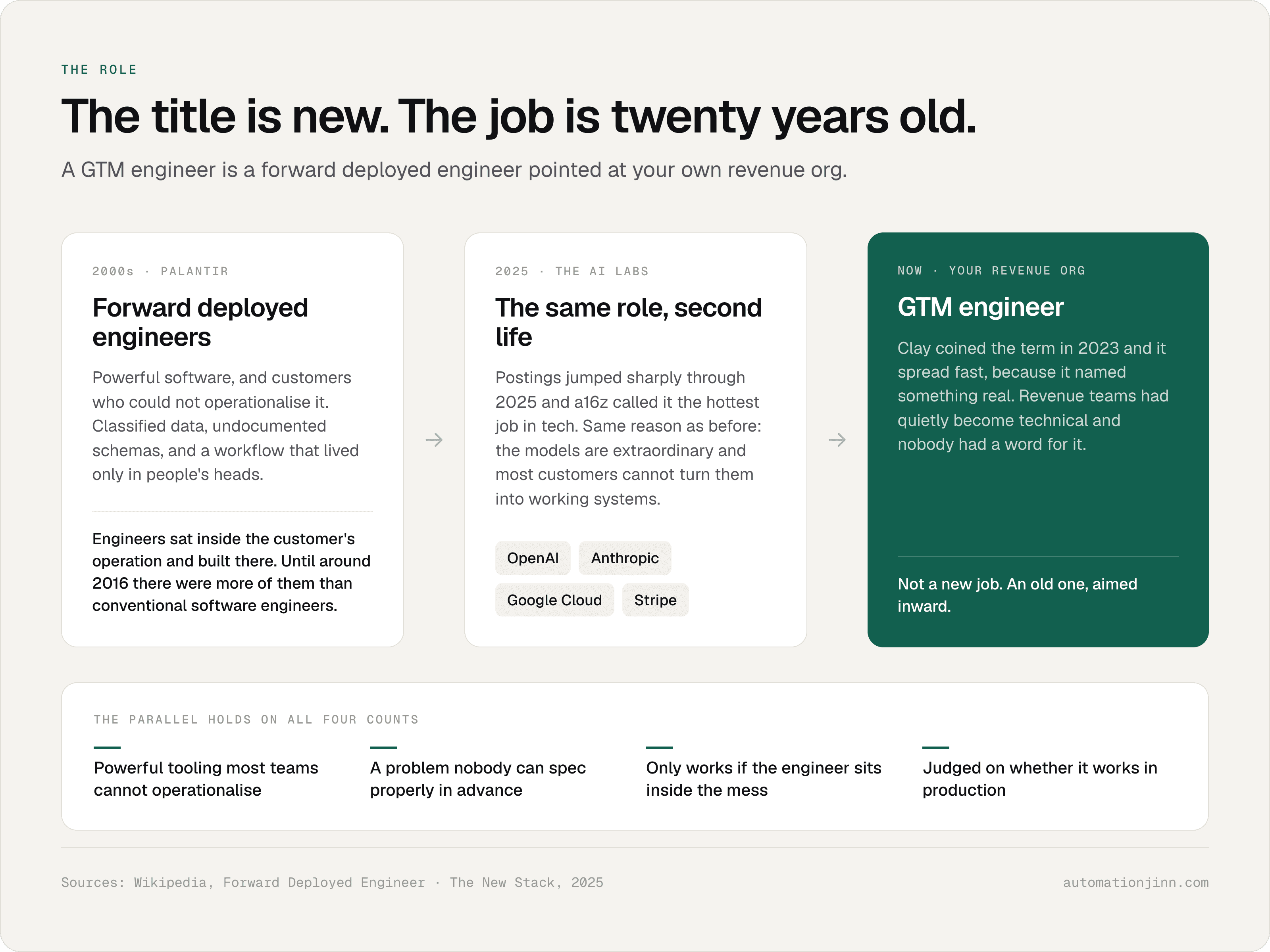
In the 2000s Palantir hit a problem that had nothing to do with sales. It had powerful software and customers, initially US intelligence agencies, who could not operationalise it. The data was classified, the schemas were undocumented, and the real workflow existed only in the heads of people who could not describe it in a requirements doc.
The fix was not better documentation or more salespeople. Palantir sent engineers to sit inside the customer’s operation and build there. It called them forward deployed engineers, internally “Deltas,” and until around 2016 it employed more of them than conventional software engineers.
The insight underneath it: implementation was not a deployment problem, it was a co-engineering problem. Powerful software plus a customer who cannot operationalise it produces exactly zero value.
That role is having a second life right now. OpenAI, Anthropic, Google Cloud, and Stripe all employ forward deployed engineers, postings jumped sharply through 2025, and a16z called it the hottest job in tech. Same reason as before: the models are extraordinary and most customers cannot turn them into working systems on their own.
A GTM engineer is a forward deployed engineer pointed at your own revenue org.
The parallel holds almost line for line. Powerful tooling that most teams cannot operationalise. A problem nobody can spec properly in advance, because the person who understands the motion is a founder who has never written a requirements doc. Work that only succeeds if the engineer sits inside the messy commercial reality rather than beside it. Both roles are judged on whether the thing works in production, not on code quality.
Here is the practical payoff, and it is worth more than any definition.
If the job is forward deployed engineering, then the talent pool is not the small population of people with “GTM Engineer” in their LinkedIn headline. Wikipedia’s own summary of the FDE role notes it overlaps with solutions architects, sales engineers, customer engineers, professional services engineers, systems integrators, and IT consultants, and that some poorly defined FDE roles are simply those jobs under a newer name.
The same is true here. The skills that make someone good at this are old ones: solutions engineering, sales engineering, integration consulting, technical ops, data modelling, and the specific discipline of talking to a commercial team without condescending to them.
So when you do hire, stop bidding against every funded startup for a scarce new title. The person you want has probably been doing this work for six years under a different one, and is not currently being fought over. That is a Series B move though. Below that the wider pool does not help you, because the problem was never finding the person. It is that the workload does not justify one yet.
You will read that one GTM engineer replaces five SDRs, that outbound teams are obsolete, and that the humans are the expensive legacy part. Agencies selling GTM engineering make this claim loudly, because it is the most flattering possible framing for what they sell.
Look at what the most automation-capable companies on earth actually do.
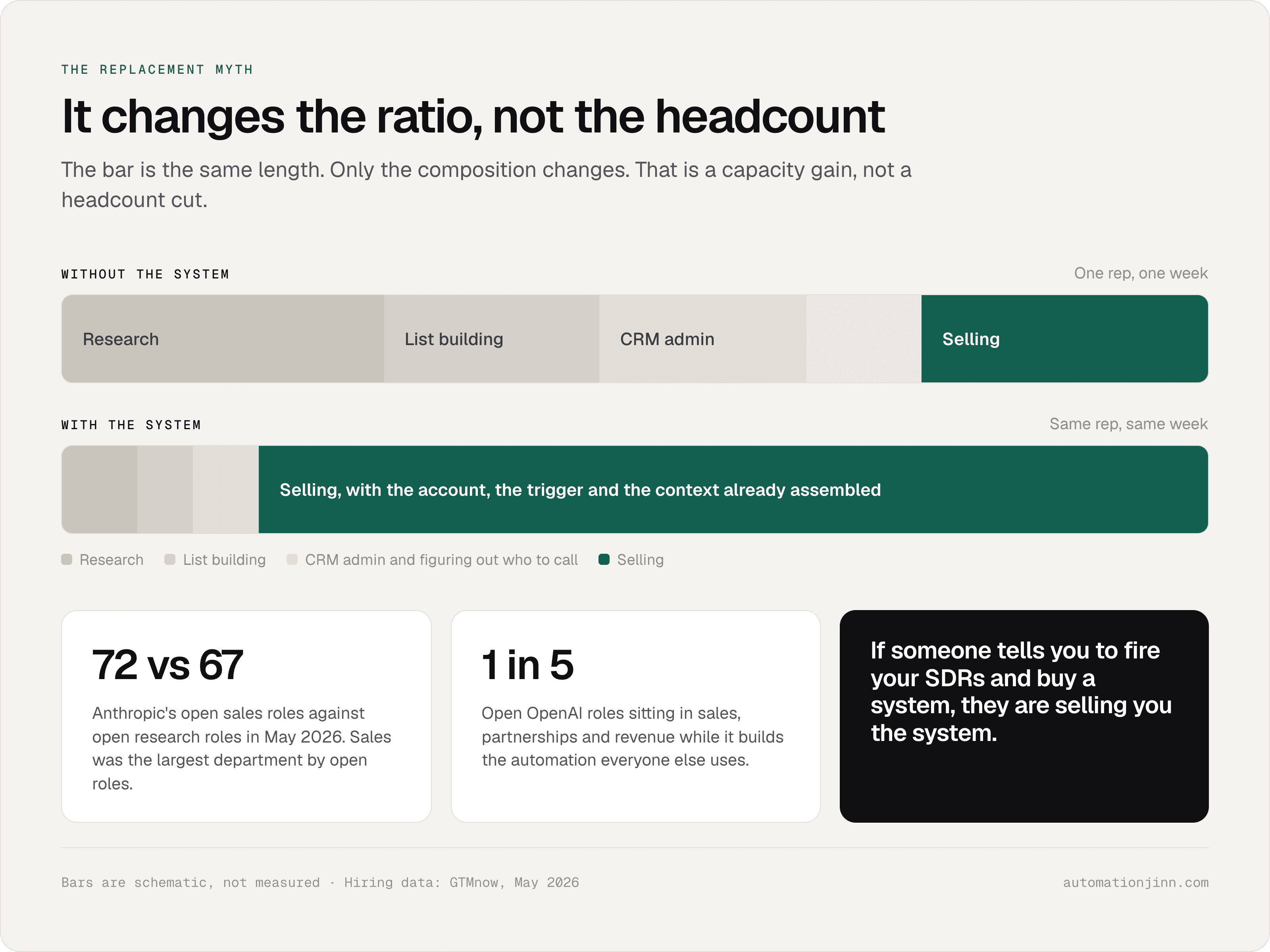
Anthropic, a company that builds the models everyone is automating with, had 72 open sales roles against 67 in research as of May 2026, with sales representing more open roles than any other department. Roughly one in five open OpenAI roles sit in sales, partnerships, and revenue. Clay, which coined the term, employs account executives and sellers and writes publicly about the plays its sellers run.
These are not organisations that lack the technical ability to automate their own outbound. They are hiring salespeople faster than researchers.
The reason is that automation and selling solve different problems. A system can find the account, spot the trigger, assemble the context, and put a qualified conversation in front of a human at the right moment. It cannot sit in a room with a sceptical CFO and a security reviewer and navigate a six-figure decision with four stakeholders who each want something different. Above roughly mid-market deal sizes, buying is a relationship and a risk decision, and neither of those automates.
What actually changes is the ratio of selling to preparation. Reps typically lose most of their week to research, list building, CRM admin, and figuring out who to call. GTM engineering takes that work away. It raises the capacity of each rep rather than reducing the number of them, and it usually makes reps better at the part you hired them for.
If someone tells you to fire your SDRs and buy a system, they are selling you the system.
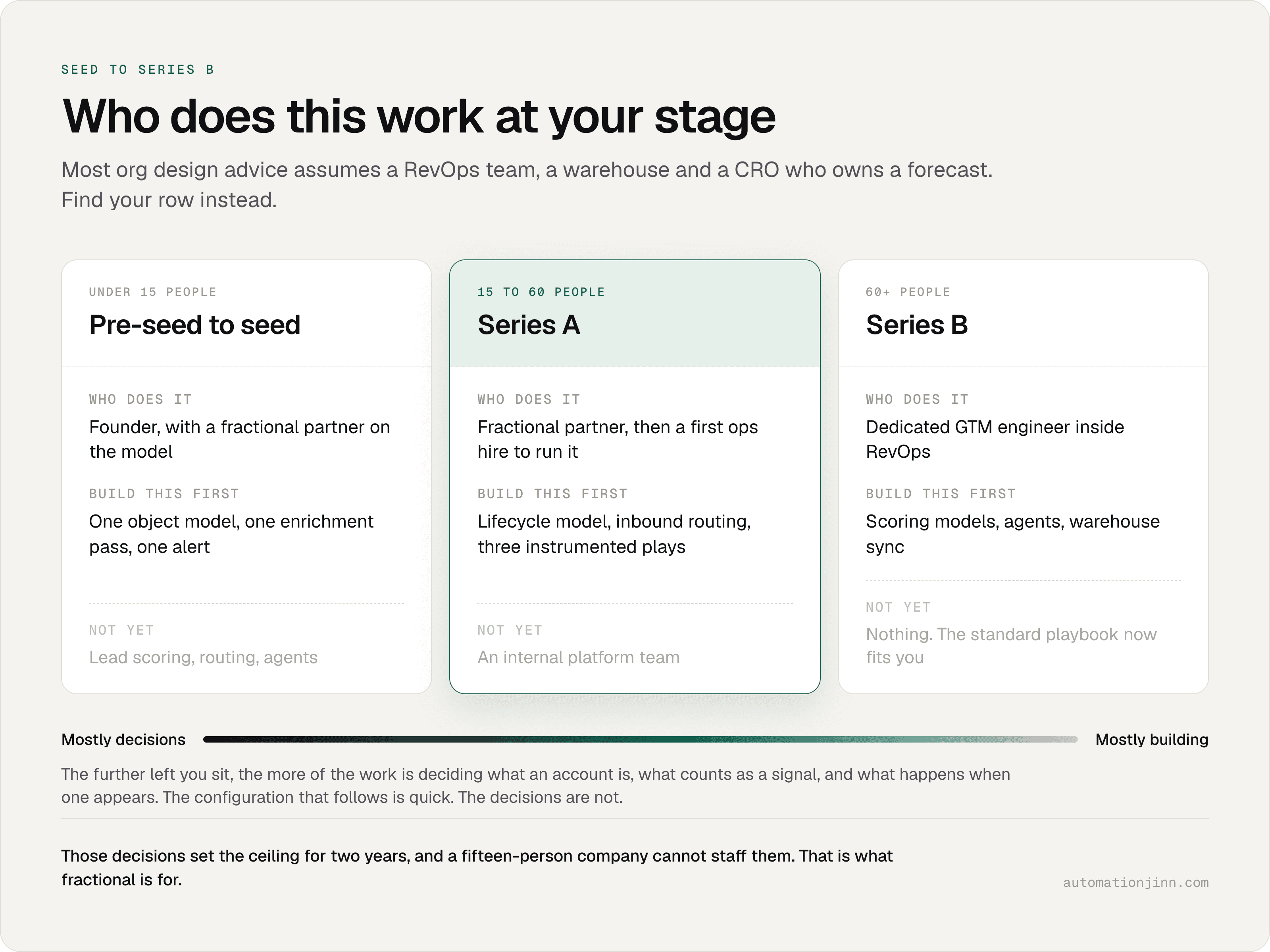
Almost every guide on this topic includes an org design section built on Intercom, Canva, Notion, Ramp, and similar. Those recommendations assume a RevOps team, a data warehouse, and a CRO who owns a forecast. If you have 25 people, that advice describes a company you will not be for four years.
Find your row instead.
Stage | Who does it | Build this first | Do not build yet |
|---|---|---|---|
Pre-seed to seed (under 15) | Founder, with a fractional partner on the model | One object model, one enrichment pass, one alert | Lead scoring, routing, agents |
Series A (15 to 60) | Fractional partner, then a first ops hire to run it | Lifecycle model, inbound routing, three instrumented plays | An internal platform team |
Series B (60+) | Dedicated GTM engineer inside RevOps | Scoring models, agents, warehouse sync | Nothing. The standard playbook now fits you |
The pattern worth noticing is that the further left you sit, the more the work is decisions rather than building. At seed, GTM engineering is mostly deciding what an account is, what counts as a signal, and what happens when one appears. The configuration that follows is quick. The decisions are not, and they set the ceiling on everything built on top of them for the next two years.
That is exactly the work a fifteen-person company cannot staff. A full-time GTM engineer is a six-figure line item for a workload that is dense for two months and light after that, and it puts the most consequential decisions in your revenue system in the hands of someone in their first sixty days. So founders make them instead, once, without having seen how each choice fails. This is the stage fractional exists for: senior decisions made by someone who has made them before, without the headcount.
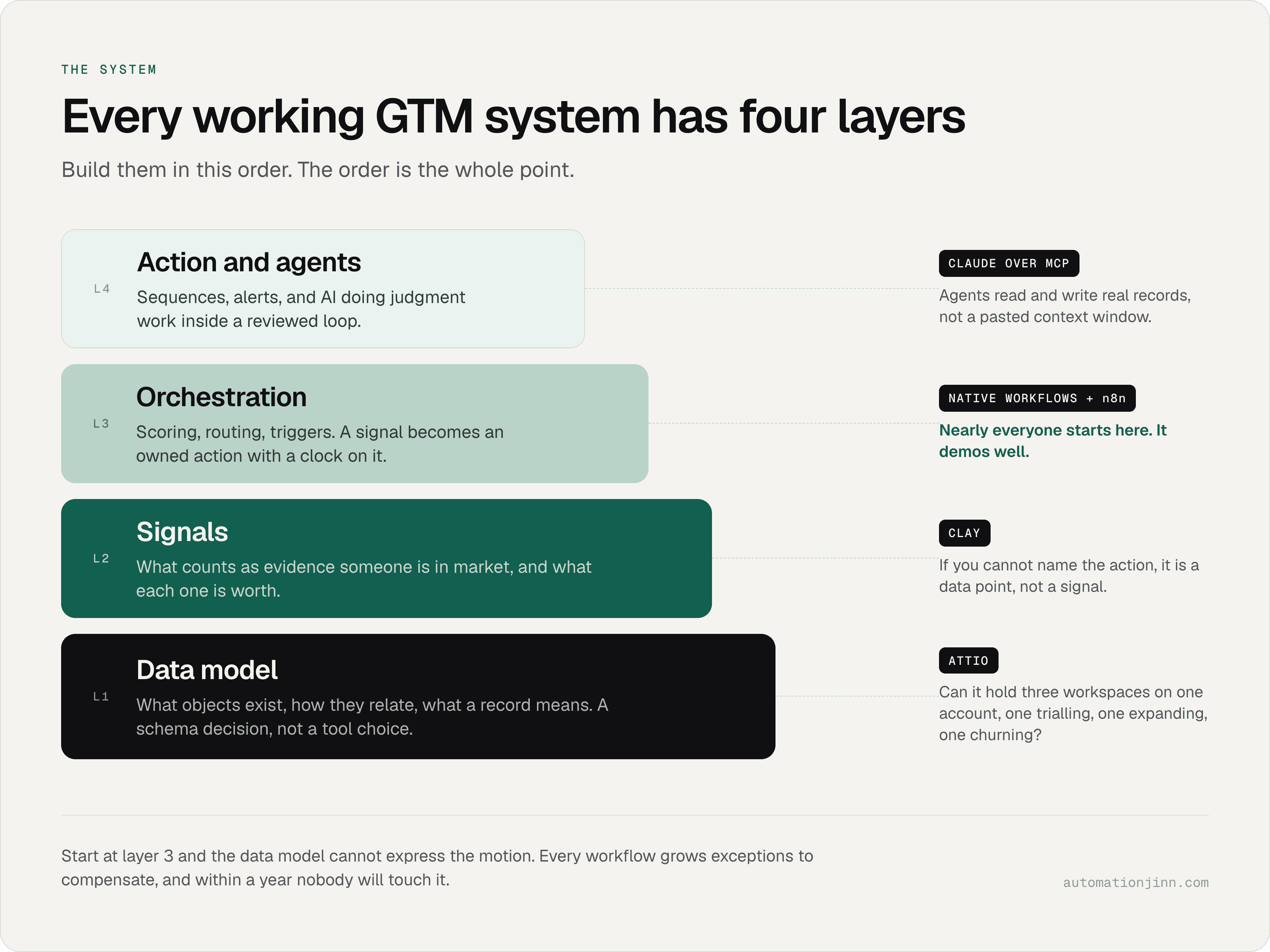
Every working GTM system runs on four layers, in this order.
Layer 1, the data model. What objects exist, how they relate, what a record means. Not a tool choice, a schema decision.
Layer 2, signals. What counts as evidence someone is in market, and what each one is worth.
Layer 3, orchestration. Scoring, routing, triggers, and the workflows that turn a signal into an owned action with a clock on it.
Layer 4, action and agents. Sequences, alerts, and AI doing judgment work inside a reviewed loop.
Nearly everyone starts at layer 3, because layer 3 demos well and feels like progress. Then the data model cannot express the motion, every workflow grows exceptions to compensate, and within a year nobody will touch it.
Here is the layer 1 test. Can your CRM express “this account has three workspaces, one is trialling, one is expanding, and one is quietly churning”? If it cannot, no amount of orchestration helps, because the thing you want to act on cannot be represented in the system you are acting from. Railway and Modal both left incumbent CRMs for exactly this reason: those systems could not model a usage-based, workspace-centric motion. The automation was never the blocker.
And the layer 2 test. “They visited the pricing page” is not a signal, because there is no obvious thing to do about it. “They visited pricing twice this week, have an open trial, and just added a second seat” is a signal, because it names an action. If you cannot state the action, you have a data point.
For the systems I build, layer 1 is Attio, because custom objects and two-way relationships let the schema match the motion rather than bending the motion to fit the CRM. Layer 2 is Clay. Layer 3 runs on native workflows plus n8n once the logic outgrows the CRM. Layer 4 is Claude over MCP, so agents read and write against real records instead of a pasted context window. Measurement closes the loop, which is where business intelligence work earns its keep.
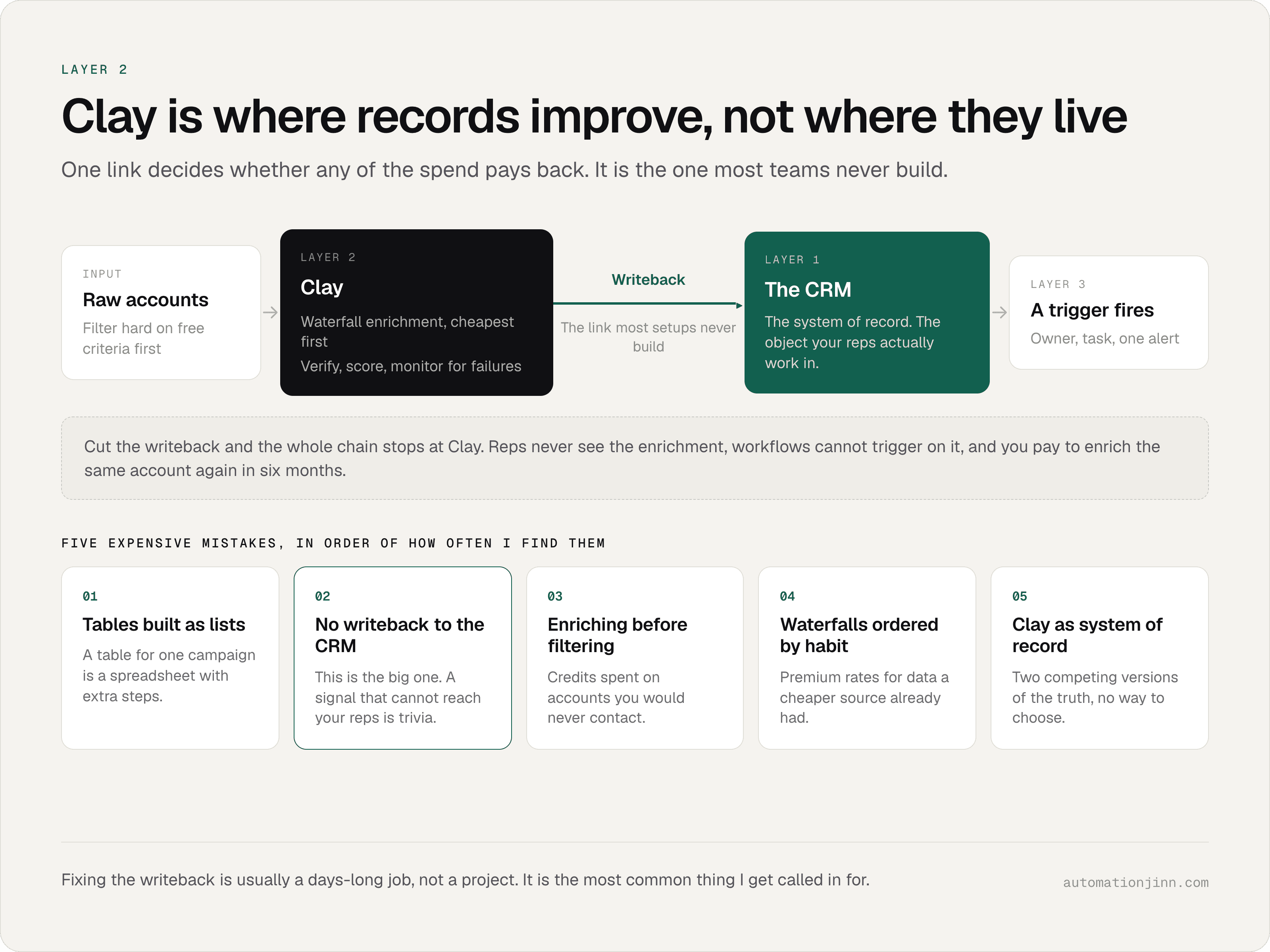
Clay is the best tool in this category and the one I see wasted most often. It is layer 2: the place records get better before they reach the CRM. It is not layer 1, and treating it as layer 1 is the root of most of the waste.
Five expensive mistakes, in rough order of how often I find them.
Tables built as lists instead of systems. A table assembled for one campaign is a spreadsheet with extra steps. The same table built as a standing pipeline, with new records flowing in, enriching, writing back, and monitored for failures, is infrastructure. The first gets rebuilt every quarter by whoever remembers how it worked.
No writeback to the CRM. This is the big one. Enrichment that lives and dies in Clay means reps never see it, workflows cannot trigger on it, and you pay to enrich the same account again in six months. If a signal cannot reach the object your reps work in, it is not a signal, it is trivia.
Enriching before filtering. Every record enriched before it is qualified is money spent on accounts you would never contact. Filter hard on cheap or free criteria first, then spend credits on what survives.
Waterfalls ordered by habit. Waterfall enrichment exists so you can try the cheap viable provider first and stop on a hit. Ordered carelessly, you pay premium rates for data a cheaper source already had.
Clay as the system of record. It is not. The CRM is. Clay is where records improve, not where they live. Teams that get this backwards end up with two competing versions of the truth and no way to decide between them.
Fix the writeback problem and the Clay spend you already have starts returning pipeline. It is the most common thing I get called in for, and it is usually a scoped fix rather than a rebuild, provided the object model can carry the data. If it cannot, writeback just moves the mess into your CRM faster. If your Clay tables are producing good data that never reaches anyone, book a call and I will tell you which of the five it is.
Abstractions are easy to agree with, so here is a specific build for a Series A product-led company. The goal is catching expansion before the customer asks.
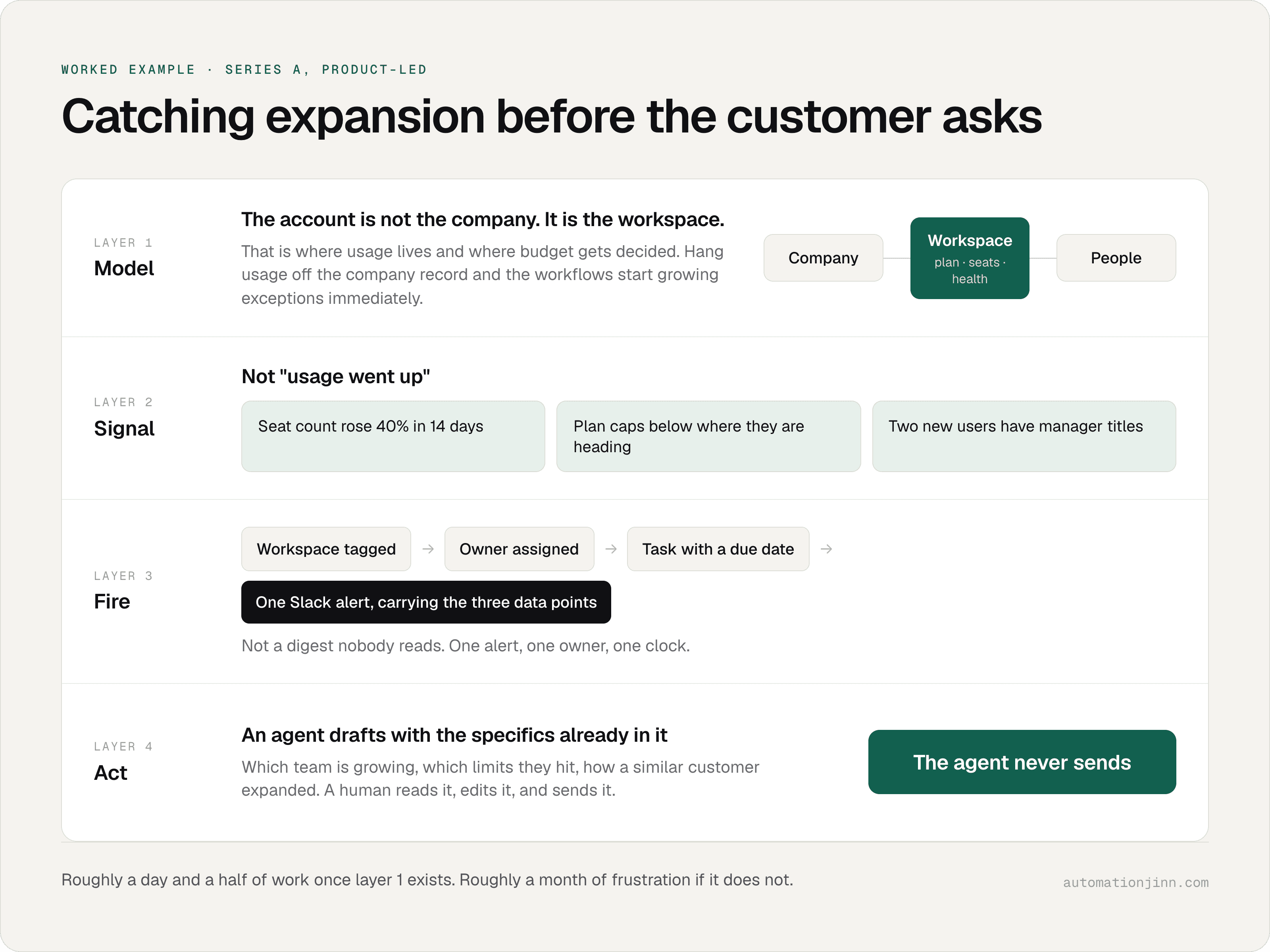
Layer 1. The account is not the company, it is the workspace, because that is where usage lives and where budget gets decided. So the model gets a Workspace object linked to Company and People, each carrying its own plan, seat count, and health. Teams that skip this try to hang usage data off the company record, which is the exact moment the workflows start growing exceptions.
Layer 2. The signal is not “usage went up.” It is “seat count rose 40% in 14 days on a workspace whose plan caps below where they are heading, and two of the new users have manager titles.”
Layer 3. When it fires: the workspace gets tagged, an owner is assigned, a task appears with a due date, and one Slack alert goes to that owner carrying the three data points that triggered it. Not a digest nobody reads. One alert, one owner, one clock.
Layer 4. An agent drafts the outreach with the specifics already in it: which team is growing, which limits they hit, how a similar customer expanded. A human reads it, edits it, and sends it. The agent never sends.
On a correct layer 1, that play is a small build. Without one, the same play takes a month, accumulates exceptions, and stops working within a quarter. The difference is never the automation. It is the model underneath, which is the part nobody demos.
Palantir never told the CIA to go hire forward deployed engineers. It deployed them. That distinction is the whole argument for how seed to Series B teams should buy this.
The work is front-loaded, and then it is not. Architecture is six to ten weeks of dense, senior, decision-heavy work: what the objects are, what a signal is, where truth lives, what happens on conflict. After that it becomes maintenance and extension, which is a different job at a different intensity. Hiring full time for a front-loaded workload means paying peak rate for trough work indefinitely, and it means the most consequential decisions in your revenue system get made by someone in their first sixty days at your company.
There is supporting evidence in the AI deployment data. MIT’s Project NANDA studied 300+ enterprise deployments and found 95% of generative AI pilots produced no measurable P&L impact. The part that matters is the split underneath it: deployments bought from specialised vendors and run through partnerships reached production roughly 67% of the time, far more often than internal builds. The gap was integration, not model quality.
A fractional engagement fits the shape of the work. You get senior architecture decisions made by someone who has made them before, on a defined scope, without converting a two-month problem into a permanent line item. Then you hire onto a system that already works, which is a far easier role to fill and a far easier one to succeed in.
This is where most agency engagements quietly fail, so make these non-negotiable with anyone you work with, me included. I write all five into scope.
You own every account and every credential from day one, with no agency-held logins. The data model is documented, not just built, in something a new hire can read. Every workflow has a named owner on your team before handover. The handover is a recorded working session, not a PDF. And if you end the engagement tomorrow, everything keeps running and you keep all of it.
An engagement that cannot survive those five conditions is selling you a dependency. That is what my fractional GTM systems work is built around, and every engagement is designed to end with your team owning the system outright
Phase | Roughly | What comes out of it |
|---|---|---|
Motion and model design | Week 1 to 2 | Object model, lifecycle definitions, signal list with named actions |
Foundation | Week 2 to 4 | Deduped and enriched data, field ownership, integrations live |
Plays | Week 4 to 8 | Three instrumented plays: one inbound, one outbound, one lifecycle |
Agents and handover | Week 8 to 10 | Agents where judgment repeats, documentation, team trained |
Scope moves with the state of your current data. A rebuild on a messy five-year-old HubSpot instance takes longer than a greenfield build, and the honest version of that estimate comes after looking at the data rather than before.
Give yourself a point for each one that is true today.
You can name your ICP in one sentence without hedging.
Your last ten closed-won deals resemble each other.
Something manual is capping growth, and it is not headcount.
You know which handoff leaks.
More than roughly 50 to 100 relevant accounts move through a month.
Someone owns the CRM, even part time.
0 to 2: not yet. A system would encode a guess and then scale it, which is the expensive way to learn you had the wrong ICP. Sell manually for another quarter and watch where it breaks. Come back when three of these are true.
3 to 4: fix the foundation, do not automate. You almost certainly need the data model and data hygiene sorted before any workflow gets built. That is usually two to three weeks of work, and doing it now is what stops you rebuilding everything at Series B.
5 to 6: you are leaving money on the table right now. You have signals you can see and cannot act on, and reps spending their week on work a system should be doing. Every month at this stage is pipeline that quietly does not happen.
If you scored 5 or 6, the fastest next step is a 30-minute call to work out what to build first.
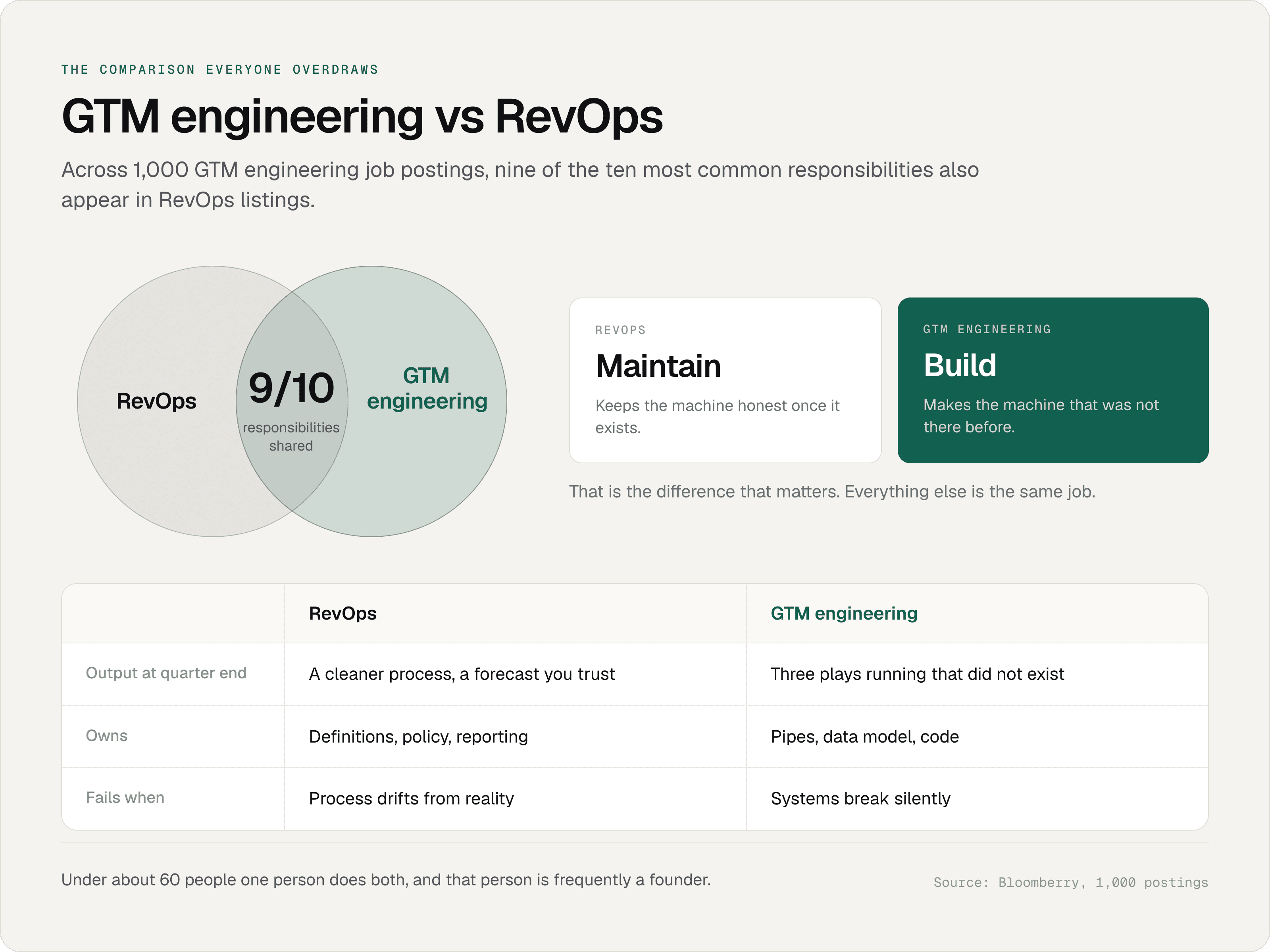
Almost every article draws a hard line here. The data does not support it. Bloomberry analysed 1,000 GTM engineering job postings and found nine of the ten most common responsibilities also appear in RevOps listings, concluding the two jobs are essentially the same. That is the same study everyone cites for the 205% growth figure, which tells you how selectively a number travels.
The difference that matters is maintain versus build.
RevOps | GTM engineering | |
|---|---|---|
Output at quarter end | A cleaner process, a forecast you trust | Three plays running that did not exist |
Owns | Definitions, policy, reporting | Pipes, data model, code |
Fails when | Process drifts from reality | Systems break silently |
Under about 60 people one person does both. Usually that is a founder doing it between everything else, which is why the build half is the half that never happens. Below Series B the answer is not to split the role in two. It is to borrow the build half.
This post argues that most seed to Series B teams should deploy rather than hire, so it is fair to say exactly what deploying looks like before you commit anything.
There is no deck. We open your actual CRM and Clay workspace and look at what is there. By the end of the call you will have a sketch of the object model your motion needs, the three plays worth building first in order, and a direct answer on whether you need a build, a hire, or neither.
You keep all of that whether or not we work together. If the answer is that you are too early, I will say so on the call, because a build at the wrong stage fails and neither of us wants that reference.
If you are running Attio, Clay, or both and something is not connecting, that is the specific problem I get called in for most. Book a discovery call and bring your current setup.
A GTM engineer builds and runs the systems behind a go-to-market motion: the CRM data model, enrichment pipelines, scoring, routing, workflows, and AI agents. The clearest analogy is a forward deployed engineer, the Palantir role now common at OpenAI and Anthropic, pointed at your own revenue team instead of a customer’s.
GTM stands for go-to-market. GTM engineering applies engineering practice to how a company markets, sells, and retains, rather than to the product itself. It is unrelated to Google Tag Manager, which shares the acronym and causes regular confusion in search results.
No, but most serious stacks use it, and it is the strongest enrichment and signal layer available. The caveat is that Clay is layer 2, not the whole system. It only pays back when enrichment writes into your CRM and triggers something. Clay without writeback is an expensive list builder.
No. It removes the research, list building, and admin around selling, which raises each rep’s capacity rather than reducing rep count. Anthropic and OpenAI both hire heavily into sales while building the automation everyone else uses. Complex deals stay human.
Below roughly Series B, usually fractional first. The architecture work is front-loaded and senior, while ongoing ownership is a different, lighter job. Getting the system built first also makes the eventual hire far easier, because they inherit something that works instead of a blank workspace.
It depends on whether you are buying construction or ownership. A scoped architecture and build engagement at seed to Series B runs $8,000 to $15,000, driven by the state of your data, how many objects the motion needs, and how many plays go live. A rebuild on a messy CRM costs more than a greenfield build. The cheapest path is getting the architecture right once, because the expensive version is paying twice.
Sparsh Gupta, Founder of Automation Jinn and an Official Attio Expert Partner, works as a fractional GTM engineer for seed to Series B B2B SaaS teams, building the data model, workflows, and agents and handing them over documented. If you want to know what your stage actually needs before you open a role, book a discovery call and we will map it in 30 minutes.