GTM Tech Stack (2026): The Nine Layers That Compound

•
•
A GTM tech stack in 2026 has nine layers: system of record, data and sourcing, signal, routing, outbound, lifecycle, conversation, orchestration, and reporting.
Here is what nobody tells you while you are picking tools. Most teams choose well. They read the comparisons, they buy sensible products, and eighteen months later the stack is still a mess. Not because a tool was wrong. Because nine tools each quietly became their own source of truth. Clay thinks the account is one thing. The sequencer thinks it is another. The dashboard reports a third, and by the time someone notices, three people are arguing about a number in a board deck.
The stack that scales is not the one with the best tool in every layer. It is the one where all nine layers agree on what an account is.
Layers are permanent. The tools inside them are not. So the useful question is never which tool to buy this quarter. It is whether what you buy now can still be added to at thirty seats without a migration.
The stage labels below are shorthand for team size and motion, not funding events. If you are bootstrapped with fifteen people on GTM, read the Series A column.
# | Layer | What it should produce | What we run |
|---|---|---|---|
1 | System of record | A model of your business a rep will actually update | Attio |
2 | Data and sourcing | Accounts worth contacting, verified | Clay, Sales Navigator |
3 | Signal | A reason to reach out today | PostHog, RB2B |
4 | Routing | The right lead on the right calendar, fast | Attio workflows, booking tool |
5 | Outbound | Volume that lands in the inbox | Smartlead, HeyReach |
6 | Lifecycle | Messaging that reacts to behaviour | Loops, Customer.io |
7 | Conversation | What was actually said, on the record | Granola, Gong |
8 | Orchestration | Judgment, plus a runtime that never forgets to fire | Claude, n8n |
9 | Reporting | Answers, not dashboards | Metabase or Hex |
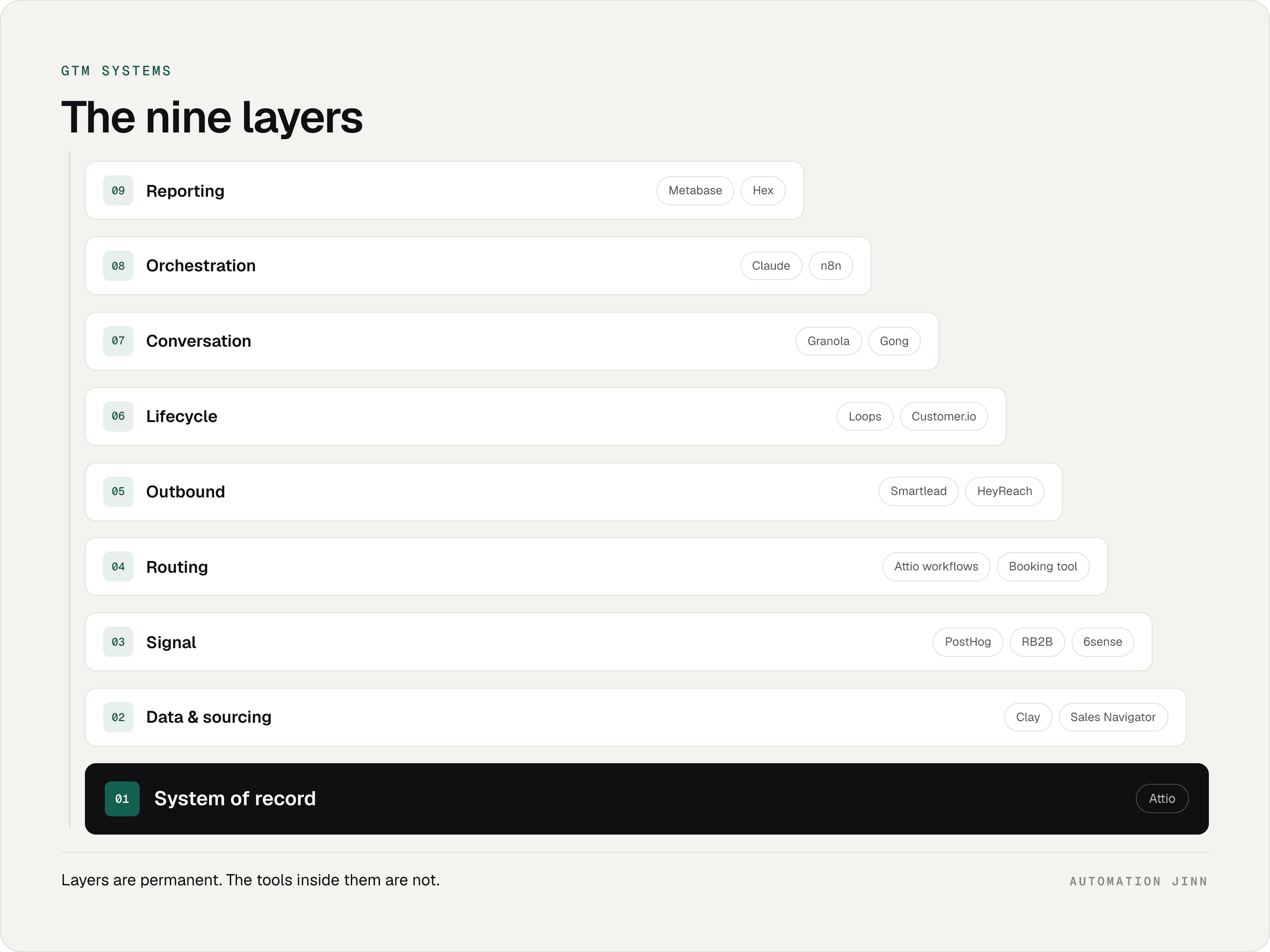
Every pick above has a boundary. Naming them is not hedging, it is the difference between a reference architecture and a brochure.
Layer | Default | Pick something else if |
|---|---|---|
System of record | Attio | You need a full marketing suite in one place, with landing pages, ads and large-scale nurture. Then HubSpot might be a better fit |
Data | Clay | You are still finding your ICP and enriching a few hundred accounts. Apollo is simpler until volume makes a waterfall pay |
Signal | PostHog | You have a data team that wants deep behavioural cohorting. Amplitude goes further |
Orchestration | Claude and n8n | Your workflows are deterministic and low-volume. Then n8n alone is the honest answer, and the model layer can wait |
Reporting | Metabase | Someone owns analysis as their actual job and most users build rather than read. Then Hex |
The usual advice is to buy enrichment first, because contact data decays. That is half right. Enrichment writes into something, and the something is what breaks.
You have seen this even if you have not named it. A team buys good enrichment, points it at a CRM with three standard objects, and crams everything into Companies and People. Six months later they have accurate data in fields that mean three different things to three different reps. Firmographics sit next to product-usage flags next to a free-text notes column somebody has been using for pricing. Match rates are excellent. The pipeline report is fiction.
The tell is always adoption. Attio’s customer Granola built a custom Inbound Leads object with tiered workflows into Deals, cut lead triage by 83%, turned a two-hour daily review into twenty minutes, and got 100% GTM adoption. Attio’s customer Railway runs a usage-based PLG motion on a custom Workspaces object that Salesforce and HubSpot could not represent at all.
None of those numbers are about features. They are about whether the system matched the business closely enough that people used it without being chased. A CRM nobody updates produces nothing for the eight layers above it, and every one of them reads from or writes to it.
Layer 1, system of record. Attio, because you can model what you actually sell to instead of bending your business into Companies, Contacts and Deals. If you sell to workspaces, you get a Workspaces object. If one customer runs five of them on separate plans, that relationship is modelled rather than implied by a naming convention nobody follows. This is the layer that decides whether the next eight compound or collide, and it is the one you cannot cheaply change later.
Layer 2, data and sourcing. Clay for enrichment and research, Sales Navigator for discovery. Clay orchestrates waterfalls across roughly 200 providers, so a paid lookup only fires when a cheaper source misses. The outcomes are the argument: Clay’s customer Intercom reports +140% outbound-sourced pipeline, Clay’s customer Anthropic reports 3x enrichment coverage while consolidating several data vendors, and Clay’s customer Pump reports +30% booked meetings and 6x faster rep ramp. Sales Navigator stays because no enrichment tool replaces searching LinkedIn’s graph directly.
Layer 3, signal. The layer that decides whether outbound is a numbers game or a timing game. PostHog covers product signals, and its free tier handles a million events a month with unlimited team members, which outlasts most seed teams. RB2B resolves anonymous website visitors and pushes straight into Clay, so a research session on your pricing page becomes an enriched account rather than a line in an analytics chart.
Layer 4, routing. The layer everyone forgets until inbound starts converting badly. A lead arrives, gets qualified, gets assigned, and gets on a calendar, and every minute between those steps costs conversion. Attio workflows handle qualification and assignment natively, so the only new tool is a booking layer. The mechanics deserve their own treatment, covered in our guides to lead routing and lead qualification.
Layer 5, outbound. Smartlead or Instantly from day one, not later. Clay does ship a sequencer, and it is powered by Smartlead underneath, running on Clay credits with no Smartlead account required. It is fine for a quick test. It is the wrong thing to build a motion on, because you will move to the real sender anyway and paying Clay credits to send commodity email is an odd way to spend an enrichment budget. Buy the tool you will still be using at Series B. HeyReach covers LinkedIn and integrates natively with both.
Layer 6, lifecycle. Loops early, Customer.io once messaging needs to branch on behaviour rather than fire on a schedule. Customer.io brings unlimited seats, custom objects and an MCP server, and it gives 12 months free to companies that have raised under $10M.
Layer 7, conversation. Granola, because it writes into Attio natively and the notes land on the record rather than in a separate archive nobody opens. Gong later, when you have enough reps that coaching at scale beats reading notes.
Layer 8, orchestration. This layer does two jobs, and collapsing them is how teams get burned. Claude does judgment: does this account fit ICP and why, score this transcript, write the personalisation. n8n Cloud is the runtime: when a signal fires, enrich, write, alert, four thousand times a month, identically, with retries and logs.
Put judgment in n8n and you get a brittle if-else tree that breaks on the first company that does not look like the last hundred. Put the runtime in Claude and you get a model that has to remember to fire, which is non-determinism in the one layer whose whole job is reliability. Run n8n Cloud rather than self-hosting while you are at it, because a free workflow that silently fails at 2am is not free.
Layer 9, reporting. Attio’s native reporting until the questions outgrow it, then Metabase or Hex. The choice turns on who is asking. Metabase suits a head of sales who wants to open a dashboard and read a number. Hex is built for someone who owns analysis as their job. Watch the billing models rather than the sticker price: Metabase counts everyone who signs in, Hex bills editors and keeps viewer seats as an unpublished Enterprise add-on. If six people build and twenty-four read, that ratio moves the bill more than the list price does.
Here is the thing teams get backwards. They upgrade their Smartlead plan when what they are actually short of is mailboxes.
Your send ceiling is a function of mailbox count, not plan tier. Roughly 30 emails per mailbox per day is the safe operating limit. Everything else is arithmetic.
Domains / mailboxes | Safe daily sends | Monthly ceiling |
|---|---|---|
5 / 25 | ~750 | ~15,750 |
12 / 60 | ~1,800 | ~37,800 |
25 / 125 | ~3,750 | ~78,750 |
A seed team running real outbound needs roughly 25 mailboxes across five domains. Not two domains and six mailboxes, which is a founder testing an ICP, not a company building pipeline. Start on Smartlead’s Pro plan and you have 90,000 monthly sends of headroom against a 15,750 ceiling, which is the right way round: the plan should never be the constraint, the infrastructure should be, because infrastructure you can add in an afternoon.
Cold outbound generates bounces and spam complaints. Your primary domain carries your sales replies, your invoices, your lifecycle email and your password resets. Burn it and all of that degrades at once, and recovery takes months.
So you buy lookalike domains, put five mailboxes on each, leave warm-up running permanently, and send everything cold from those. This is day-one hygiene, not a Series B upgrade. What actually changes later is moving off a shared IP pool onto dedicated IPs and servers, so a stranger’s sending reputation stops being your problem.
Most people reading this already own a stack. Five checks, ten minutes, and you will know which one you have.
Can you answer “how many accounts matched ICP last month” without exporting anything? If the answer lives in a spreadsheet somebody rebuilds monthly, your scoring is not in the system, it is next to it.
Ask three people what “qualified” means. One answer means the definition is a field. Three answers means it is a vibe, and every downstream number inherits the disagreement.
Is any scoring or segmentation logic living in a saved view? Filters are not logic. A filter is one person’s opinion, invisible to every other tool, and it leaves when they do.
If your best rep left tomorrow, what leaves with them? If the answer includes anything about how deals get prioritised, that logic was never in the stack.
Can an agent read your account status, or does a human have to open a tab? This one gets more expensive every quarter.
Fail two or more and the problem is not your tools. It is that nothing is enforcing a single definition across them, which is exactly what our Attio and Clay implementations exist to fix.
None of these show up on an invoice.
Choosing a CRM that cannot model your motion. Reps stop updating it, the forecast runs on stale stages, and the eventual migration re-maps every integration in the stack rather than one. Attio’s customer Modal left HubSpot for exactly this reason: it could not model workspaces.
Sending cold email from your primary domain. One of the few GTM mistakes that damages a system you cannot replace. Recovery is measured in months and there is no vendor to escalate to.
Buying sending before signal. A sequencer pointed at an unqualified list produces bounces, complaints and a scorched domain. Sending is a commodity. The reason to send is the asset.
Buying the sequencer you will replace. Convenience now, migration later, and the migration always lands in the quarter you are trying to hit a number.
Buying tools an agent cannot operate. Anything without an API or MCP server becomes a permanent manual step, and that tax compounds every quarter your team runs more work through Claude.
Letting each tool keep its own version of the truth. The quiet one, and the reason the others hurt so much. Fix it and the stack compounds. Leave it and you own nine tools and no system.
Scale does not degrade a stack gradually. It breaks it at specific cliffs, most of them invisible while you are choosing tools at five seats.
Cliff | What happens | Plan for it by |
|---|---|---|
10 seats on Attio Plus | Hard cap, and no custom objects on that tier anyway | Starting on Pro |
Object model set wrong | Retrofitting re-maps every integration, not one | Modelling before you fill anything |
Reporting limits | 3 reports on Free, 15 on Plus, 100 on Pro | Knowing which tier your questions need |
Permissions | None on Free, basic on Plus, advanced on Pro | Pro before your first non-founder hire |
Mailbox ceiling | Volume stalls while the plan has headroom | Counting mailboxes, not plan tiers |
Reporting seats | Per-user and per-editor billing diverge sharply at 30 | Counting builders and readers separately |
None of these are performance problems. They are architecture problems that arrive on a schedule, and the cheapest moment to solve them is before the team depends on the thing you have to change.
Stage labels are useless on their own. These are the conditions that should actually make you buy.
Addition | Buy it when |
|---|---|
HeyReach | LinkedIn is a real channel with more than one sender, not a founder’s inbox |
RB2B | Enough inbound traffic that anonymous visitors are worth resolving |
Customer.io over Loops | Lifecycle messaging branches on behaviour, not just on a schedule |
More mailboxes | Reps are hitting daily send limits, whatever the plan allows |
Dedicated IPs and servers | One bad campaign would damage a domain your revenue depends on |
Gong | Enough AEs and SDRs that coaching at scale beats reading call notes |
6sense | The motion is account-based demand gen, not named-account outbound |
Hex over Metabase | Someone owns analysis as their job, and most users build rather than read |
Warehouse plus Hightouch | Product events exceed what belongs on a CRM record |
The connective tissue is where stacks leak. Signal fires in PostHog or RB2B, Clay enriches and scores the account, the result writes to an Attio record, a workflow routes it to a rep or a sequence, Granola captures the call, and the reporting layer reads the whole path back. n8n and Claude carry anything the native integrations do not.
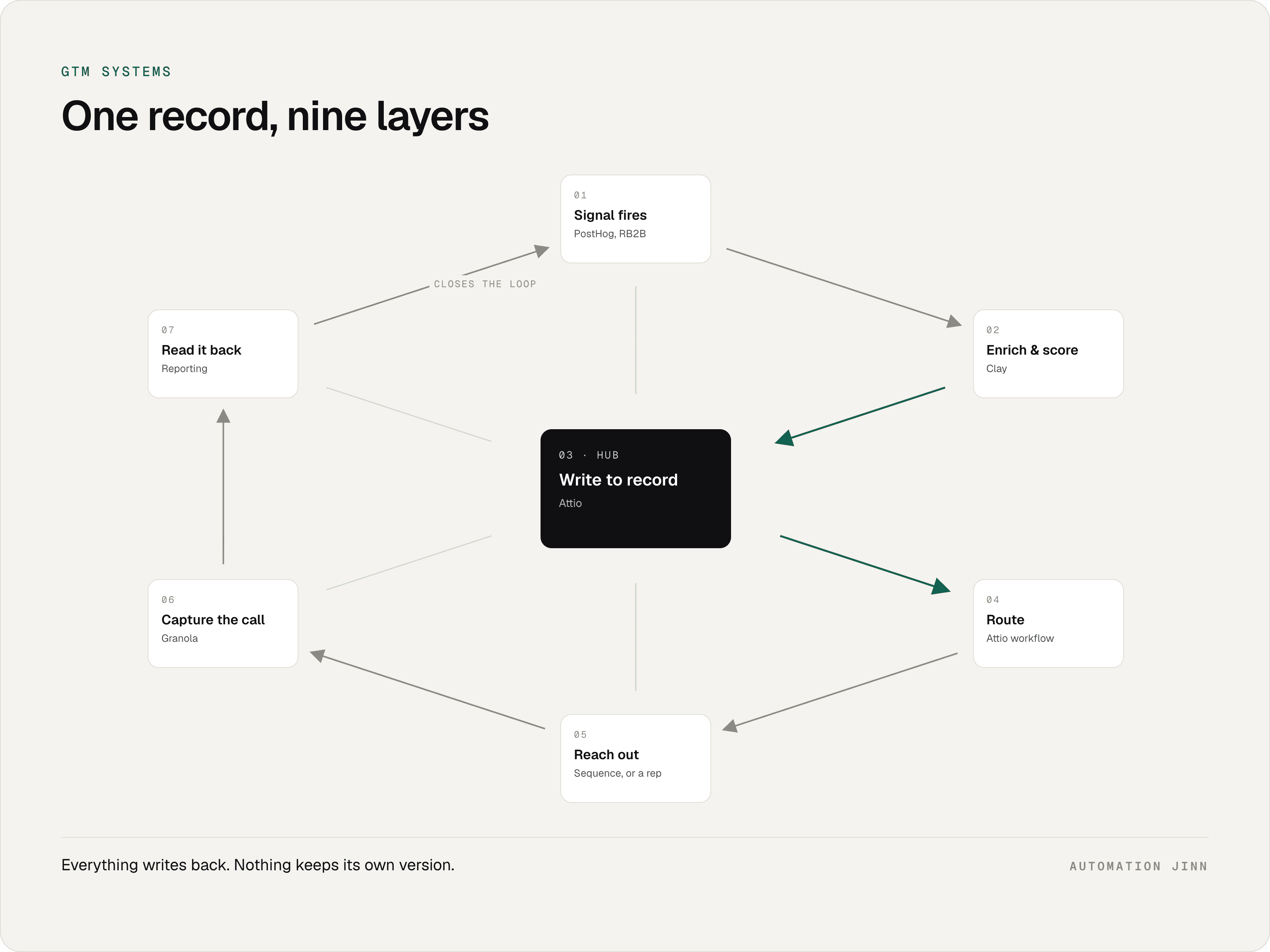
Two rules keep that flowing, and they are the entire thesis in practice. Everything writes back to one object in Attio rather than living in the tool that created it. And every score or status is a field on a record, never a filter in someone’s saved view.
Break the first and your tools disagree. Break the second and your logic lives in one person’s head, which works fine until they take a holiday. It is unglamorous work, and it decides whether the other eight layers were worth buying.
If your team runs research, scoring or list-building through Claude, every tool is either reachable by that model or it is a manual step forever. This is the quietest change in the 2026 stack: seven of these nine tools now ship an MCP server, and five ship a command line as well.
Tool | MCP server | CLI | API and webhooks |
|---|---|---|---|
Attio | Yes | Yes, plus App SDK | |
Clay | Yes | Yes | |
n8n | Yes | Yes | |
PostHog | Yes | Yes | |
HeyReach | Yes | Yes | Yes |
Customer.io | Yes | Yes | |
Granola | Yes | Yes, on Business | |
Hex | Yes | Yes | |
Smartlead | Yes |
Blank means the vendor does not publish it today, not that it will never exist. This table dates faster than the pricing.
An API means you can build against it. An MCP server means a model can operate the tool without you writing and maintaining glue code, and a CLI means an agent working in a terminal can drive it directly. The practical consequence: a GTM engineer running Claude Code can now touch most of this stack without a single custom integration, which was not true a year ago. That gap is a legitimate tiebreaker between two otherwise similar products, and we go deeper on the CRM side in our guide to connecting Attio to Claude and AI agents.
Published annual-billing rates, verified against each vendor’s own page. Three lines are usage-based rather than fixed and belong in a separate budget: Clay actions and data credits above plan, PostHog above its free tier, and Hightouch.
GTM seats | Fixed year 1 | Per month |
|---|---|---|
5 | $13,298 | $1,108 |
15 | $45,799 | $3,817 |
30 | $107,233 | $8,936 |
Seed covers Attio Pro, Clay Launch, two Sales Navigator seats, Smartlead Pro with five domains and twenty-five mailboxes, Granola and Claude Team, with PostHog and Loops on free tiers that comfortably suffice. Series A adds RB2B, HeyReach, Customer.io, Metabase and roughly triple the sending infrastructure. Series B adds dedicated IPs and servers, Hex, and larger seat counts, and excludes Gong, 6sense, Hightouch and the warehouse, none of which publish self-serve pricing. Add n8n Cloud at €20 a month on Starter and €50 on Pro; n8n prices in euros, so it sits outside these totals, plus a booking tool for layer four.
For scale on the layer that matters most: Attio Pro at $79 per user per month annually against HubSpot Sales Hub Enterprise at $150 plus a $3,500 onboarding fee, per HubSpot’s pricing page, is a $16,280 difference at 15 seats in year one. Custom objects are Pro and above in Attio and Enterprise-only in HubSpot Sales Hub, which is why that is the fair comparison.
Two figures commonly quoted wrong: Attio seat prices went up, so Plus is $35 and Pro $79 annually, and Clay bills on two meters, with Launch including 2,500 Data Credits and 15,000 Actions and Growth including 6,000 and 40,000. Guides that say “credits” are describing half the bill.
Verify current pricing on each vendor’s site before buying.
The cheap Attio tier is not the real entry tier. Custom objects start on Pro, so budget accordingly rather than discovering the ceiling in month three.
Clay spend is hard to forecast in month one. Two meters plus waterfall behaviour means your first invoice teaches you something plan selection did not. Set guardrails on the expensive lookups before you run volume.
RB2B’s person-level identification is US-only. Elsewhere you get company-level resolution, which changes the play from emailing a person to routing an account.
Nine layers means nine things that can quietly stop. More surface area is the price of a stack that compounds, and it is exactly why the orchestration layer is not optional.
None of that argues for a different stack. It argues for designing it once, deliberately, instead of assembling it under deadline.
Nine layers, webhooks, enrichment waterfalls and agent access need an owner. In 2026 that role is usually a GTM engineer: part RevOps, part builder, the person who makes signal flow into enrichment into routing into sending without anyone exporting a CSV.
Most seed to Series B teams cannot justify the hire yet, which leaves three options. Run it yourself and learn credit efficiency by overspending on it. Hire a freelancer, fast and cheap right up until they leave and nothing is documented. Or have it built once as a system you own, which is what our GTM systems work does, starting at the object model and working outward.
A GTM tech stack is the set of tools a company uses to find, reach, convert and measure customers. It has nine layers: system of record, data and sourcing, signal, routing, outbound, lifecycle, conversation, orchestration and reporting. Seed teams typically run six, adding the rest as specific triggers hit.
Common GTM tools by layer: Attio, HubSpot and Salesforce for system of record; Clay, Sales Navigator and Apollo for data; PostHog, RB2B and 6sense for signal; Smartlead, HeyReach and Outreach for outbound; Customer.io and Loops for lifecycle; Granola and Gong for conversation; n8n and Claude for orchestration; Metabase and Hex for reporting.
Fixed cost runs about $13,300 in year one at five seats, $45,800 at fifteen and $107,200 at thirty, on published annual rates. Usage-based lines sit on top: Clay credits above plan, PostHog above its free tier, and Hightouch. Gong, 6sense and Hightouch’s paid tiers are quoted rather than listed.
The system of record, chosen for its data model rather than its feature list. Every other layer writes into the CRM schema, so a wrong schema corrupts everything downstream regardless of enrichment quality, and replacing it later means re-mapping every integration rather than one.
Roughly one mailbox per 30 safe daily sends. A seed team running real outbound needs about 25 mailboxes across five secondary domains, which supports 750 sends a day. Your ceiling is set by mailbox count, not by your sending plan, so add mailboxes before upgrading tiers.
The nine-layer table near the top is the template, paired with the table of where each default is the wrong call. Copy the layer structure and the trigger list rather than the specific vendors, since the right pick in layers two through six depends on your motion, volume and where you sell.
Sparsh Gupta, Official Attio Expert Partner, helps seed to Series B B2B SaaS teams build GTM systems where every layer agrees on what an account is. If you want yours wired into one data model, book a discovery call.