AI Consulting Services (2026): What You're Actually Buying


•
•
AI consulting services are six separable things sold under one word: a workflow audit, data and systems cleanup, the build, integration work, reporting, and handover. Most firms sell you the build and quietly drop the two components that decide whether it survives contact with your business.
That is not a pricing problem, it is a diagnosis problem. The agent is the last part of the work. Everything before it is the system the agent reads from and writes to, and if that system is wrong, you have not bought automation. You have bought a faster way to produce confident nonsense.
MIT’s Project NANDA reviewed over 300 publicly disclosed AI initiatives and found that roughly 95% of enterprise generative AI pilots produced no measurable P&L impact. That number gets quoted as proof AI is overhyped. Read the failures and it is almost never the model. The model was pointed at a CRM nobody trusted.
An agent that researches inbound leads has to write to a company record. Which object holds the truth when your CRM says one thing and your billing system says another? Who owns that field? What happens when enrichment pushes in a duplicate? Nobody asks those questions in a demo, because a demo runs on the clean case. Production runs on the exceptions.
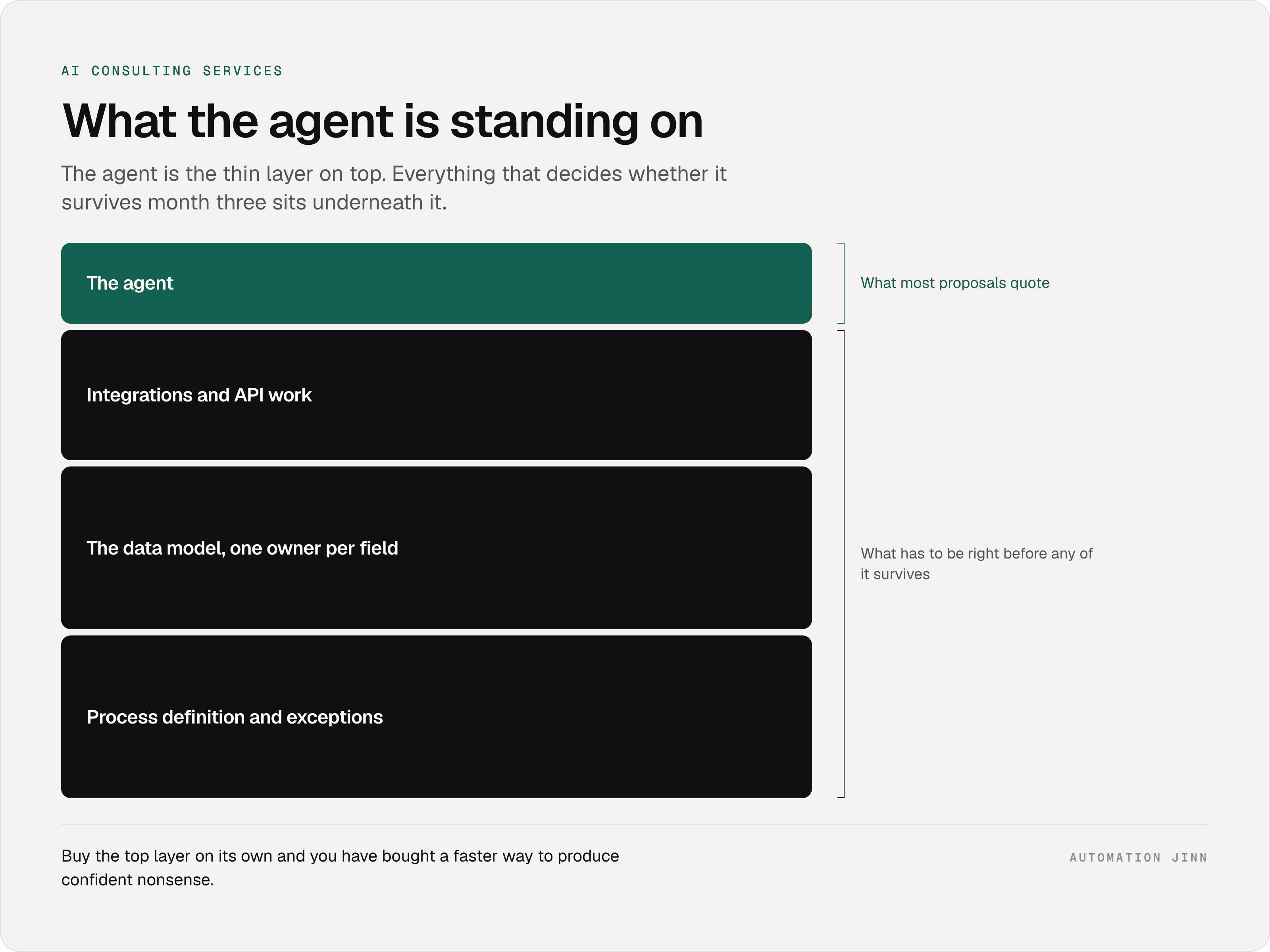
McKinsey’s 2025 global survey of 1,993 respondents found companies seeing real value from AI were nearly three times as likely to have fundamentally redesigned their workflows, and that workflow redesign contributed more to business impact than almost any other factor they tested. Redesigning the workflow is the system work. It is the line item being sold to you as optional.
So the question to hold in your head while reading any proposal is not what will this cost. It is which half of the job is in here.
Every engagement I have run or reviewed decomposes into the same six parts. Here is what you should be able to point at when each is finished, and roughly how much of a fixed-scope budget it takes.
Component | What you actually receive | Share of budget |
|---|---|---|
Workflow audit | A written map of the processes examined, and why some were rejected | 10-15% |
Data and systems cleanup | A CRM you can build on, with a named owner per field | 20-25% |
The build | The working agent or automation, running in production | 35-40% |
Integration and API work | Connections between tools with no native connector | 10-15% |
Reporting | The metric, its baseline, and where it lands after | 5-10% |
Handover | Documentation, access, and the runbook for when it breaks | 5-10% |
The build is under half. That number surprises people, and it is the most useful thing on this page.
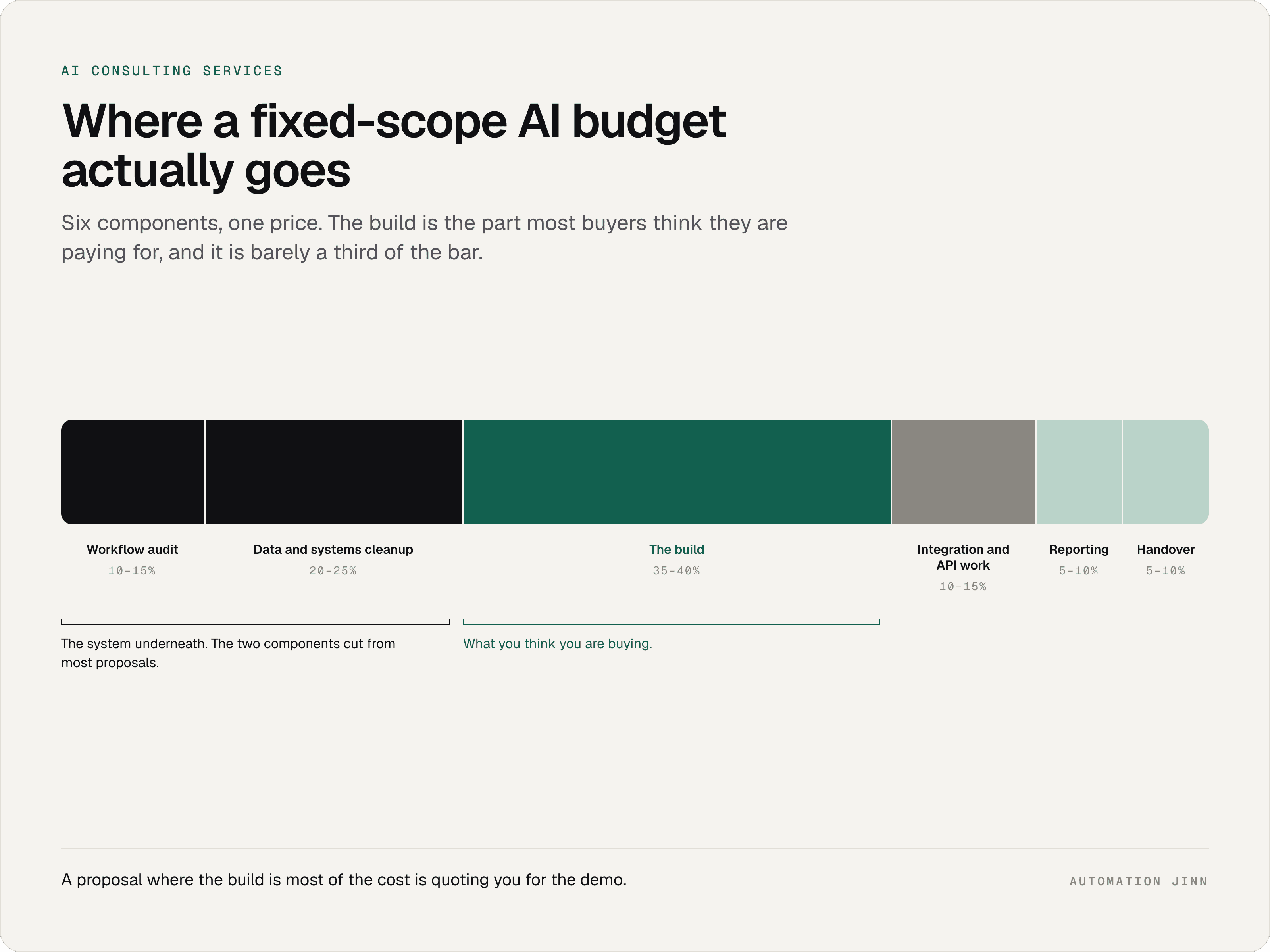
Rows one and two are the system. They are also the two that get cut first, because the audit feels like paying someone to describe your own business back to you, and nobody wants to hear that their CRM is the actual problem. Cut them and the build still demos beautifully. It just starts producing wrong answers in month three, at which point the fix costs more than the audit would have.
Handover is the quiet one. It rarely gets cut outright, it gets defined so loosely that when you ask six months later how the thing works, the answer is a call with the person who built it.
Generic advice is useless here, so here are the specific workflows. For seed to Series B B2B teams these six come up again and again, and each one is only as good as the system column next to it.
GTM workflow | What it needs underneath | Hours reclaimed |
|---|---|---|
Inbound lead research to CRM | One source of truth for company and role | 8-15 per week |
Outbound list building and enrichment | Dedupe rules that survive Clay pushing new records | 5-10 per week |
Meeting notes to owned tasks | Tasks that attach to the deal, not a generic list | 5-10 per week |
Pipeline reporting that reconciles | One definition of stage and close date | 6-12 per week |
Quote and document generation | Clean product and pricing fields | 4-8 per week |
Renewal and churn-risk flags | Usage data joined to the account record | Revenue, not hours |
Those ranges are what I see across engagements, not a published benchmark. The pattern that holds is the shape: high frequency, low judgement, currently done by someone expensive.
Look down the middle column. Every one of those is CRM architecture. This is why GTM systems work and AI agents and automation work turn out to be the same project far more often than either side of the market admits. The firms selling you agents do not want to scope the data model. The firms selling you a CRM migration do not want to own the automation on top. You end up buying both, twice, from people who each blame the other.
For an Amsterdam fintech, the work started with outbound lead flow and automatic deal creation, which removed over 200 hours of manual effort on its own. Then a bot reading the merchant book to flag accounts drifting toward churn while there was still time to act. Then a retention dashboard. The dashboard mattered most, and not for the reason you would guess: what it surfaced was significant enough that Klearly created a dedicated Customer Success Manager role off the back of it. The automation saved hours. The visibility changed the org chart.
None of that was possible until the account record could be trusted. That was the first invoice, and it was the one that made the rest cheap. You can read more of the case studies if you want the shapes in more detail.
The tier you are talking to sets the price far more than the difficulty of the work. Independent consultants are around $150 to $350 an hour and MBB partners past $1,000 for the same calendar hour.
Tier | Right when | The trade |
|---|---|---|
Big Four and MBB | Board mandate or regulated programme | Credibility, and juniors doing the build |
Global IT consultancies | Multi-workstream rollouts across many systems | Operational scale, long contracting cycles |
GTM systems specialists | Revenue workflows on a CRM that needs work | Senior people building it, narrower domain |
Freelancers | One defined task you can manage yourself | Cheapest, single point of failure |
Automation Jinn sits in the third row, and I would rather say so plainly than pretend the tiers do not exist. If you have a board demanding a named global firm, hire the named global firm. If your problem is that pipeline reporting takes a person a day a week because three systems disagree, the third row is where the money works hardest, because the person scoping it is the person building it and they have seen your data model before.
What you buy at the top end is often institutional credibility rather than engineering. That is a real thing to buy. It is just worth knowing that is the line item.
Gartner found widespread “agent washing”, the rebranding of existing products such as AI assistants, RPA and chatbots without substantial agentic capabilities, and estimated only about 130 of the thousands of agentic AI vendors are real. The same release predicts over 40% of agentic AI projects will be cancelled by the end of 2027.
Services firms are not immune. Gartner’s May 2026 forecast puts worldwide AI services spending at $585 billion this year, up from $436 billion in 2025. Money like that pulls in a lot of people who added AI to their homepage last quarter.
Take any AI consulting proposal, go through the six components, and mark each green or red. It takes ten minutes and it is the most reliable signal I know.
Component | A real scope says | A weak one says |
|---|---|---|
Workflow audit | Names the processes it will examine and why | “Discovery and requirements gathering” |
Data cleanup | Names the object or field to fix and who signs off | Nothing, or “as required” |
The build | Names the trigger, the steps, and the exception path | “AI-powered automation solution” |
Integration | Lists each system and whether a native connector exists | “Seamless integration with your stack” |
Reporting | Names the metric and its value the week before go-live | “Dashboards and analytics” |
Handover | Names whose account it runs in and what documents you get | “Training and support included” |
A proposal that opens at the build, with rows one and two missing, is quoting you for the demo. That is the single clearest tell, and it is usually the cheapest proposal in the stack.
Two things that are almost never written down and should be. First, whose account it lives in: if the build sits on the consultant’s workspace and API keys, you are renting, and the test is whether you could end the relationship on a Friday and still be running on Monday. Second, who is accountable in week five, because go-live is where reality starts disagreeing with the plan.
Apply all of this to my proposals too. I would rather be held to it than be picked because I sounded convincing on a call.
Three pricing models dominate, and comparing across them is where most buyers lose.
Model | What you are buying | Watch for |
|---|---|---|
Hourly | Someone’s time | Their inefficiency lands on your invoice |
Fixed scope | A defined system in production | Scope written vaguely so it can expand |
Retainer | Continuous capacity | Paying for availability you do not use |
An hourly quote and a fixed-scope quote for the same project are not two prices for one thing, they are two different products. Hourly moves the risk of the work being harder than expected onto you. Fixed scope keeps it with the vendor, which is why fixed-scope proposals get written more carefully, and why we scope that way.
We price at $5,000 to $8,000 for a single system end to end, $8,000 to $15,000 for several connected systems sharing clean data, and $20,000 and up for a whole revenue function with agents and reporting sequenced together. The data model work is inside those numbers, not a change order after you have signed. Ongoing work runs separately on a fractional retainer.
Published market ranges start considerably higher because most firms publishing them are scoped for enterprise programmes. Ours are not, because a seed to Series B team does not need a transformation programme. It needs pipeline reporting that reconciles itself.
Two situations where the sequencing is off, and the smaller first step is the better buy.
Your motion is still changing weekly. Pre product-market fit, the process you automate this month is the one you redesign next month, and you pay to build it twice. Wait until the shape holds for a quarter.
The number is too small. If the workflow costs you less than about $15,000 a year in loaded time, no engagement at these prices returns its cost. Three people spending five hours a week each at $75 loaded is $58,500 a year on one process, which clears it comfortably. Run that arithmetic before you speak to anyone, us included.
Neither of these means AI is wrong for you. They mean one component needs to happen before the others, which is a scoping question rather than a reason to wait. Getting that order right is most of what you are hiring a specialist for.
You do not need a proposal, a budget or an AI strategy to have a useful conversation. You need one workflow.
Pick the process that annoys you most this week. Write it as a sequence of steps, note roughly what it costs in hours across everyone who touches it, and list the systems it runs through and who holds admin on each. That last one delays more projects than anything else and nobody thinks about it until week two.
Bring that to a call and we will scope it live: which part is a system problem and which part is an automation problem, what it would cost as a fixed scope, and what would have to be true for it to fail. You keep that answer whether or not you hire us. If you also have a proposal from someone else, bring it, and we will run it against the six components above.
If you are earlier than this and still deciding whether to hire anyone, the companion piece on when to hire an AI implementation consultant covers the signals and the vetting questions. If you are building the function rather than buying a project, GTM engineering covers what that role actually does.
AI consulting services are expert-led engagements that take AI from decision to production. In practice they bundle six components: a workflow audit, data and systems cleanup, the build, integration work, reporting, and handover. Most providers price the six as one number, and most quietly exclude the first two.
Published 2026 hourly benchmarks run from roughly $150 for independents to $1,000 and above for MBB partners. Fixed-scope pricing is the more useful comparison for growing teams. We scope from $5,000 to $8,000 for a single production system up to $20,000 and above for a full revenue function, with the data model work included rather than billed later.
A credible proposal names the specific processes it will examine, the data objects it will fix and who owns them, the trigger and exception path for each build, every system it touches, the metric it will move with a pre-launch baseline, and whose accounts the finished system runs in. A proposal that opens at the build is quoting for the demo.
Match the tier to the job rather than the brand. Big Four and MBB fit board mandates, global IT consultancies fit multi-workstream rollouts, GTM systems specialists fit revenue workflows on a CRM that needs work, and freelancers fit one defined task you can manage. Then check whether the scope includes the system or only the agent.
It depends on what the workflow costs you. Below roughly $15,000 a year in loaded time the return is not there yet. Above it, a scoped build typically breaks even within a couple of months and keeps paying every year after. Run the arithmetic on one process before you speak to any vendor.
There is no single best, only the right tier for your situation. Firms that top best-of lists are optimised for enterprise programmes and priced accordingly. For a seed to Series B team, the better question is which provider will fix the data model as part of the build, put a senior person on it, and deploy into accounts you own.
Sparsh Gupta, Founder of Automation Jinn, builds AI agents and GTM systems for seed to Series B B2B teams who want manual work off their plate without adding headcount. If one workflow is eating hours every week and you want it scoped properly, book a discovery call.