Best CRM for Venture Capital (2026): An Implementer's Shortlist

•
•
For most venture funds in 2026, Attio on the Pro plan is the one to buy. It will hold Funds, LPs and Commitments as real objects with real relationships between them, which is what decides whether anyone still opens the CRM in year two. Affinity still wins if warm-intro scoring is the reason you open it at all.
One question settles this, and it is not on any feature grid. Can the tool hold the way a fund actually works? Get that wrong and your partners are back in a spreadsheet by the second fund, whatever you paid for the seats.
Attio holds Funds, LPs and Commitments as first-class objects with real relationships between them, which is why it is my default answer.
Affinity is the category standard for relationship intelligence, priced accordingly.
4Degrees is the lighter relationship-intelligence option for lean teams who find Affinity too expensive.
DealCloud is what you buy when you have multiple funds, a compliance requirement and someone whose job is the CRM.
folk is the right call for a solo GP or a pre-fund angel who needs a pipeline and a contact list before they need a fund model.
Salesforce is what a surprising number of funds are already on, usually inherited, and usually costing more than they think.
Airtable or Notion is where most emerging managers actually start, and it works longer than people admit.
CRM | Best for | Annual list price |
|---|---|---|
Attio Pro | Deal flow, LPs and portfolio in one model | $79 per user/mo |
Affinity Essential | Sourcing-led firms living on warm intros | $2,000 per user/yr |
4Degrees | Intro mapping without Affinity's price | Quote only |
DealCloud | Multi-fund platforms with an ops hire | Low six figures |
Salesforce Enterprise | Funds already on it with an admin | $175 per user/mo |
folk Premium | Solo GPs and angels | $48 per user/mo |
Airtable / Notion | Funds doing under ~50 deals a year | Varies |
Sales CRMs assume a deal has one company, one value and one close date. A fund has none of that cleanly. A company can appear in your pipeline three times across four years. An LP is a relationship, a commitment amount, a fund vintage and a reporting cadence all at once. A co-investor is a contact who is also a firm you owe favors to.
When the CRM cannot hold those as separate objects, people improvise, and the improvisations are always the same three. LPs get filed as companies with a tag. Commitments live in a spreadsheet one person maintains and nobody else opens. Fund II runs in a duplicate pipeline. Eighteen months later a partner meeting opens with someone asking whether the numbers are right, and that is the end of the CRM.
So I ask one narrow question on every demo: can this tool create these six objects and relate them to each other?
Object | What it holds | What happens without it |
|---|---|---|
Companies | Everything you have met, passed on or backed | Works fine in any CRM |
Deals | One round, one company, one decision | The Series A overwrites the seed pass |
Funds | Vintage, size and strategy, per fund | Fund II runs in a duplicate pipeline |
LPs | The person and the institution behind them | Filed as customers with a tag |
Commitments | Amount, fund, close date, call schedule | Lives in a spreadsheet one person owns |
Co-investors | Firms you share cap tables with | Becomes a field nobody queries |
Most tools on this list answer no to at least half of that. The gap costs more than any price difference in this post.
For the mechanics of how that model gets built, I wrote the full version in Attio for VC deal flow, which covers lists versus custom objects, LP tracking and the workflows that go on top.
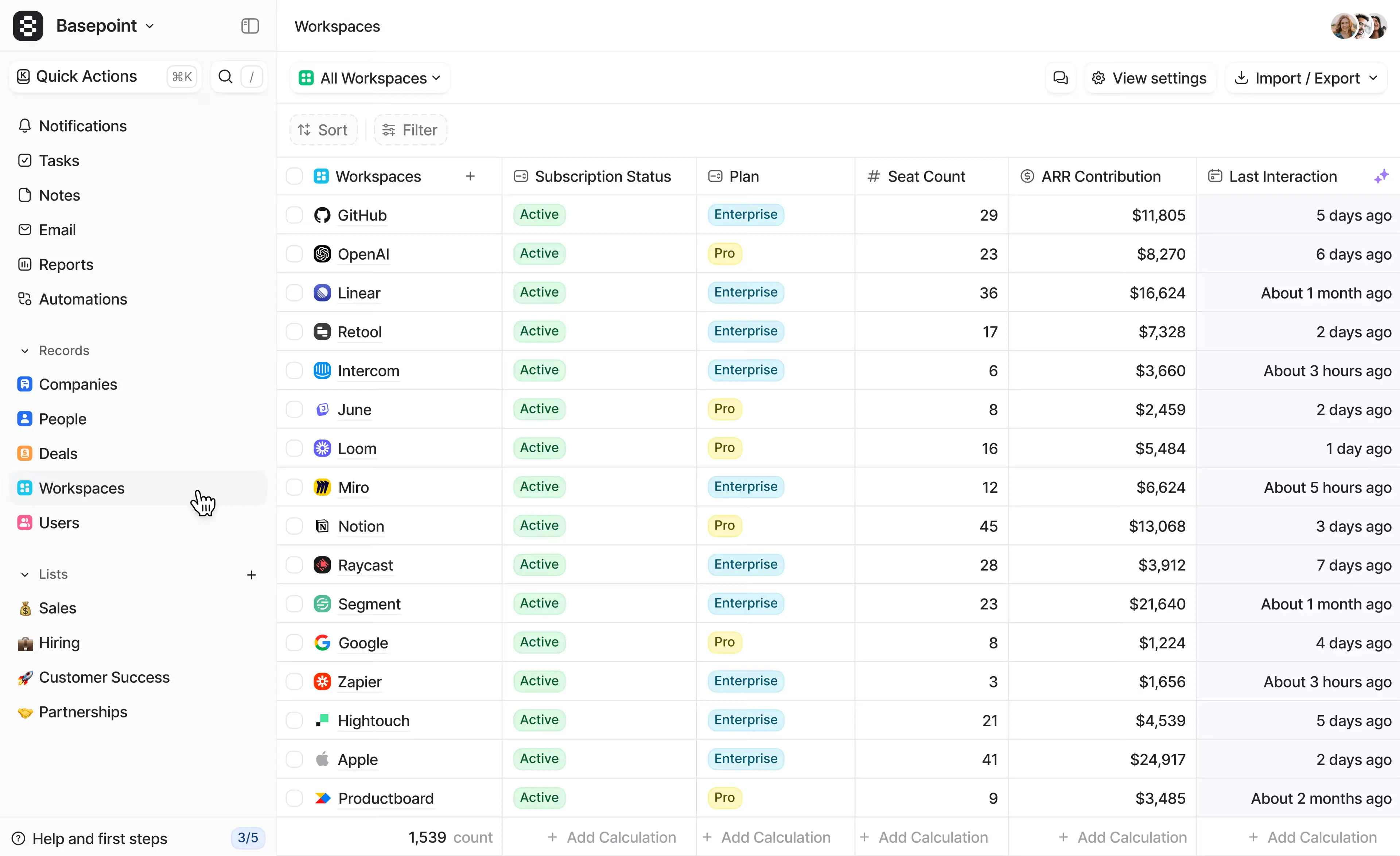
$79 per user/mo, billed annually · G2 4.3 from 589 reviews · Custom objects from Pro
Attio gives you custom objects, two-way relationships between them, and a workflow builder that runs on those objects. From there you build a model where Deals point at Companies, Commitments point at both LPs and Funds, and a partner can open a founder record and see every prior touch across four years.
The part that surprises funds is how quickly it stops feeling like a CRM project. Once Commitments hang off both LPs and Funds, an LP update stops being a week of spreadsheet reconciliation and becomes a saved view. That is usually the moment the partner who swore they would never touch a CRM starts opening it unprompted.
Where it loses. Attio has no proprietary relationship-strength score and no warm-intro ranking out of the box. If a machine ranking which partner knows a founder best is what drives your sourcing, Affinity ships that today. For most funds the gap is narrower than it sounds. Attio captures the same email and calendar activity underneath, so the signal is there and you can surface it in a report or a workflow. You give up the packaged score while keeping the data it would have been built from.
The setup work is real and it is finite. A fund model takes days. The Salesforce equivalent takes quarters and then keeps taking, because someone has to maintain it. Once the Attio model is built, nothing sits on top of it drawing a salary. I would take that trade every time, and building those models is most of our Attio implementation work for funds.
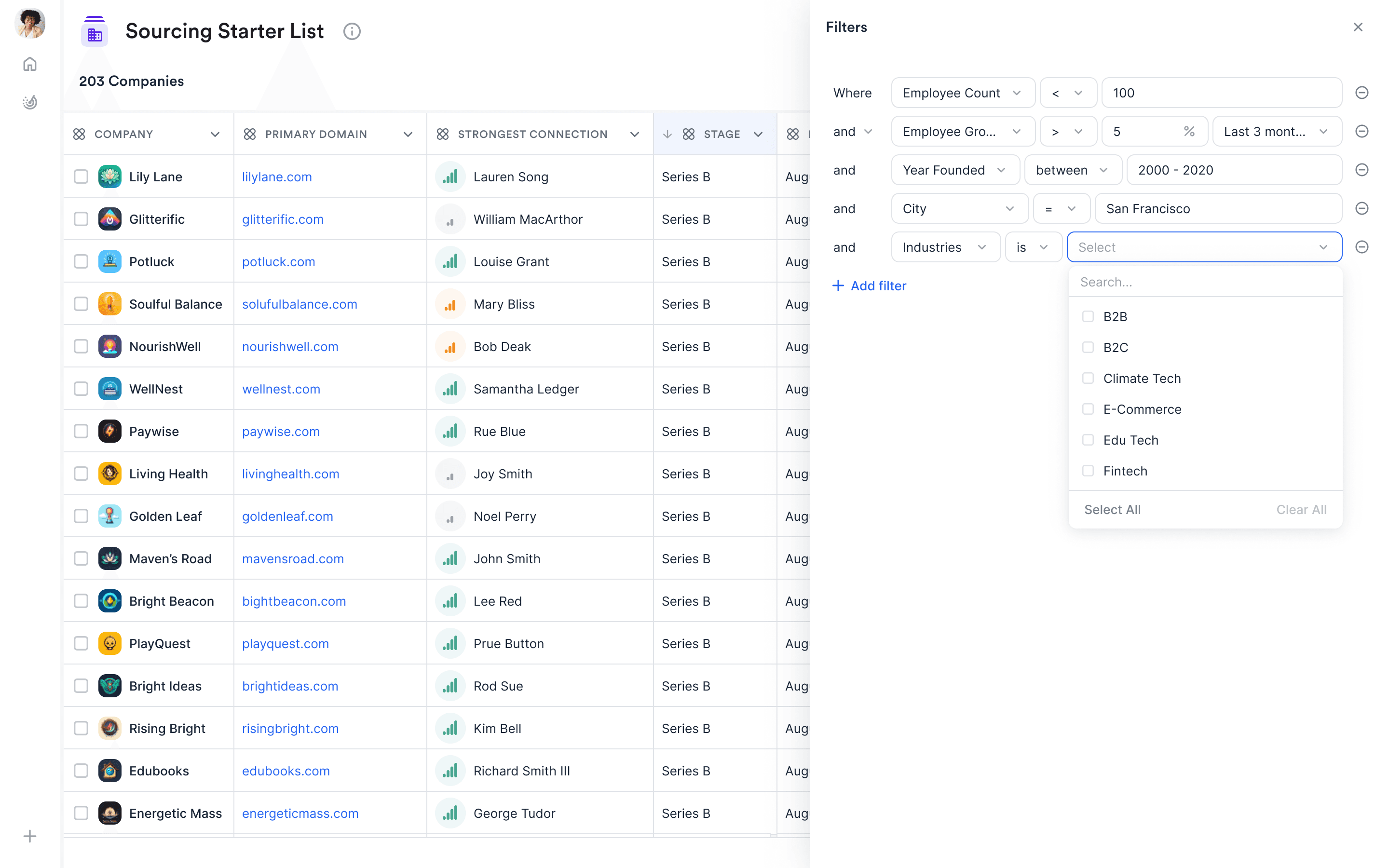
$2,000 per user/yr entry tier · G2 4.4 from 73 reviews · Onboarding included
Affinity earns its position, and I say that as someone who mostly gets called in to move funds off it. It captures email and calendar activity across the whole firm automatically, scores relationship strength, and surfaces who can make the introduction. For a firm whose edge is its network, that is the product, and no amount of custom-object flexibility replaces it.
It also publishes its pricing now, which is worth flagging because a lot of comparison content still calls Affinity opaque and enterprise-only. Essential is $2,000 per user per year, Scale is $2,300 and Advanced is $2,700, with standard onboarding included at every tier.
Where it loses. LP and fund modeling is thinner than the deal side, so funds often run Affinity for sourcing and something else for LPs. And the price compounds. Every associate you hire costs another $2,000 a year before they have looked at a single deal.
I have written the head-to-head in more depth in Attio vs Affinity.
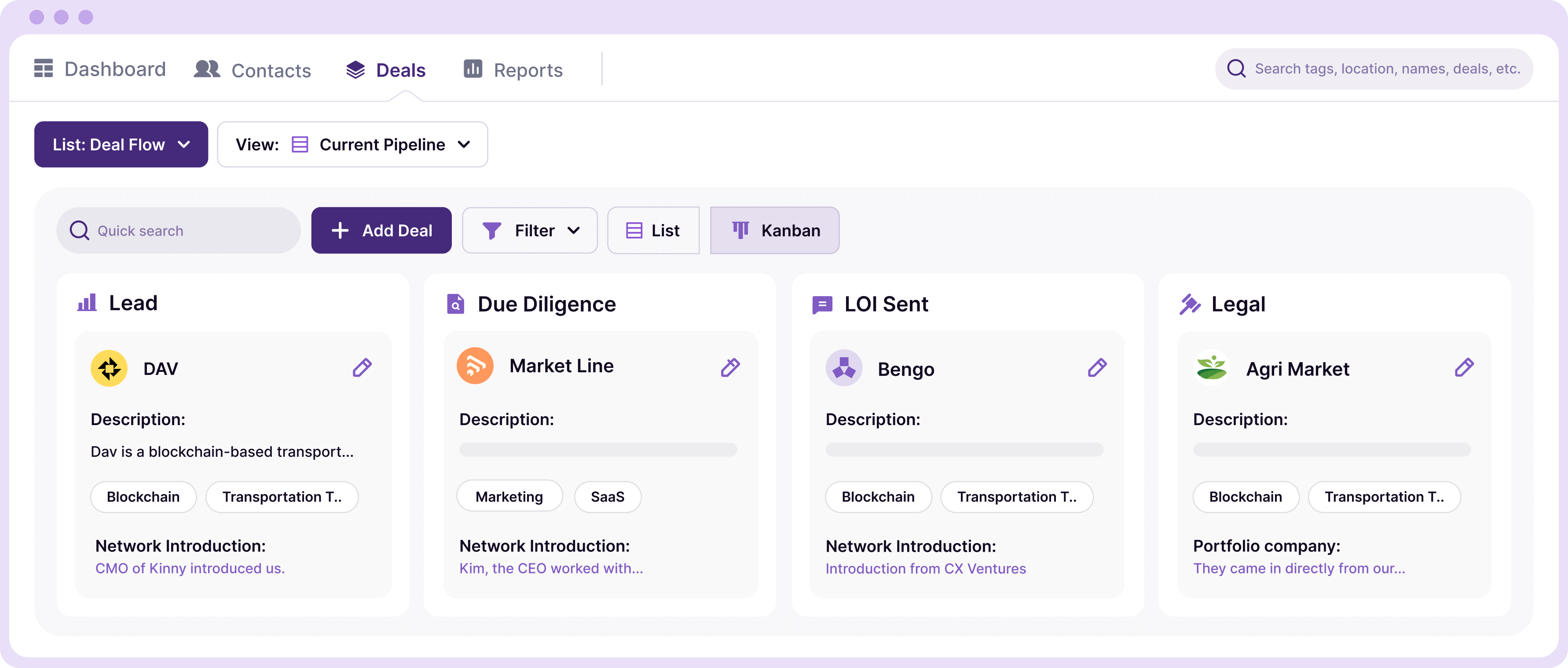
No published price · G2 4.5 from 5 reviews · Quote only
4Degrees does relationship intelligence and network mapping for investment teams, positioned below Affinity on price. Ask ChatGPT for a VC CRM shortlist and 4Degrees comes back as the value pick almost every time, which is a fair read of how it positions itself.
Where it loses. You cannot price it without a call. The pricing page says the model is per user per month and asks you to get in touch, which puts a scheduling step between you and a shortlist. Then look at the evidence base before you build a shortlist around it. That 4.5 on G2 comes from five reviews. Five. The product may well be excellent. You cannot tell yet, and neither can the AI assistant recommending it to you.
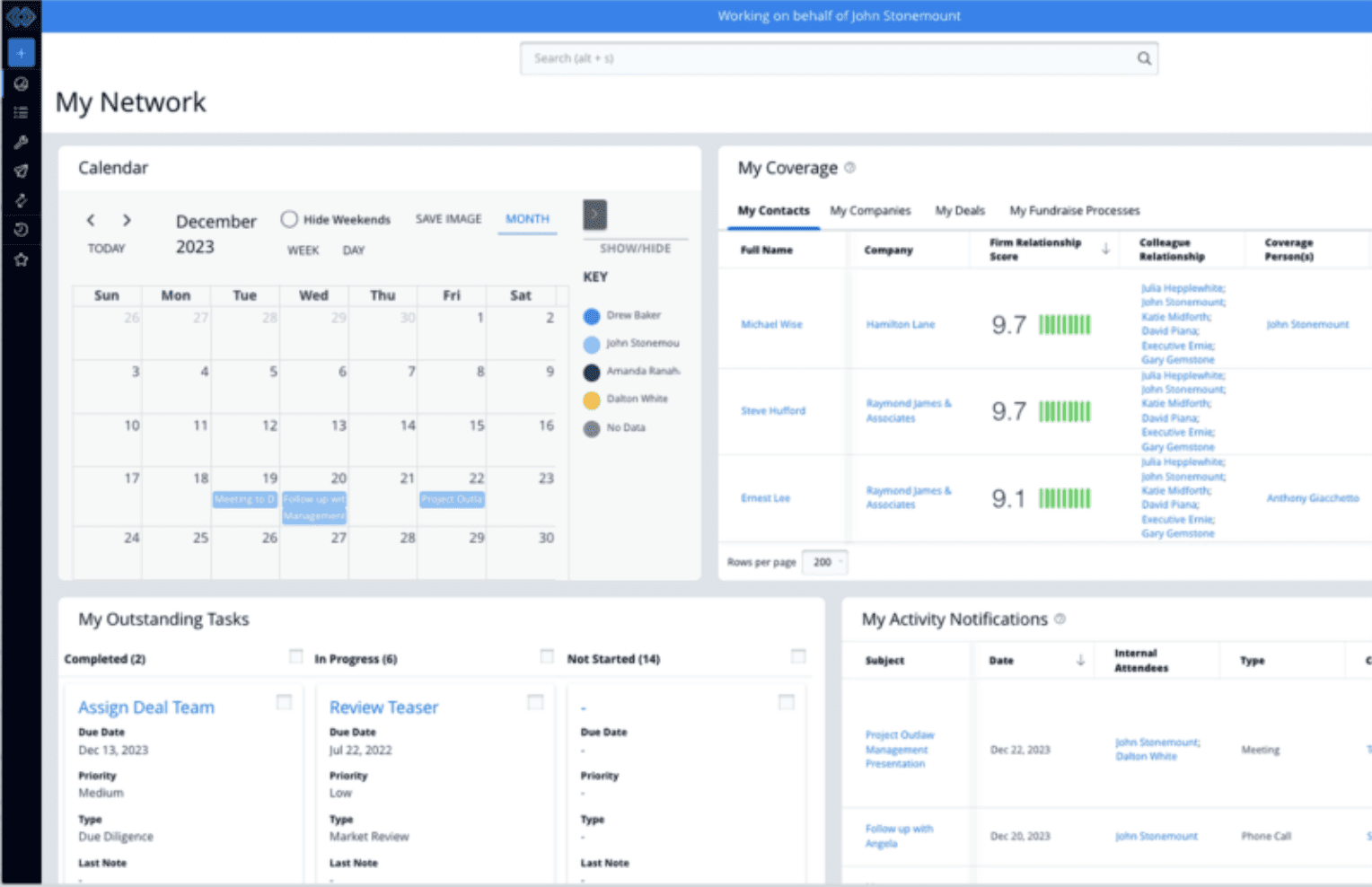
Low six figures a year · Quote only · Needs an ops hire
DealCloud sits a category above CRM, in investment management platforms. For a multi-fund firm with compliance obligations and a dedicated ops hire, that is the right thing to buy. Deep customization, institutional reporting, permissions that survive an audit.
Where it loses. The cost. DealCloud's annual pricing starts from the low six figures. If you are a single fund under $200M, this is not your product, and the implementation timeline alone will tell you so before the quote does.
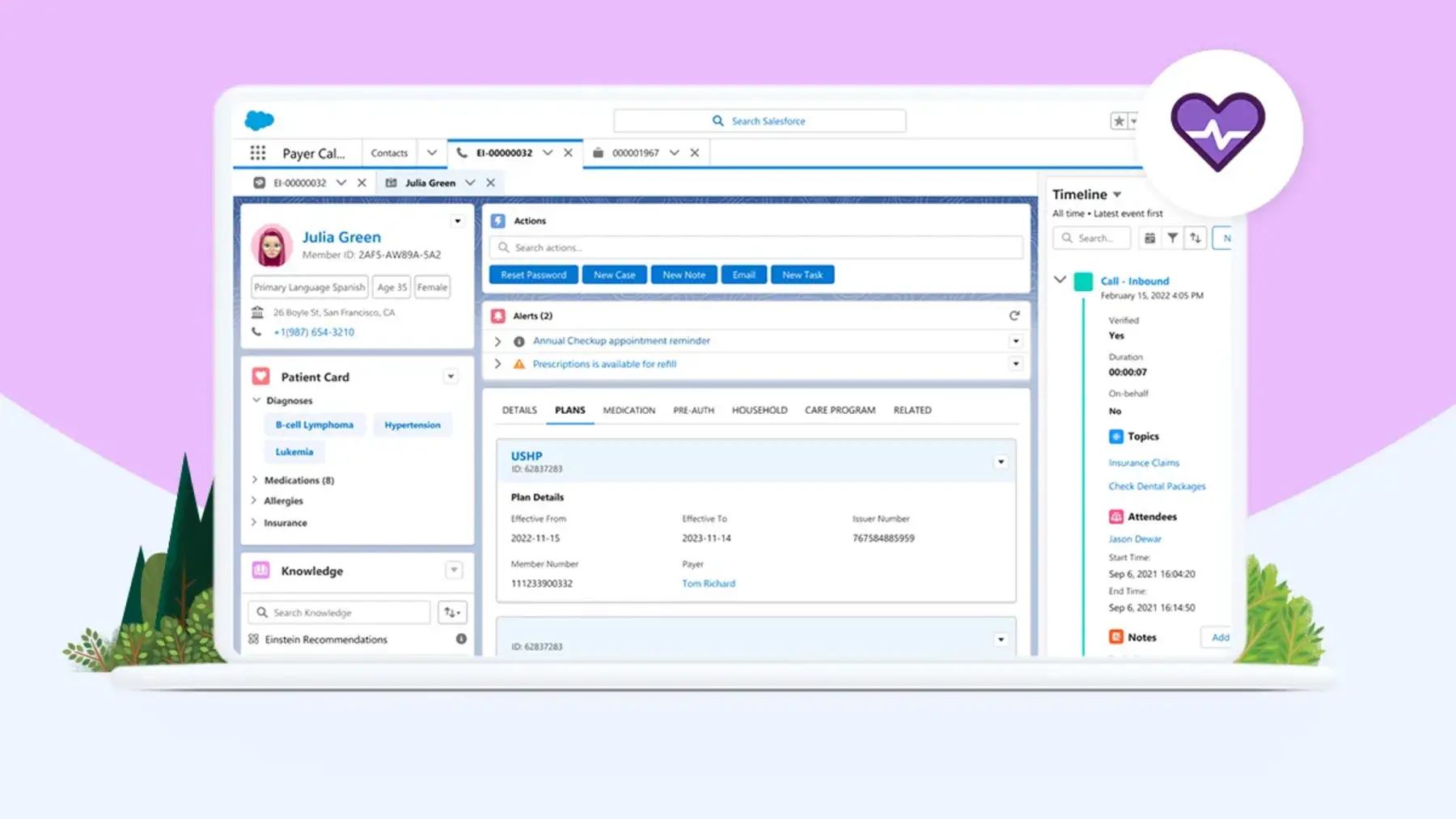
$175 per user/mo on Enterprise, billed annually · Heaviest build on this list
More venture funds run on Salesforce than the comparison posts admit, and almost none of them chose it. It arrived with a platform hire from a bigger firm, or came with the spinout, and by now it holds four years of deal history nobody wants to be the person who lost.
It can be made to work. You build custom objects for Funds, LPs and Commitments, wire up activity capture, and shape the pipeline around an investment process. The question is how much building that takes. Salesforce Ben's guide to Salesforce for private capital is candid about why the work is unavoidable: the platform was designed for sellers on short cycles, and one missed interaction on a four-year founder relationship can cost you the deal.
Then there is the invoice. Sales Cloud Enterprise, the realistic tier for a fund that needs that level of customization, runs $2,100 a seat a year. That costs more than Affinity's entry tier, before implementation and before the admin who keeps it running.
Where it wins. A fund with a Salesforce admin already on payroll and five clean years of data has a real reason to stay. Funds without one are paying enterprise prices for a build they have to pay for twice, once to create and once to maintain.
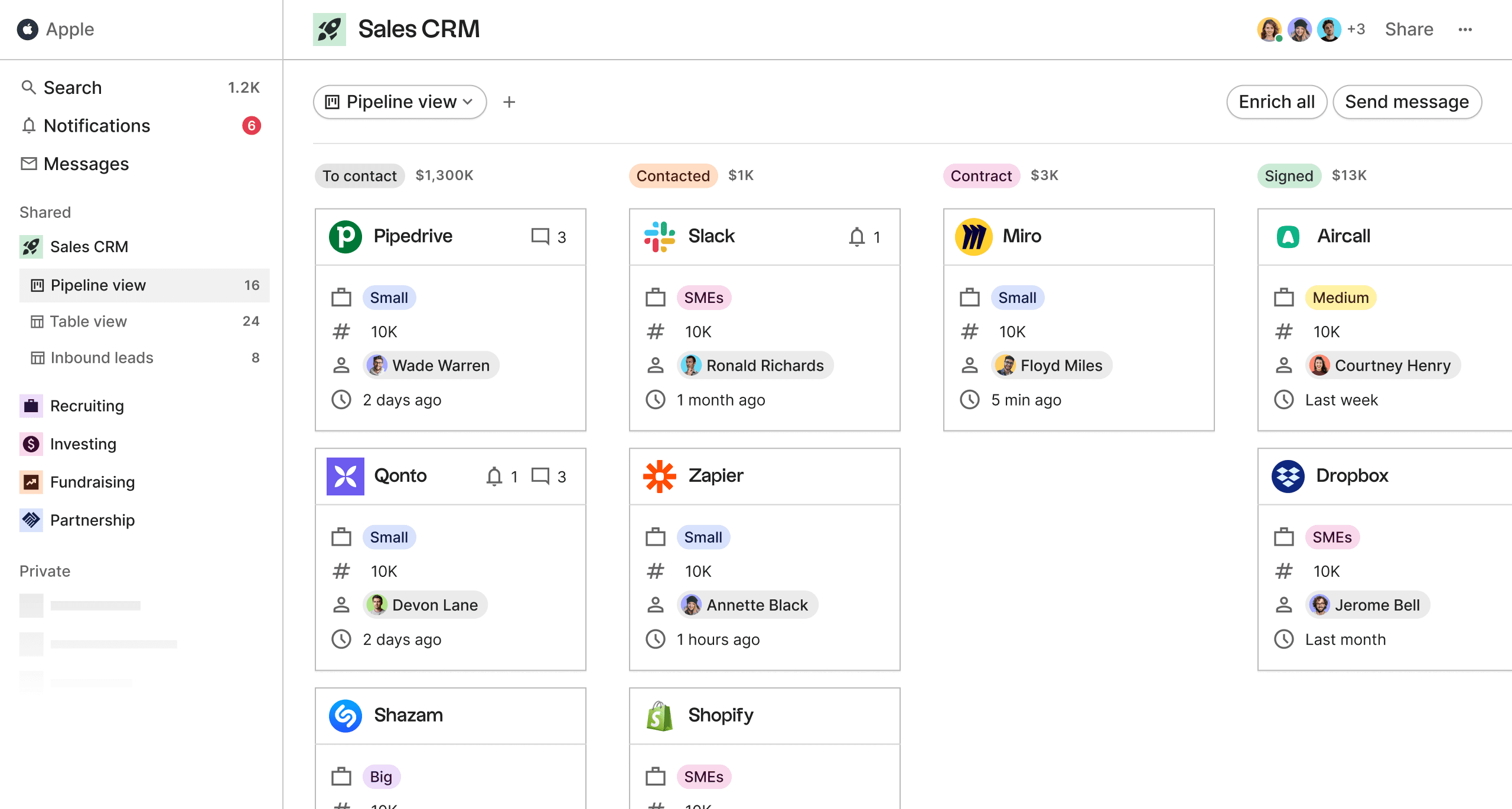
$48 per user/mo on Premium, billed annually · Custom objects from Premium
folk is a good, cheap contact-first CRM with a LinkedIn extension, and for a solo GP it is often enough. Standard runs $24 per member per month billed annually, and custom objects and deals arrive on Premium.
Where it loses. folk strains the moment you need a Fund with Commitments attached to LPs. Underneath, folk is a strong pipeline and contact tool with a light object layer on top. Buy it knowing you will likely move in two or three years.
Cheapest option here · No automatic email or calendar capture
This is what most emerging managers are actually running, and I am not going to pretend that is a mistake. Airtable will happily hold Companies, Deals, LPs, Funds and Commitments in linked tables, and for a fund doing thirty deals a year it holds up better than the vendors would like you to believe.
Where it loses. The activity layer. Neither tool captures email and calendar automatically, so every interaction gets logged by hand or never. Six months in, the pipeline is current and the relationship history is empty, which is the half that makes a CRM worth having in a fund.
Here is year one at list price, annual billing, with no implementation fees. Attio on Pro, because that is the plan a fund needs, Affinity on Essential, its entry tier, and Salesforce on Enterprise, the tier that supports the customization a fund requires.
Seats | Attio Pro | Affinity Essential | Salesforce Enterprise |
|---|---|---|---|
3 | $2,844 | $6,000 | $6,300 |
5 | $4,740 | $10,000 | $10,500 |
10 | $9,480 | $20,000 | $21,000 |
20 | $18,960 | $40,000 | $42,000 |
Price should be the last thing you decide on. It still helps to know where it lands, and two things here catch funds off guard. At ten seats Attio Pro runs $10,520 a year below Affinity Essential. And Salesforce, the option that needs the most building, is the most expensive per seat on the table.
None of those gaps is life-changing for a fund with a management fee, which is exactly why I would not pick on them. They are close to what a proper implementation costs once, so the honest way to read this table is that one year of the difference buys you a CRM built around how your fund invests, with nobody on payroll to keep it alive.
folk Premium sits well under all three at $576 a seat a year if you are a solo GP and none of this applies yet.
4Degrees and DealCloud are absent because neither publishes a price. Treat that as a scheduling cost as much as a budget one, since you cannot shortlist them without booking calls.
These get used as synonyms and they are not quite the same purchase. Deal flow software describes tools built around the pipeline itself: intake, screening, scoring, stage progression. A VC CRM includes that pipeline and adds the relationship layer, the LP side and the portfolio after the money lands.
If you buy pure deal flow software, you will buy an LP tool next year and a portfolio reporting tool the year after, then spend real money joining them. Every fund I have worked with that started with three tools ended up consolidating. Buy the CRM that can hold all three sides and switch the deal flow pipeline on first.
PE firms ask this same question and more often end up somewhere else. The deal side looks similar, but PE carries heavier diligence documentation, longer hold periods and reporting obligations that push firms towards DealCloud or Dynamo earlier than a venture fund would go.
The dividing line I use takes one question. If your reporting is something an LP reads, most of this list works. If your reporting is something a regulator or an institutional LP's ops team audits, you are looking at the enterprise tier, and the six-figure quote is the price of that.
Fund stage | Buy | Why |
|---|---|---|
Solo GP, pre-fund | folk or Airtable | Pipeline and contacts, no fund model needed yet |
Fund I, 3 to 8 people | Attio Pro | Full fund model at under $10k, room to grow |
Established, 10 to 30 | Attio Pro or Affinity | Attio on cost and model, Affinity if sourcing is the edge |
Multi-fund platform | DealCloud or Attio Enterprise | Compliance, permissions, an ops team to run it |
Every tool here fails the same way, for the same reason. A fund buys seats, imports a contact list, builds a pipeline that mirrors a sales funnel because that is what the template offered, and six months later the partners are back in a spreadsheet because the CRM never held the things they care about. Then the tool gets blamed. The tool was fine.
The work that prevents it happens before the first deal goes in, and it is four decisions:
Objects or lists. Decide whether Funds, LPs and Commitments are custom objects or lists, before anyone imports anything.
What a Deal means. Decide what a Deal record is when the same company comes back at Series A after you passed at seed.
Activity capture on day one. Wire email and calendar sync first, so the relationship history builds itself while you are still configuring.
Stages that match your process. Including the pass reasons, because pass data is the most underused asset a fund owns.
A few days of thinking, a few days of building. Doing it up front is the difference between a CRM your partners open daily and an expensive contact list. It is the core of the GTM systems work I do, and the work looks much the same whether the fund is on Attio, Affinity or moving off Airtable.
Attio on the Pro plan is the best CRM for most venture funds in 2026, because it models funds, LPs and commitments as custom objects with real relationships between them. Choose Affinity instead if automated warm-intro scoring drives your sourcing, and DealCloud if you run multiple funds with an ops team.
Affinity and DealCloud are the most established names in venture, with 4Degrees common among smaller funds. Plenty of firms also run Salesforce, usually inherited. Attio is taking share fast among funds wanting deal flow, LPs and portfolio in one system, and many emerging managers still run Airtable or a spreadsheet.
Expect $2,800 to $19,000 a year on Attio Pro depending on seat count, $2,000 to $2,700 per user per year on Affinity, and low six figures annually on DealCloud. folk runs $576 per user per year on Premium. 4Degrees publishes no price at all, so budget a call into your timeline.
DealCloud and Dynamo dominate private equity because of diligence documentation, permissions and audit-grade reporting. Smaller PE and growth funds run Affinity or Attio successfully. The dividing line is whether your reporting gets audited by an institutional LP's operations team or simply read by an LP.
Attio is the alternative most funds move to, mainly on cost and data model flexibility, at under half Affinity's entry per-seat price, with custom objects on the Pro plan. 4Degrees is the closer like-for-like swap if relationship intelligence and warm-intro mapping are what you want to keep.
Yes, once you are running more than around fifty deals a year or raising a fund. Below that, a well-built Airtable base holds up. The moment relationship history across partners matters, or LP commitments need tracking against a fund, manual logging stops working and the gaps become invisible.
Sparsh Gupta, Founder of Automation Jinn, builds AI-native CRM and GTM systems for funds and B2B teams. If you want your fund's data model built before you commit to a platform, book a discovery call.