Best AI CRM (2026): An Implementer's Shortlist


•
•
The best AI CRM in 2026, for a B2B SaaS team between seed and Series B, is Attio. It is the only CRM on this list that pairs a fully flexible data model with AI agents that do real work inside it, at a price a startup can carry. Clarify is the boldest alternative if you want the CRM to maintain itself, and HubSpot or Salesforce still win in specific situations I'll spell out below.
I implement CRMs for a living, so my bias runs toward the tools I can make perform, and I'll disclose exactly where that bias sits. What I won't do is rank a product first because it paid for placement. That alone separates this list from most of what ranks for this query.
Look at who wrote the pages competing for this search. Attio ranks Attio first. ZoomInfo ranks ZoomInfo first. Lark ranks Lark first. Creatio ranks Creatio first. The affiliate publishers are more subtle about it, but TechnologyAdvice discloses that vendors pay for placement in its guide, and Zapier's list routes you through tracked referral links and includes Zapier itself. Every one of those pages earns from the click, whether or not the pick fits your team.
That is why the most useful voice on this results page is a Reddit thread in r/CRM, where actual operators compare notes on AI features, and Google keeps ranking it near the top. Buyers trust practitioners over placements.
My conflict of interest, stated plainly: Automation Jinn is an Official Attio Expert Partner, and I recommend Attio to most of my clients. I also decline projects where Attio is the wrong fit, because a CRM implementation that fails takes my reputation down with it. Read the rankings with that in mind.
Feature checklists are useless here because every CRM now claims AI. In client evaluations I run three tests instead.
Test 1: What happens to the schema when your business changes? A CRM built in 2010 has fixed objects, contacts, companies, deals, and treats everything else as a workaround. An AI-native CRM lets you define objects and relationships, so an agent can reason over your actual business, workspaces, usage events, fund commitments, whatever your motion needs. I've written a full breakdown of what makes a CRM AI-native if you want the deeper argument.
Test 2: Where does the AI sit? A chat window bolted onto fixed records can summarize what a record already contains. An agent wired into email, calls, and product data can research an account, score it, draft the follow-up, and write the result back. The second kind removes work from your team. The first kind gives them a new toy.
Test 3: What does the AI cost at real usage? Almost every vendor now meters AI through credits stacked on top of seat prices. The sticker price and the real price diverge the moment your team uses AI daily. I've run the math further down, and it changes the rankings more than any feature does.
CRM | Best for | AI-native? | Pricing model |
|---|---|---|---|
Attio | B2B SaaS, seed to Series B | Yes, agents on a flexible data model | Per seat, $0 to $79+ |
Clarify | Founder-led teams, zero admin | Yes, AI builds the CRM itself | Credits only, seats free |
Day.ai | Lean teams wanting max automation | Yes, per-agent pricing | Per agent, $24 to $200 |
HubSpot | Marketing-led growth | No, agents on fixed hubs | Per seat plus credits |
Salesforce | Enterprise scale and compliance | No, agents on legacy schema | Per seat plus credits |
Verify current pricing on each vendor's site before buying. Every vendor on this list has changed prices or packaging in the last twelve months.
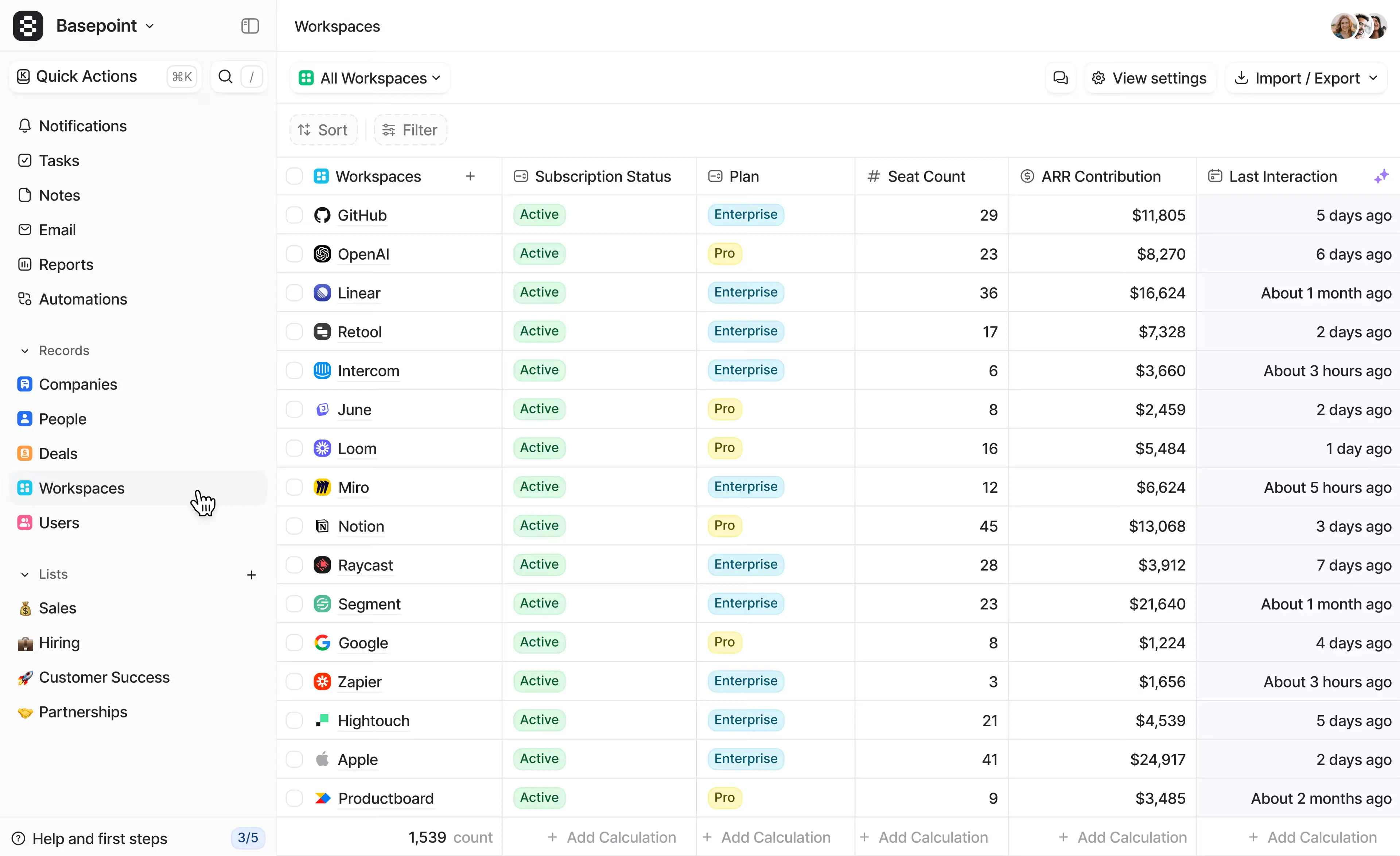
Best for: seed to Series B B2B SaaS teams that want one CRM to survive from founder-led selling through a RevOps hire.
Attio wins because it passes all three tests at once, and no other CRM does. Everything in the data model is configurable: objects, relationships, fields. When Railway needed to run a usage-based PLG motion, they modeled it on a custom Workspaces object with a home-grown adoption score flowing in, something their previous tools could not represent at all. Granola built a custom inbound-leads object with tiered routing into deals and cut lead triage time by 83 percent. Those are Attio's published customer stories, and they match what I see in client builds: the data model bends to the business, so the business stops bending to the CRM.
What stands out:
AI features that do work rather than describe it. AI Attributes fill fields against a rubric you write, Call Intelligence extracts MEDDPICC or BANT answers from calls onto records, and the Research Agent runs live web research inside workflows.
Ask Attio answers plain-language questions across emails, calls, and records, and since mid-2026 Workflows can orchestrate full revenue agents.
A native MCP server, which means Claude and other AI tools can read and write your CRM directly. Most competitors haven't built that door yet.
Real momentum behind it: 4.3 out of 5 on G2 across 500+ reviews, and the fastest-growing CRM vendor on Ramp's spend data from 70,000+ businesses as of August 2026.
Honest limitations:
Plus caps at 10 seats and has no custom objects, so the real price for a scaling team is the $79 Pro tier, where custom objects, Call Intelligence, and Sequences live.
Attio covers outreach email and sequences but is no substitute for a full marketing suite with landing pages and ads, so marketing-led teams keep a separate tool.
It is younger than the incumbents, which mostly shows up as a thinner template library.
Treat all three as budgeting inputs: they tell you which plan to price and what to pair Attio with.
Pricing: free up to 3 seats; Plus $35 per user per month billed annually ($44 monthly); Pro $79 ($99 monthly); Enterprise custom. AI features are included on every plan through a credit allowance that scales by tier, with no onboarding fee anywhere.
My verdict: My go to CRM for a client wanting a modern AI native CRM which can scale with their needs.
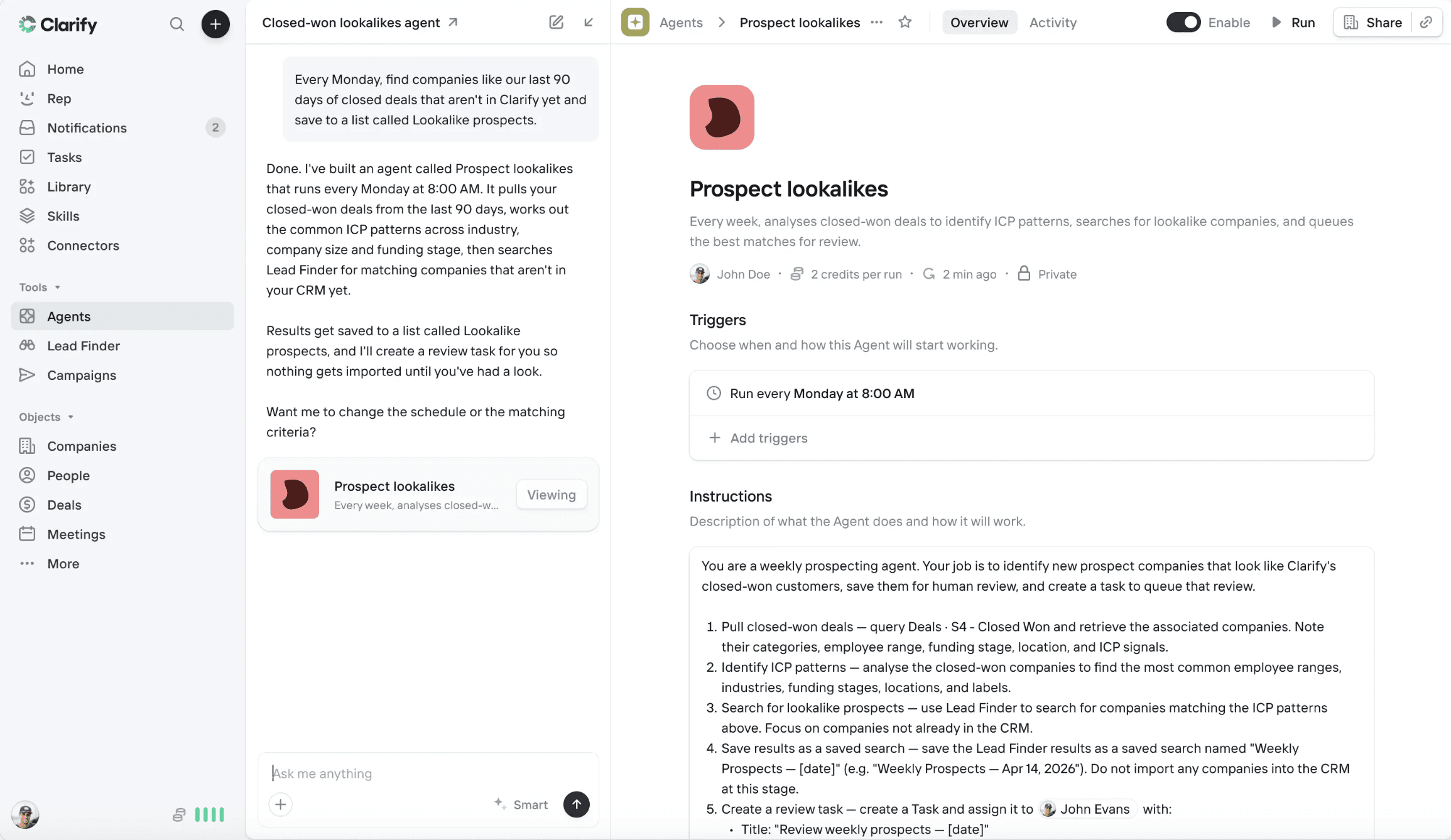
Best for: founder-led teams with a simple motion who keep failing at CRM hygiene.
Clarify inverts the whole category. Instead of reps entering data that AI then summarizes, Clarify builds the record itself from email, calendar, and meetings, then lets an assistant called Rep and background agents handle the repetitive work on top.
What stands out:
The CRM assembles itself: it identifies contacts and companies, detects deals, summarizes calls, and fills AI-generated fields from conversations.
Unlimited seats on every plan, so headcount growth costs nothing. You pay for AI work through credits instead.
For a five-person founder-led team, the credit model can undercut every per-seat CRM on this list.
What to watch:
Depth. A team that needs territories, complex reporting, or a RevOps layer will hit the ceiling.
Maturity. Clarify is young and its review base is thin, so run it on real data before trusting it as your system of record.
Pricing: free plan with 1,000 credits a month; Starter $50 a month for 5,000 credits, extra blocks at $50 per 5,000; Growth custom.
My verdict: the bake-off candidate. If you're pre-Series A and allergic to CRM admin, run Clarify against Attio for two weeks and see which one your team actually opens.

Best for: lean teams that want to staff the pipeline with agents instead of admins.
Day.ai was founded by Christopher O'Donnell, who led product at HubSpot for a decade, and it reads like his second draft of the category. You hire agents the way you'd hire staff, and teammates join free.
What stands out:
Pricing runs per AI agent deployed, and every human teammate joins free, so cost tracks automation rather than headcount.
Agents do the CRM work on schedules and events: meetings recorded, records updated, follow-ups drafted, reports built, without anyone touching a CRM screen.
For a lean team, the economics are hard to argue with. Five Professional agents run $3,600 a year at monthly rates, and adding people costs nothing.
What to watch:
The same caution as Clarify: young product, small company, and you're betting your system of record on it.
Per-agent pricing is unusual enough that you should model your own team on it before assuming it's cheaper.
Pricing: Turbo agents $24 a month (follow-ups, tasks); Professional $60 (pipeline, reports, scheduled work); Executive $200 (prospecting, workspace-wide instructions). Annual billing takes 20 percent off.
My verdict: the most aggressive automation bet on this list. Run it beside your current stack before switching anything off.
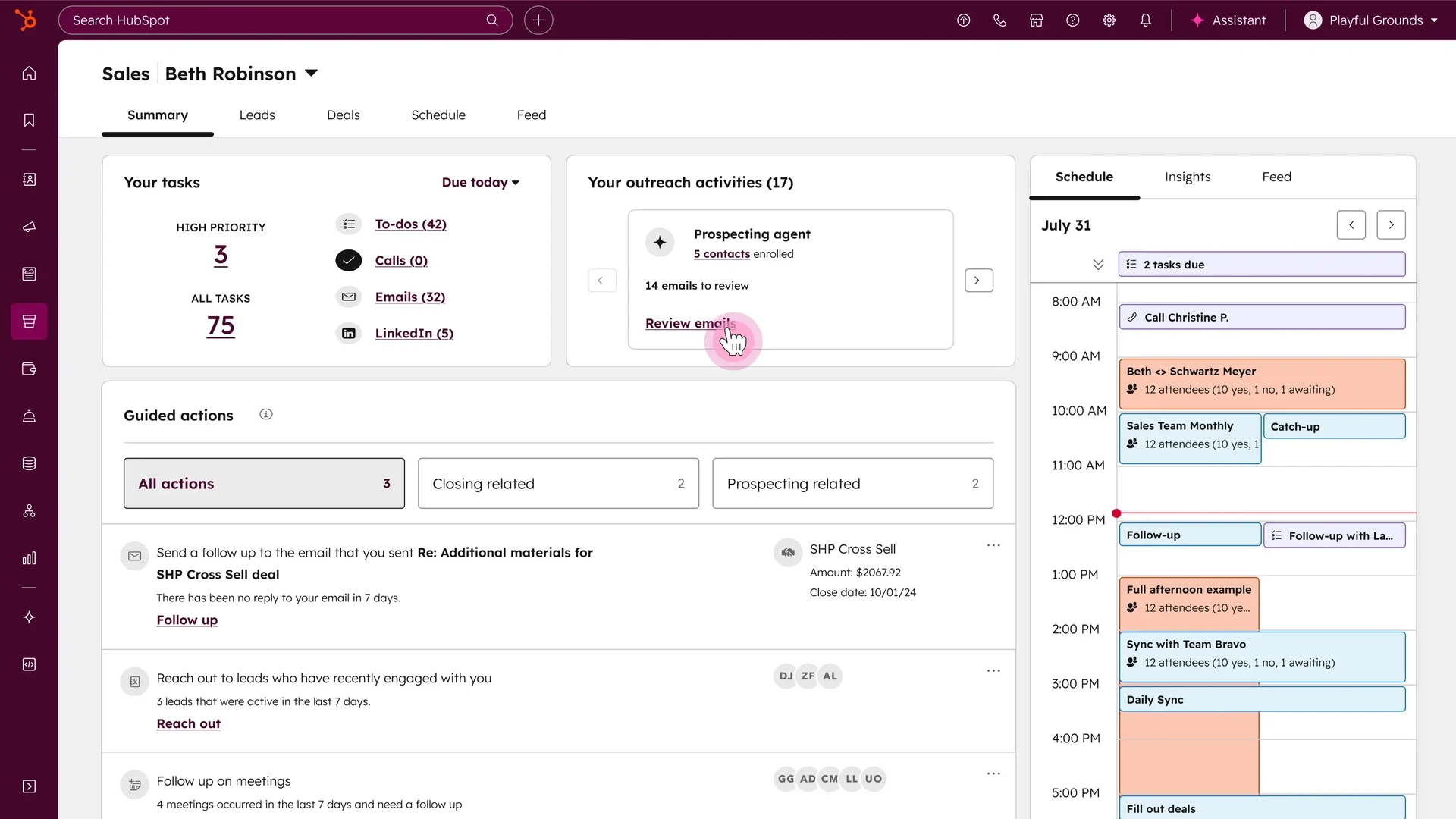
Best for: teams whose growth runs on content, email nurture, and inbound funnels.
HubSpot is the strongest all-in-one suite on this list, and for a marketing-led motion it's still the right call. Breeze and Agent Hub are real products, and the agents plug into a marketing engine none of the AI-native CRMs can match.
What stands out:
Prospecting, customer, and data agents that work across marketing, sales, and service in one login.
The deepest marketing automation of any tool here: landing pages, email nurture, ads, and reporting that the AI-native CRMs haven't built.
A usable free tier for 2 users, which makes trying it cheap.
What to watch:
The schema. Hubs come with fixed structure, required fields, and custom objects gated to the Enterprise tier of Sales Hub, so the flexibility you get on day one is what you keep.
The meter. AI agents consume HubSpot Credits at $9 per 1,000, and the Prospecting Agent costs 100 credits per researched outreach. Professional includes 3,000 credits a month, which is 30 agent-touched leads before the meter starts. A team running 500 agent outreaches a month burns about 50,000 credits, over $420 a month on top of seats.
The onboarding fees: $1,500 mandatory on Professional, $3,500 on Enterprise.
Pricing: free for up to 2 users; Starter around $20 per seat per month; Professional $90 per seat per month billed annually plus onboarding; Enterprise $150 plus onboarding.
My verdict: a strong product whose sticker price is a weak predictor of the invoice, which is exactly what test three exists to catch. If you're already on it and it fits your motion, stay and adopt Breeze properly. If you're fighting the schema, we've written a migration guide from HubSpot to Attio covering what moves cleanly and what doesn't.
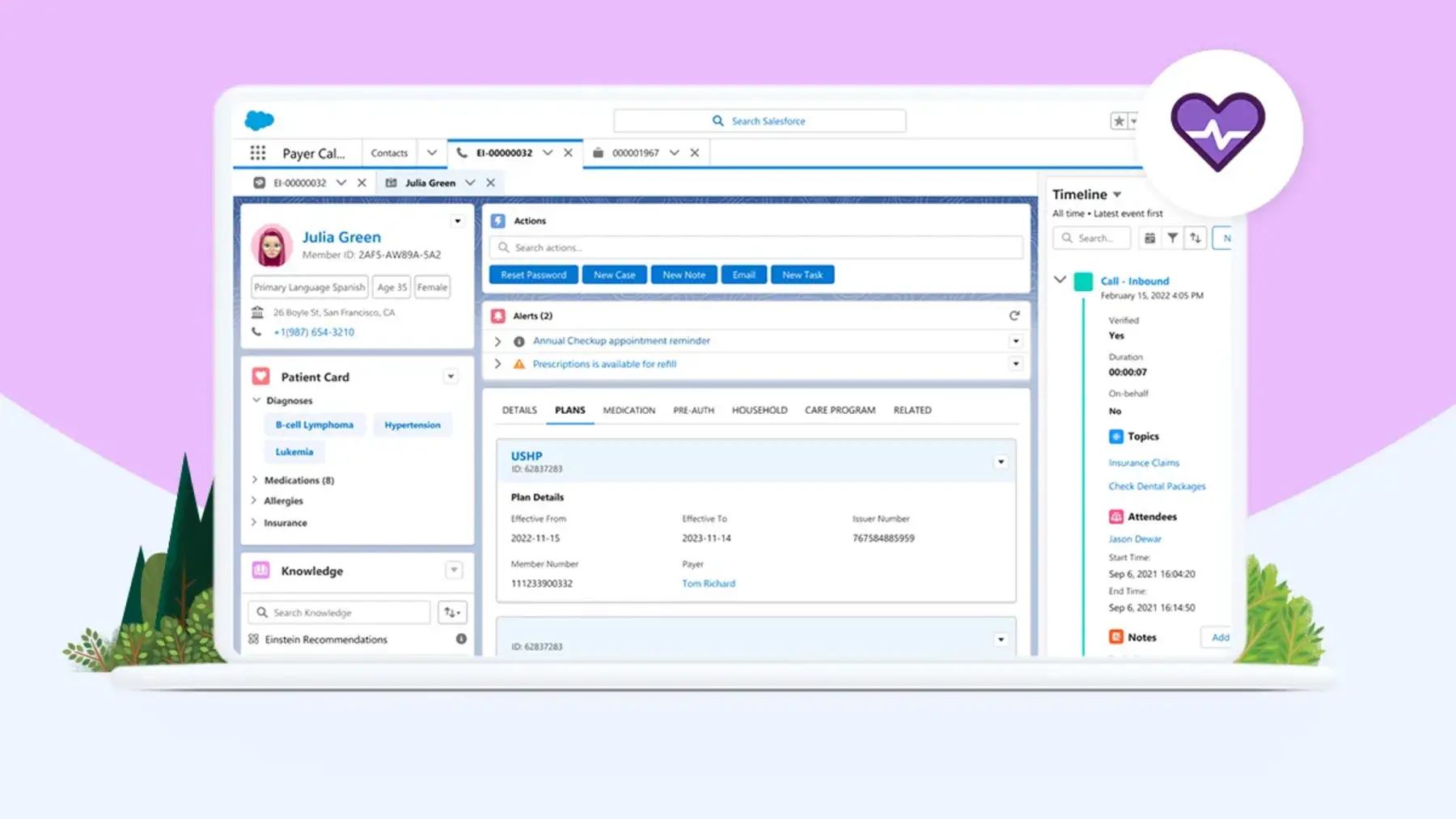
Best for: post-Series C organizations with a RevOps team, compliance requirements, and customers who expect Salesforce integrations.
Salesforce still owns the category by adoption, used by 76 percent of businesses buying in the category on Ramp's August 2026 data, and Agentforce is a serious attempt to put autonomous agents on enterprise data.
What stands out:
Governance and permissioning depth no AI-native challenger matches, plus the compliance certifications enterprise buyers ask for.
Agentforce agents for qualification, nurture, coaching, and pipeline management, running on the largest CRM install base there is.
An implementation partner network for every conceivable requirement.
What to watch:
AI arrives late in the price list. Conversation Intelligence and Agentforce land at the $175 Enterprise tier, and several agent features are "available for purchase" on top of that.
True cost is hard to see upfront: per-seat licensing, Flex Credits, and add-ons stack, before implementation and the admin headcount Salesforce assumes.
Pricing: Starter Suite $25 per user per month up to Unlimited at $350; the bundled Agentforce 1 Sales edition runs $550 per user per month.
My verdict: for the teams this post is written for, the math rarely closes. A 10-person startup buying it is spending Series B money on a Series D problem. Buy it when you have that problem.
Here's year-one cost for a sales team at three sizes, annual billing, using each vendor's published prices, before any credit overages. Attio Pro is $948 per seat per year with no onboarding fee. HubSpot Sales Hub Professional is $1,080 per seat per year plus $1,500 mandatory onboarding. Salesforce Enterprise is $2,100 per seat per year, implementation not included.
Team size | Attio Pro | HubSpot Sales Hub Pro | Salesforce Enterprise |
|---|---|---|---|
5 seats | $4,740 | $6,900 | $10,500 |
10 seats | $9,480 | $12,300 | $21,000 |
20 seats | $18,960 | $23,100 | $42,000 |
Clarify and Day.ai break the table's logic on purpose. Clarify at Starter is $600 a year regardless of team size, plus credit blocks as AI usage grows. Day.ai charges per agent, so five Professional agents cost $3,600 a year at monthly rates, less on annual billing, whether two people or ten work alongside them.
Then add the meter. This is where AI CRM budgets blow up in my client work: the seats were priced, the credits were not. Before you commit to any tool on this list, estimate your monthly AI actions, enrichments, agent runs, researched outreaches, call analyses, and price them in that vendor's credit currency. Ten minutes of arithmetic beats a renewal-day surprise.
Zoho and Freshsales: capable budget CRMs with useful assistants in Zia and Freddy, but both bolt AI onto fixed schemas, and neither passes the first test.
Pipedrive: still the cleanest visual pipeline for a small sales team, with AI layered on top rather than underneath.
Close: a strong calling-first CRM whose AI is scoped tightly to outbound. Worth a look if your team lives on the phone.
Folk: suits relationship-driven teams outside classic sales motions.
ZoomInfo and Creatio: rank highly on competing lists mostly because ZoomInfo and Creatio wrote those lists.
Leaving a tool off this shortlist means it failed a test for this reader, a seed-to-Series-B B2B SaaS team. A field-service business or a 5,000-person enterprise would rank these differently.
Match the tool to your motion, then verify with a two-week trial on real data.
Pick Attio if you're building a real B2B sales organization and want one CRM to survive from founder-led selling through a RevOps hire. Pick Clarify if your team is small, your process is simple, and CRM hygiene is the thing you keep failing at. Pick Day.ai if you want to staff the pipeline with agents instead of admins and can tolerate an early-stage vendor. Pick HubSpot if marketing automation matters as much as sales. Pick Salesforce when your compliance and complexity require it, and no earlier.
Whichever you choose, the CRM's AI is only as good as the data model underneath it. An agent running on a messy schema automates the mess faster. That design work, objects, relationships, routing, and the workflows on top, is exactly what we do in our Attio implementation work, and it's the difference between an AI CRM that runs your pipeline and one that writes summaries nobody reads. If you're starting from a broader evaluation, our complete Attio guide covers the platform end to end.
Attio is the best AI CRM for B2B SaaS teams between seed and Series B, combining a flexible data model with AI agents, call intelligence, and an MCP server from $35 per user per month. Clarify is the strongest zero-admin alternative, and Salesforce leads for enterprises with compliance needs.
You can, and AI coding tools make a basic contact tracker a weekend project. Maintaining one is the trap: sync, dedupe, permissions, and reporting consume engineering time forever. Configuring an AI-native CRM with custom objects gets you a bespoke data model without owning the infrastructure underneath it.
No. CRMs are becoming more central as AI takes over the manual work inside them: data entry, enrichment, call notes, follow-up drafts, and research. The system of record gains value as agents depend on it for context, which is why AI-native CRMs expose their data through APIs and MCP servers.
By market adoption, Salesforce, HubSpot, and Zoho lead, with Salesforce used by 76 percent of businesses buying in the category on Ramp's August 2026 spend data. By AI-native architecture for startups, the top three are Attio, Clarify, and Day.ai, with Attio the fastest-growing CRM vendor on that same dataset.
Yes. Attio's free plan covers 3 seats with AI features and a monthly credit allowance. Clarify's free plan includes unlimited seats and 1,000 AI credits a month. HubSpot's free CRM supports 2 users with limited AI. All three are real working tiers, useful for validating a tool before paying.
Realistic 2026 pricing runs $35 to $99 per user per month for Attio, $90 plus credits for HubSpot Sales Hub Professional, and $175 and up for Salesforce tiers with AI included. Budget for usage credits on top of seats, since agent actions are metered separately on most platforms.
Sparsh Gupta, Founder of Automation Jinn, builds AI-native GTM systems for B2B SaaS teams, from CRM architecture to the agents and automations on top. If you want your AI CRM chosen and implemented against your actual sales motion, book a discovery call.

GTM systems

GTM systems

GTM systems
GTM systems
