Attio Alternatives and Competitors (2026): When Attio Is Not the Fit

•
•
If you are comparing CRMs in 2026, Attio is the AI-native option most seed-to-Series B B2B teams should shortlist first: a flexible data model you own, with AI research, call intelligence and revenue agents built in rather than bolted on. It is not the only strong choice. If your priority is a full marketing suite, a phone-first sales floor, enterprise compliance or dealmaker relationship scoring, a different tool fits better.
I build on Attio as an Official Attio Expert Partner, so I have a point of view. I also have no rival CRM to sell you, which most alternatives lists cannot say. What follows is the seven competitors that actually matter, matched to the teams they serve, with pricing pulled from each vendor’s own page this week and compared tier for tier rather than entry price against entry price. For a lot of teams running this search, the tool they are describing is Attio. For some, one specific need points elsewhere, and I will say so plainly.
Alternative | Best for | Comparable tier (annual/seat) | Trade-off vs Attio |
|---|---|---|---|
HubSpot | All-in-one marketing plus sales | $90/mo | Onboarding fee, objects need Enterprise |
Salesforce | Enterprise and compliance | $175/mo | Implementation and admin overhead |
Pipedrive | Simple sales-only pipeline | $79/mo | No custom objects at any tier |
Folk | Solo founders and small agencies | $48/mo | Light on depth as you scale |
Affinity | VC and PE deal flow | $2,700/yr | Roughly triple the price, dealflow-shaped |
Close | High-volume inside sales | $99/mo | Not built to model your data |
Airtable | Teams that need a database | $45/mo | Not a CRM until you build it |
Matching tier means the plan that lines up with Attio Pro at $79 per seat per month annually. Entry plans cost less and do less. Prices move, so check each vendor’s page before you buy; two of these changed in the last month alone.
Most alternatives guides open with a pile of Attio complaints scraped from old reviews, plenty of them written before Attio shipped Workflows and AI agents in early 2026. Here is the honest sort, from someone who implements this thing for a living.
Common complaint | Does it hold up? | The reality |
|---|---|---|
“The AI is shallow” | Outdated | Attio ships Ask Attio, an AI Research Agent, Call Intelligence, and revenue agents on Pro and above |
“Only a handful of integrations” | Misleading | Native apps plus a full API, webhooks, an MCP server, and Zapier or Make for the long tail |
“It is a database, not a decision tool” | Setup gap | True when it is set up as a bare contact list, the model and workflows are meant to be built on purpose |
“Too much manual data entry” | Setup gap | AI Attributes and Workflows automate entry once configured |
“Attio gets expensive at scale” | Depends | At matching tiers, Attio Pro undercuts HubSpot, Salesforce, and Close |
“No marketing, calling, or invoicing suite” | Real | Attio is a focused CRM core that integrates with best-of-breed tools for those jobs |
Only the last one is a reason to leave rather than a reason to configure. If you need a marketing engine, a dialer, or invoicing and project management under one roof, that is a real product boundary and the right move is a tool built for it.
The rest are either out of date or a rollout that stopped halfway. Attio’s AI features are current, and it holds 4.3 out of 5 on G2 across more than 500 reviews, not the tiny sample some older posts still quote. The “it is just a database” and “too much manual work” complaints almost always trace back to setup rather than the product, and fixing a setup is a great deal cheaper than migrating a revenue team.
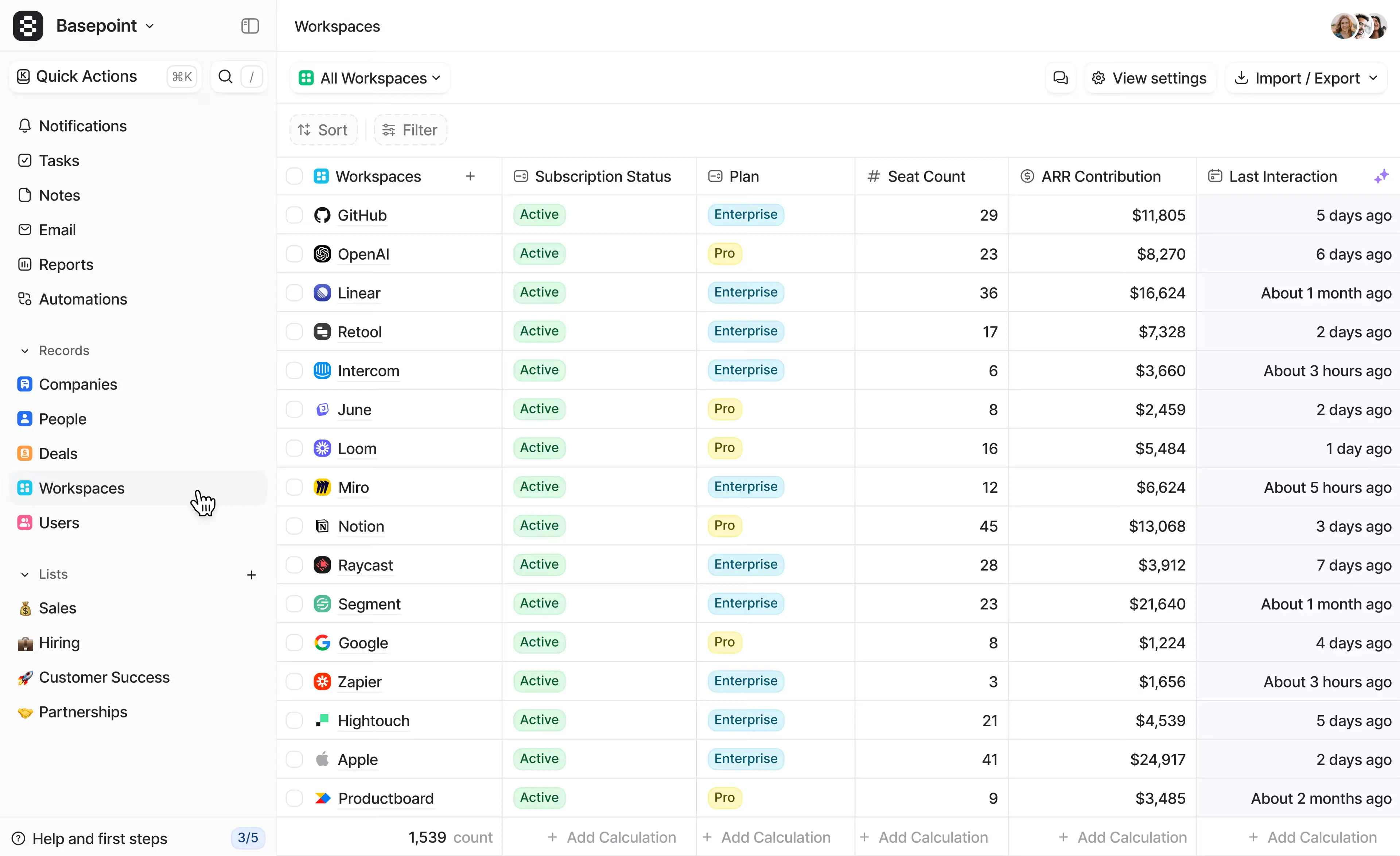
Attio is the right call when your data model is the hard part and you want AI in the workflow rather than in a side panel. If your motion runs on workspaces, usage, accounts, or anything that refuses to sit neatly inside “contact and deal,” Attio models it with custom objects and two-way relationships, then runs agents and Workflows on top. AI Attributes fill fields against a rubric you write. The Research Agent pulls live web context onto records. Call Intelligence writes meeting notes straight onto the deal. An MCP server lets your own AI tools query the CRM directly. That is why usage-based and product-led companies like Railway, Modal and Granola ended up there after HubSpot and Salesforce could not model their motion.
It also wins on ownership and momentum. The free plan covers three seats with no time limit, Plus is $35 per user per month annually and Pro is $79, with no onboarding fee anywhere in the lineup. On Ramp’s CRM category data, Attio is the fastest-growing CRM vendor and sits fourth by adoption, ahead of a declining Pipedrive. For the full picture, see my Attio review and the complete Attio guide for startups.
Now the seven alternatives, one at a time.
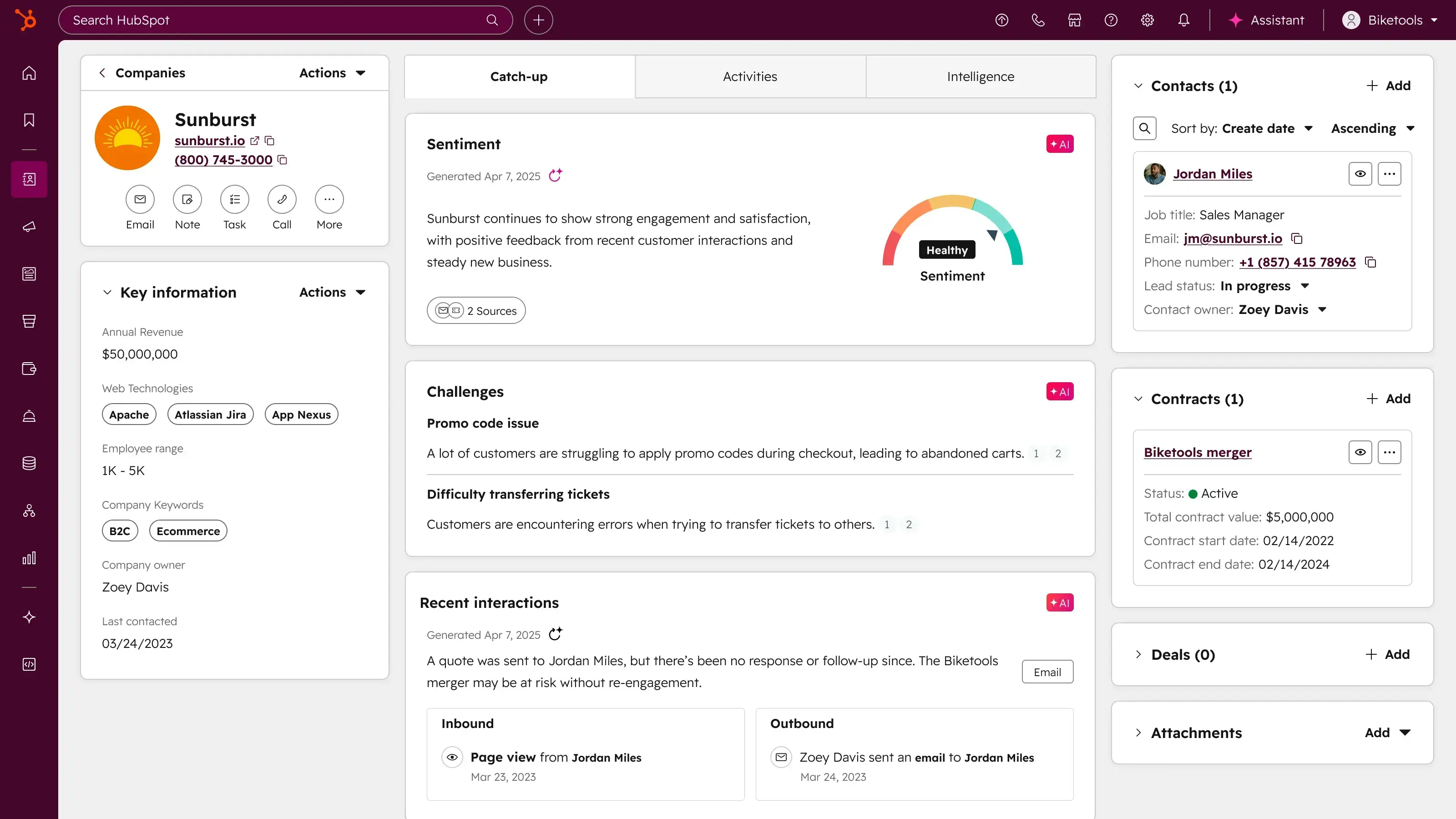
An all-in-one platform built around inbound marketing, with sales and service layered on top.
Where it wins. A full marketing suite with landing pages, ad management and large-scale nurture that Attio does not try to be. Mature reporting and dashboards out of the box. A 2,000-app marketplace that covers almost anything.
The catch. Custom objects are locked to the Enterprise tier at $150 per seat, where they are standard on Attio Pro at $79. A one-time onboarding fee lands on Professional ($1,500) and Enterprise ($3,500). Marketing Hub is a separate product at roughly $890 a month annually. And Breeze AI sits on a 2006-era core rather than running through the data model.
What it costs. Free CRM, Starter around $20, Professional at $90 per seat per month annually plus onboarding, Enterprise at $150.
My take. If marketing is your engine, HubSpot’s breadth wins and it is not close. If your edge is your product and your sales motion, you are maintaining an entire suite to use a slice of it. Deep dive: Attio vs HubSpot for startups.
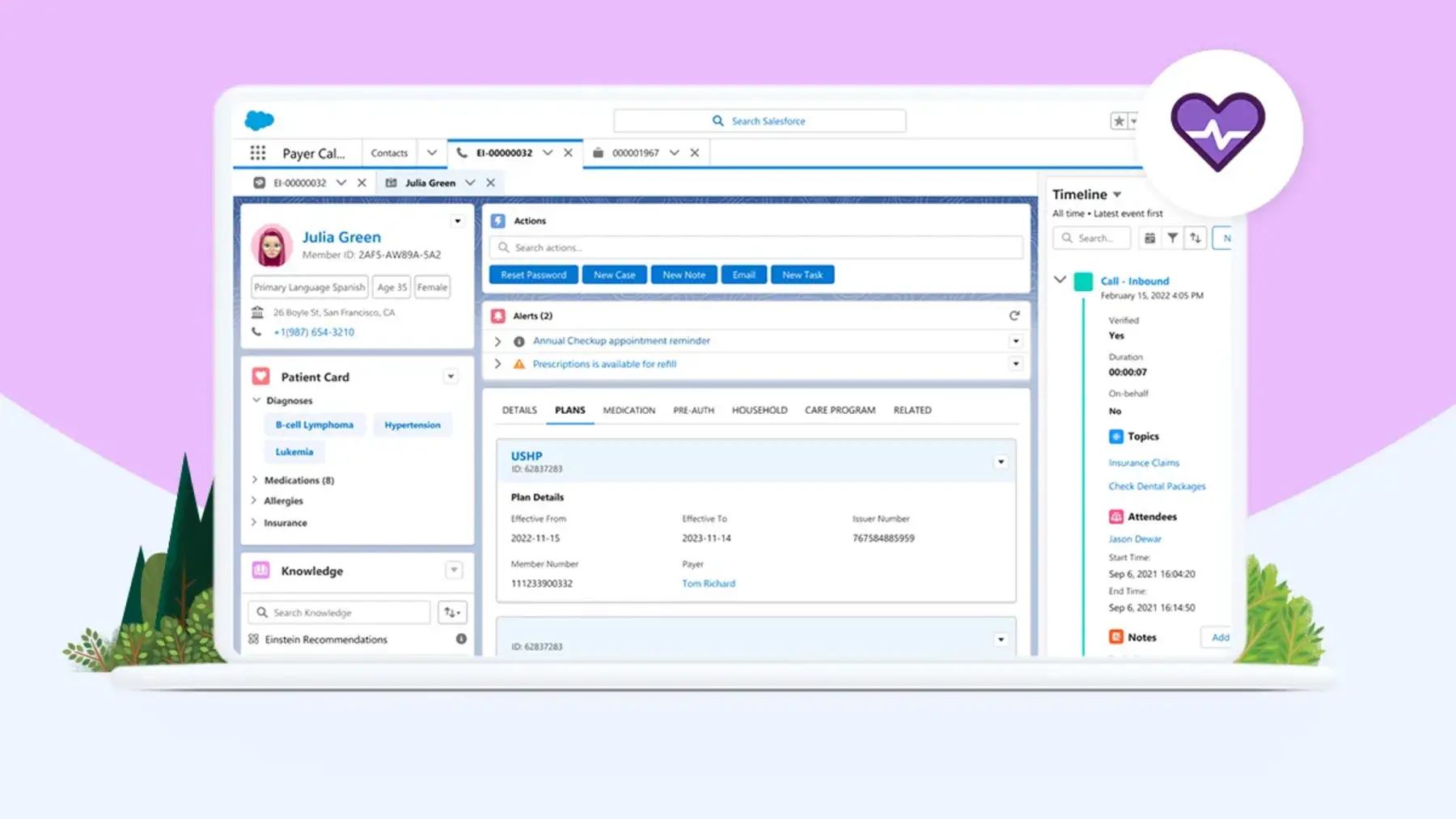
A programmable enterprise CRM built for large, process-heavy, often regulated organizations.
Where it wins. Effectively unlimited customization and the deepest reporting once complexity is truly enterprise-grade. The largest ecosystem in the market through AppExchange. The strongest compliance posture anywhere: SOC 2 Type II, FedRAMP and HIPAA.
The catch. AI is gated to the $175-and-up tiers, with the full agent suite at $550 per seat on Agentforce 1 Sales. Implementation routinely runs into tens of thousands. And most orgs end up carrying a dedicated admin just to keep the thing running.
What it costs. Starter Suite $25, Pro Suite $100, Enterprise $175, Unlimited $350 per seat per month, plus implementation. Enterprise is where the AI most teams want actually begins.
My take. Below enterprise scale it is more machine than a startup can operate, and that overhead is precisely what Attio removes. Deep dive: Attio vs Salesforce for startups.
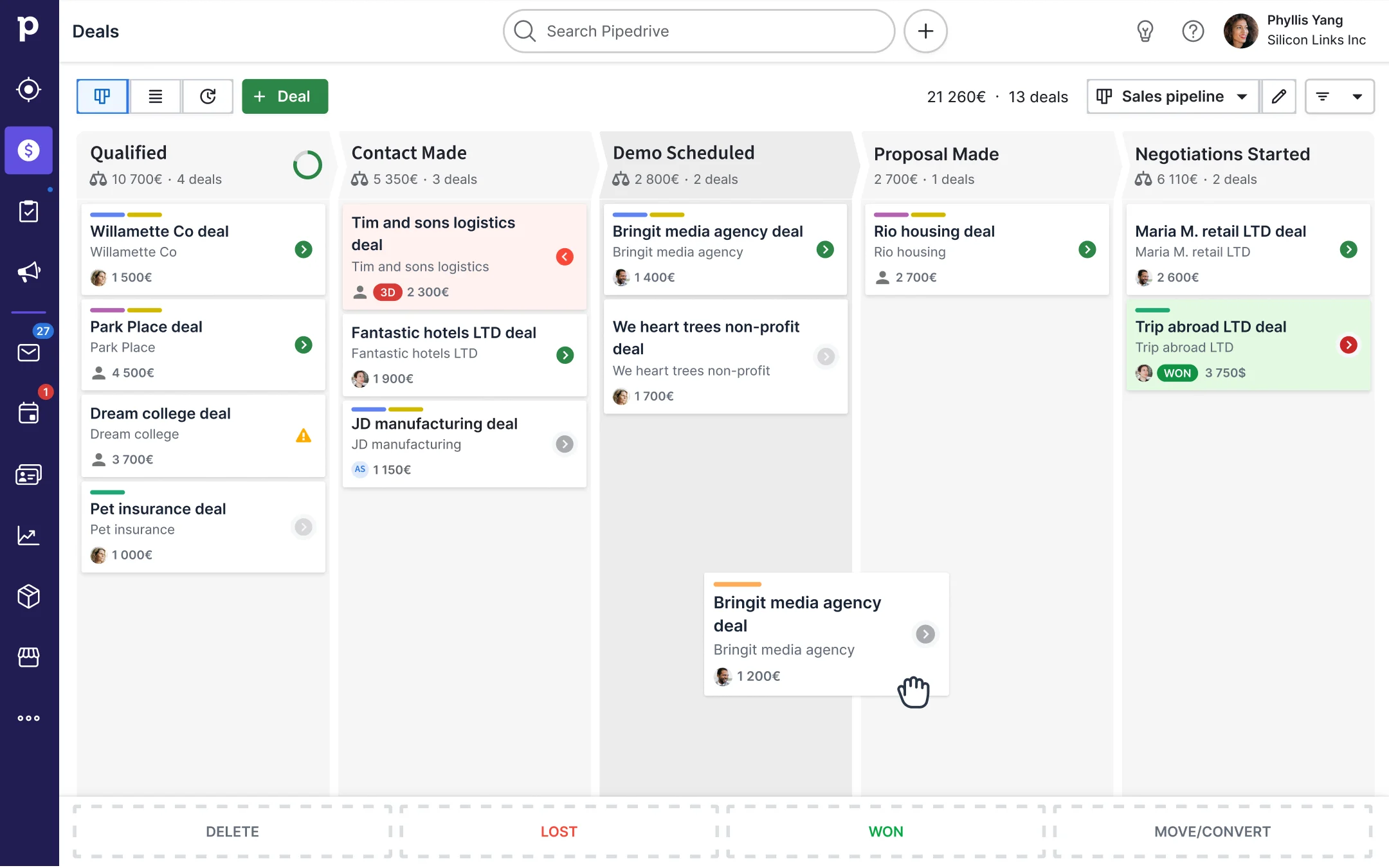
A focused, visual pipeline tool built around one job: moving deals across a board.
Where it wins. The lowest entry price of any full CRM here, with essentially zero configuration. A rep can work the board within an hour of signing up. A solid 500-app marketplace.
The catch. Four fixed objects, People, Organizations, Deals and Activities, and no custom objects at any tier, including the top one. Automation and sequences start on Growth rather than the entry plan. Enrichment arrives higher up and through paid add-ons, and there is no free tier at all.
What it costs. Lite $14, Growth $39, Premium $59, Ultimate $79 per seat per month annually, with a 14-day trial.
My take. Here is the number that reframes this one. Pipedrive Ultimate now costs exactly what Attio Pro costs, $79 a seat, and still cannot model a single custom object. You are paying the same money for a board instead of a system. The day your motion stops being linear, workspaces, partners, usage, a second product, the board runs out of shapes. Deep dive: Attio vs Pipedrive.
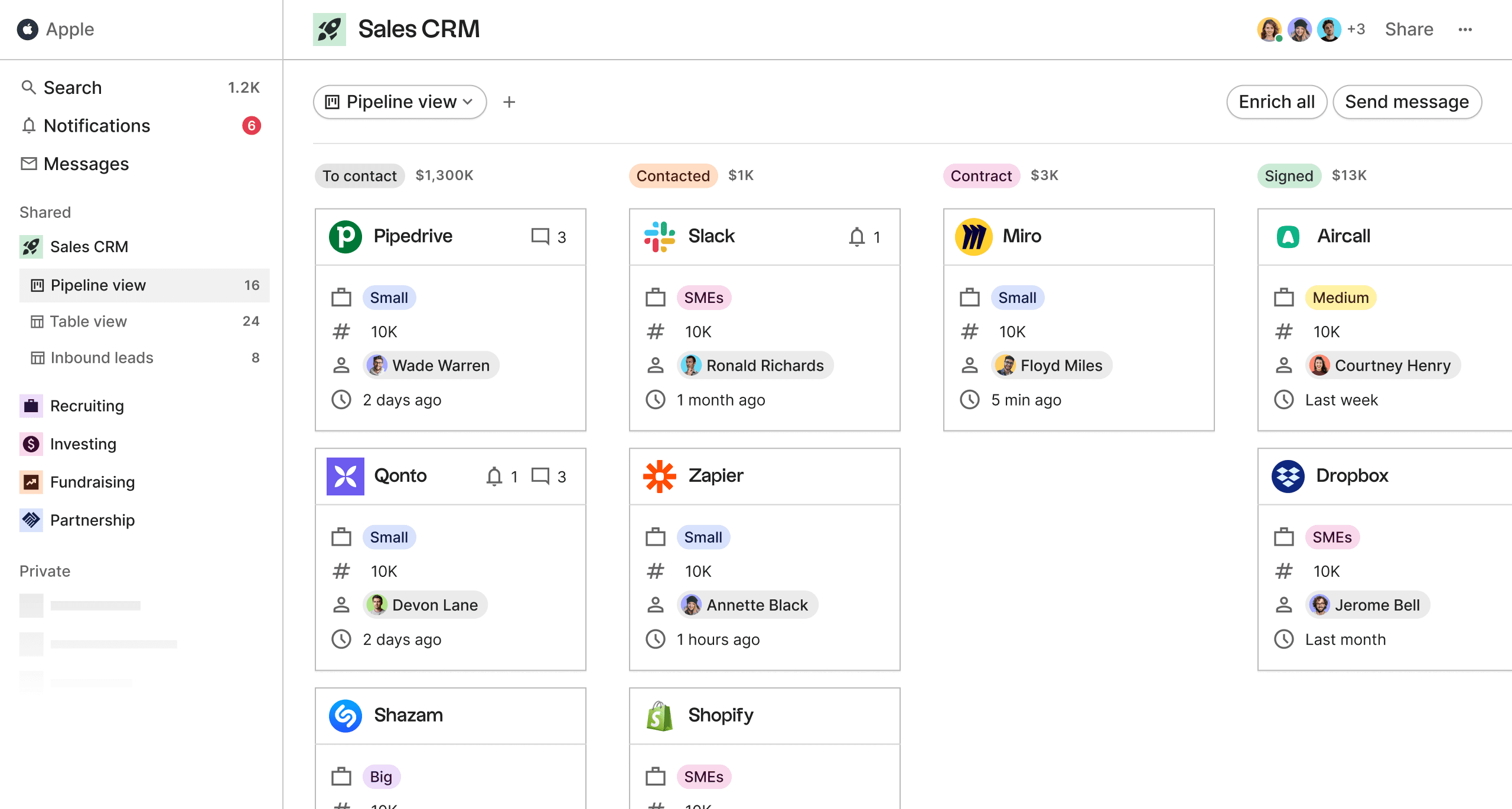
A relationship-first CRM built for near-zero setup.
Where it wins. Fast setup with a clean, spreadsheet-like feel. One-click LinkedIn contact capture through the folkX Chrome extension. Built-in enrichment without wiring up external tools. WhatsApp sync at the entry tier, which matters more than US teams expect once deals cross borders.
The catch. Custom objects and email sequences only arrive on Premium. Reporting is thin and heavy pipelines are not the point. And there is no permanent free tier, just a two-week trial that locks the workspace when it ends.
What it costs. Standard $24 per member per month annually, Premium $48, which is the tier that matches Attio Pro’s custom objects and sequences.
My take. The best smart address book on the market, and I mean that as a compliment. When the CRM has to model a real revenue motion rather than remember people, teams move to Attio, whose free plan already covers three seats for nothing. Deep dive: Attio vs folk.
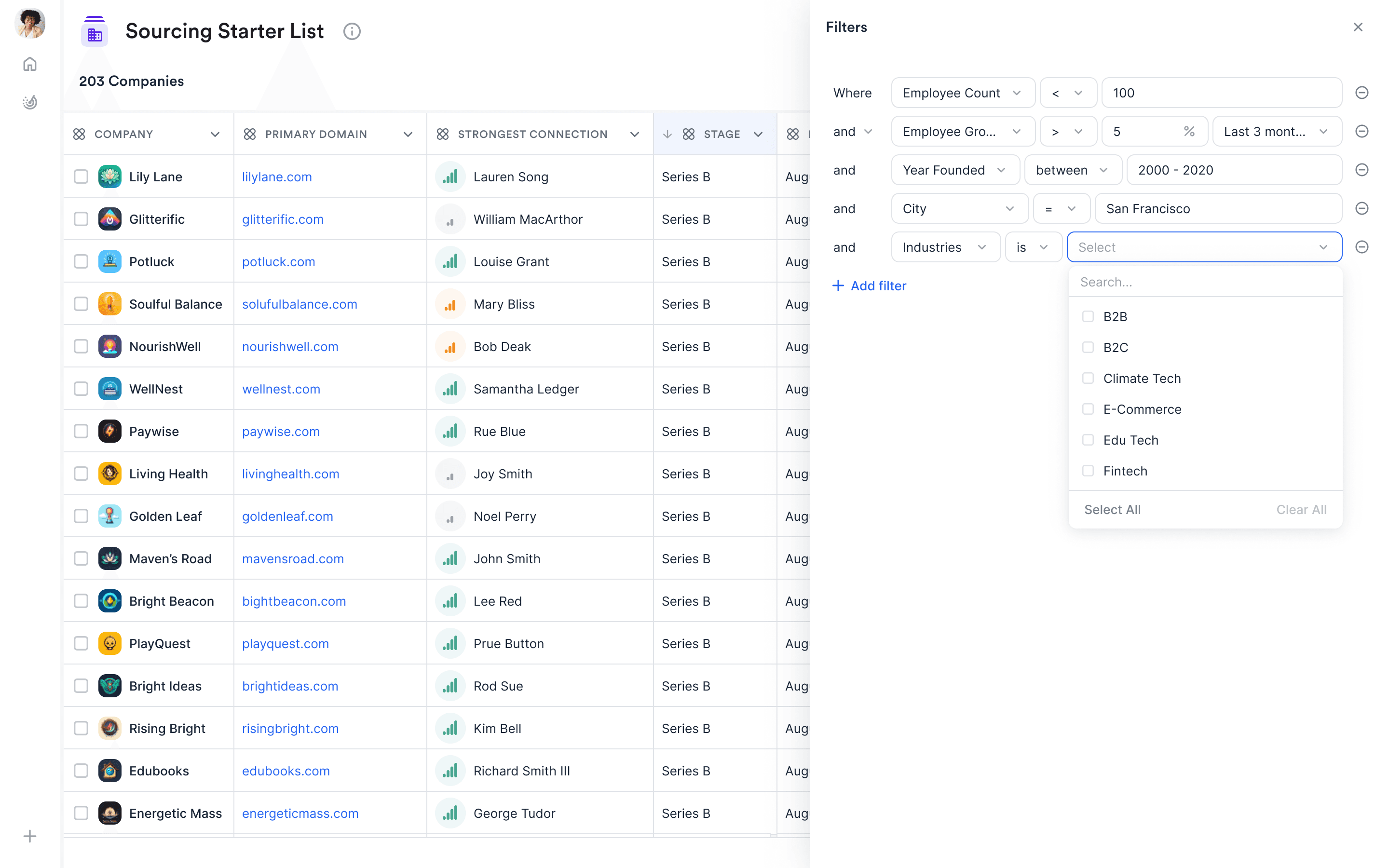
A relationship-intelligence CRM built for dealmakers, with a firm-wide relationship graph mined automatically out of your team’s email and calendar history.
Where it wins. Deeper network analytics than anyone else here: warm-intro pathing and relationship-strength scoring across the whole firm. It is the incumbent standard in venture and private equity, with investment-specific integrations. And for a conventional fund it fits out of the box, with onboarding measured in days.
The catch. Two and a half times the price, and an investment-shaped structure that resists being remodelled around LP operations or anything non-standard. The full API suite sits on Enterprise. Annual billing only, and no free trial.
What it costs. Essential $2,000 and Scale $2,300 per user per year, with Enterprise quoted on request. Affinity trimmed its published tiers recently, so higher per-seat figures still circulating on comparison sites no longer appear on its own pricing page. Scale is the like-for-like tier, carrying the AI notetaker and a hosted MCP server, against Attio Pro at $948 a year.
My take. The real question is whether proprietary relationship scoring is worth two and a half times the money. If you regularly win deals because the graph surfaced a warm path nobody remembered, Affinity earns every dollar. If your sourcing runs on theses and hustle, Attio runs the entire fund, dealflow, LPs, portfolio and talent, for well under half the cost, which is how Union Square Ventures reached 90% team adoption in under three months. Deep dive: Attio vs Affinity for VC and deal flow.
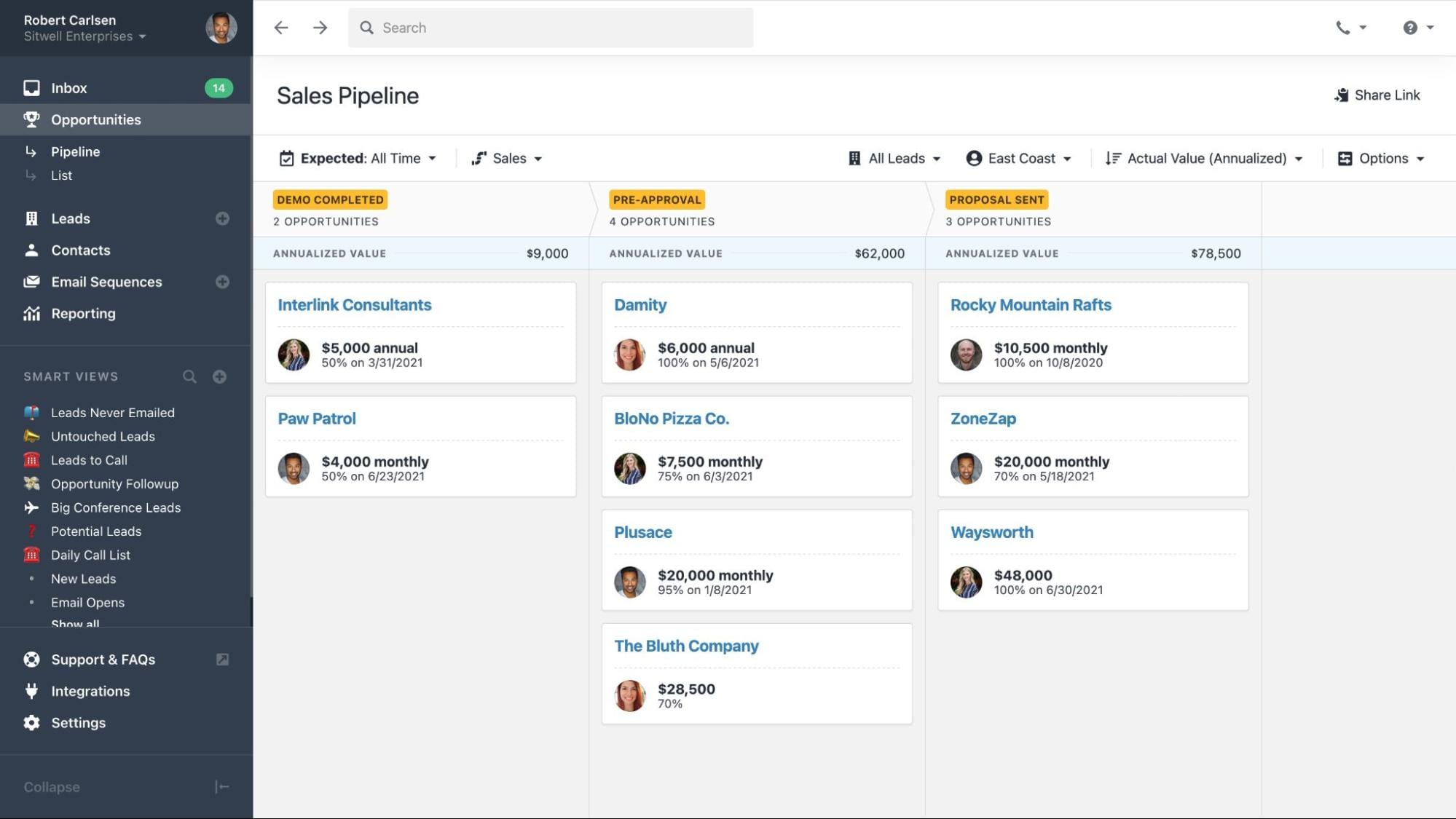
A sales-execution CRM built for high-volume inside sales, with calling, SMS and a power dialer native to the product.
Where it wins. Built-in dialer, SMS and cadences, plus an AI sales agent. Far less tool-switching for phone-heavy reps. Quick to adopt for a pure outbound motion.
The catch. It is an execution tool rather than a flexible platform, and it is not built to model usage-based or product-led revenue. The tier with the dialer and workflows sits above Attio Pro on price.
What it costs. Solo $9 for a single user, Essentials $35, Growth $99, Scale $139 per seat per month annually. Growth is where the power dialer and workflows live.
My take. Pick it for the phone, not the schema. Plenty of teams pair a dialer with Attio as the system of record rather than reshaping their whole CRM around calling.
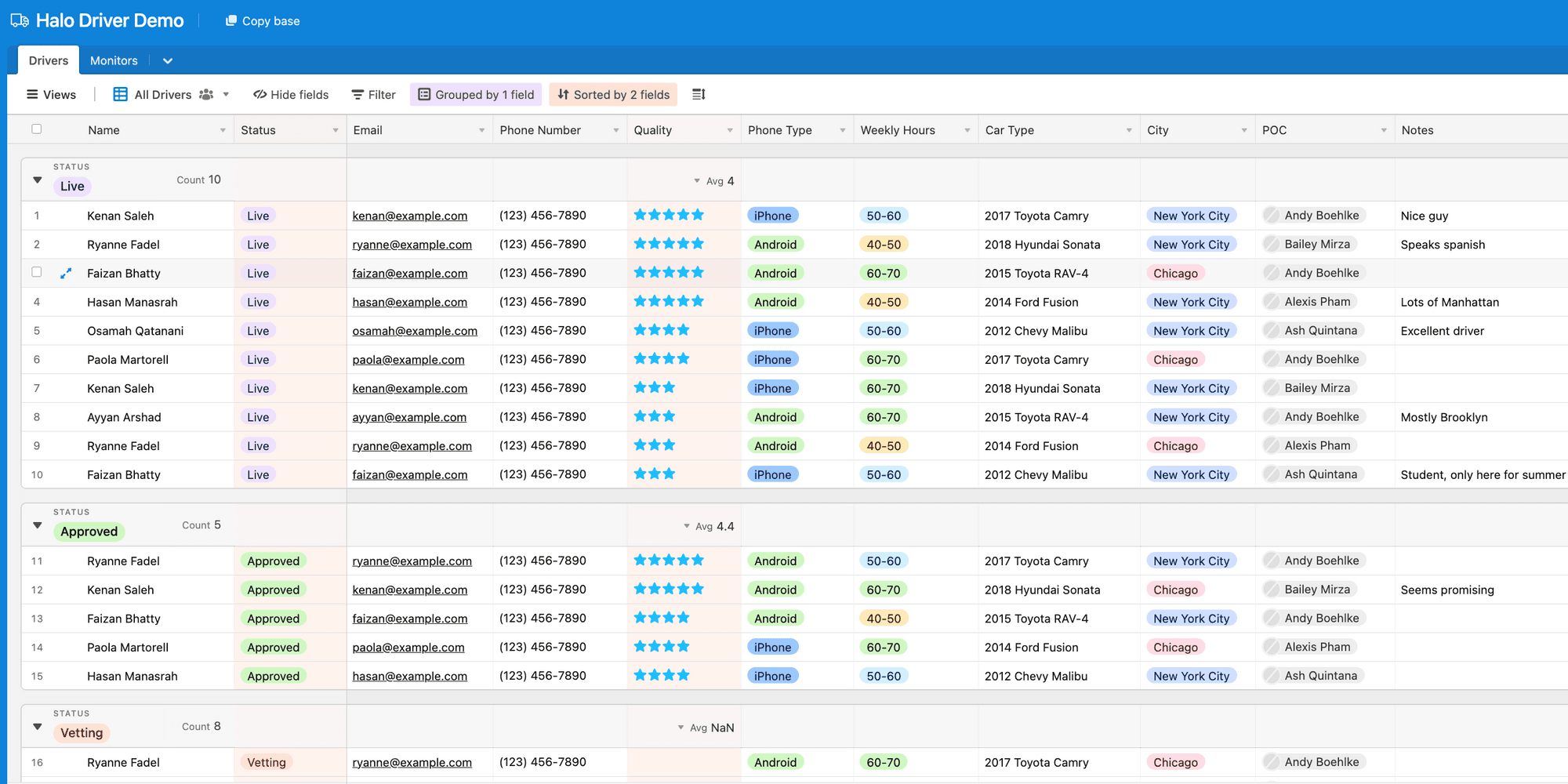
A spreadsheet-database hybrid with total control of the schema, and not a CRM out of the box.
Where it wins. Complete control over structure, which suits tracking anything from campaigns to inventory. A free tier that is actually usable. Familiar, flexible and quick to prototype in.
The catch. No native email sync, contact enrichment, call intelligence or sequences. You build the CRM layer yourself, and then you maintain it forever.
What it costs. Free for up to five editors, Team $20, Business $45 per seat per month annually, Enterprise custom.
My take. If you want to build everything from scratch, Airtable is a fine foundation. If you want an AI-native CRM that still bends to your model, Attio hands you the same flexibility with the CRM primitives already assembled.
A real new category showed up in 2026, and it is worth separating from the tools that simply put “AI” on the homepage.
Monaco is the one aimed squarely at the reader of this post. Founded by Sam Blond, formerly CRO at Brex, it launched out of stealth in February 2026 with $35M from Founders Fund and has since raised again, and it targets seed and Series A startups by name. It builds your total addressable market on day one, runs outbound, records meetings and maintains the pipeline itself, with human AEs supervising the agents. Rox went the opposite way, reaching a $1.2B valuation selling an agent swarm to Global 2000 accounts, and it layers on top of Salesforce rather than replacing it, so it is not really a CRM decision at all. Lightfield sits between them, auto-capturing email and meetings for teams who want the CRM to fill itself.
The shared pitch is that Attio is a database you still have to feed. That was fair in 2024 and is out of date now: Attio does the same automatic capture from inboxes and calendars, then layers AI Attributes, the Research Agent, Call Intelligence and Ask Attio on top of a data model most of these tools do not expose. The real question is not automation versus busywork. It is whether you want a system of record you own and can reshape, or a system that decides its own shape and asks you to trust the output. For a founder who has not yet worked out how they sell, the second is very tempting. For a team whose motion is already specific, it is a bet on someone else’s schema.
Two more names come up constantly on this search without belonging to that category at all. Breakcold is a multichannel sales CRM, pulling LinkedIn, WhatsApp and Telegram into one inbox at $59 a month per workspace plus $10 a seat, and it is a real buy for a small team whose deals happen in DMs. Copper is a Google Workspace CRM at $59 a seat annually that wins on adoption for Gmail-native teams, though it stops dead at contacts, companies and deals with no custom objects at any tier.
The fastest way to misjudge CRM cost is to line up entry prices. Attio’s entry is a free plan for three seats and Plus at $35. The tier most growing GTM teams land on is Pro at $79, which brings custom objects, Call Intelligence, Sequences, Workflows, AI agents and API access with an MCP server. Set against the tier that actually matches it, the picture changes.
CRM | Tier that matches Attio Pro | Annual price/seat |
|---|---|---|
Attio | Pro (custom objects, native AI, sequences) | $79/mo |
Folk | Premium (custom objects, sequences) | $48/mo |
Pipedrive | Ultimate (still no custom objects) | $79/mo |
Close | Growth (dialer, workflows) | $99/mo |
HubSpot | Professional (plus $1,500 onboarding) | $90/mo |
Salesforce | Enterprise (AI tier), plus implementation | $175/mo |
Affinity | Advanced (AI, API) | $2,700/yr |
At feature parity, Attio Pro still undercuts HubSpot, Salesforce, Close and Affinity, and includes AI that the others gate behind higher tiers or sell as add-ons. At ten seats that is $9,480 a year for Attio Pro, against $10,800 for HubSpot Professional before onboarding, $11,880 for Close Growth, and $23,000 for Affinity Scale.
One row deserves a second look. Pipedrive Ultimate matches Attio Pro exactly on price while offering no custom objects, which is the clearest illustration on this page that sticker price and capability are different questions.
And Attio is not the cheapest option here, which I am not going to pretend otherwise about. folk and Airtable both cost less, and the lighter tools further up cost less again. What separates them is what you get for the gap: folk is a lighter relationship tool, Airtable is a database you assemble into a CRM yourself. Attio’s price buys one model that finance, CS, product and a fleet of agents can all work off, without a perpetual admin tax. If you do not need that yet, buy the cheaper thing with a clear conscience. If you will need it within the year, buying it twice is the expensive path. Full detail in Attio pricing explained.
Work backward from the one thing you cannot compromise on. A marketing engine points to HubSpot. Compliance and enterprise depth point to Salesforce. A phone-first sales floor points to Close. A lightweight relationship tracker points to folk. Dealmaker relationship scoring at any cost points to Affinity. Raw database flexibility points to Airtable.
And if it is an AI-native CRM that models your actual motion, scales with the team and does not need a full-time admin, that description is Attio, which is why it is where most teams running this search end up.
After enough migrations one thing becomes obvious. Most teams weighing an Attio alternative are describing what Attio already is: an AI-native CRM they can own and shape. When a switch does happen and sticks, it is almost always down to a specific structural need, a marketing suite, a dialer, enterprise compliance, a relationship graph, rather than Attio falling short at its core job.
The teams that get the most out of it share one habit. They designed the object model and the workflows deliberately up front, so the AI had clean structure to act on. That is the difference between a CRM you fight and one that runs your motion, and it is worth getting right before you buy anything on this list. If a competitor clearly fits your non-negotiable, switch with confidence. If the answer is an AI-native CRM you own, that is Attio, and getting the setup right the first time is the work I do.
There is no single best alternative; it depends on your non-negotiable. HubSpot wins for all-in-one marketing and sales, Salesforce for enterprise and compliance, Close for a phone-first sales floor, folk for lightweight relationship management, and Affinity for network-driven VC and PE deal flow. For a flexible, AI-native CRM you own, most teams stay on Attio.
For seed-to-Series B B2B SaaS teams that want an AI-native CRM they own, Attio is one of the strongest options in 2026, with a flexible data model, native AI and a 4.3 out of 5 on G2. The best fit depends on your priority: a marketing suite, a dialer or dealmaker relationship scoring can point elsewhere.
Attio is free for up to three seats, then $35 per user per month for Plus and $79 for Pro, billed annually, with no onboarding fee. Compared tier for tier, Pro undercuts HubSpot Professional at $90 and Salesforce Enterprise at $175, and includes AI features the others gate behind higher plans.
Attio is an AI-native platform built to model complex revenue motions with custom objects and workflows. Folk is a lightweight relationship CRM built for near-zero setup. Attio scales with a growing GTM team, while folk suits solo founders and small agencies who value simplicity over depth.
Attio is self-serve, AI-native and fast to deploy with no admin tax. Salesforce offers deeper customization, a vast ecosystem, and SOC 2 Type II, FedRAMP and HIPAA compliance, at the cost of higher pricing, implementation projects and a dedicated admin to run it. Attio suits startups, Salesforce suits enterprises.
Yes. Attio’s free plan supports up to three seats with no time limit and no credit card required. It includes real-time contact syncing and automatic enrichment. Paid plans start at $35 per user per month annually for Plus and $79 for Pro, which adds custom objects, Call Intelligence and AI agents.
Sparsh Gupta, Founder of Automation Jinn and an Official Attio Expert Partner, helps seed-to-Series B B2B SaaS teams choose the right CRM and build an AI-native GTM system that drives revenue. If you want an expert read on whether Attio is the fit before you commit, book a discovery call.